
Mexico’s week in review: Peso sinks to 18 as school safety, storms and trade talks dominate
In the week that closed on September 28, Mexico faced a stark mix of tragedy, political maneuvering and economic optimism that reverberated from the streets of Cuernavaca to the halls of the Senate.
In the week that closed on September 28, Mexico faced a stark mix of tragedy, political maneuvering and economic optimism that reverberated from the streets of Cuernavaca to the halls of the Senate. The surge of violence against students, the memory of past massacres, a hurricane that battered the Pacific coast, and renewed trade talks with the United States all unfolded against a backdrop of a peso that slipped to 18 per dollar. As a journalist who has spent years listening to the stories of families in colonia, ejido and tianguis, I find these intersecting currents tell a deeper tale about the nation’s struggle for safety, sovereignty and prosperity.
Escalating Violence in Morelos and Its Impact on Communities
Two 17‑year‑old students from a prep school linked to the Autonomous University of the State of Morelos (UAEM) were shot dead in Cuernavaca on Saturday night, adding to a grim tally of six UAEM students murdered in the state this year. The killings come just weeks after the September 12 death of Spanish exchange student Claudia Tacoronte, also in Cuernavaca. The wave of bloodshed has turned Morelos into the nation’s deadliest region for youths aged 13‑17 and 18‑29, according to the outlet’s ranking of homicide rates from January to August.
Students and members of the Somos party took to the streets on Sunday, protesting outside the state attorney general’s office. Their demands for justice prompted President Claudia Sheinbaum to announce a special security plan for Morelos on Monday, promising federal coordination with Governor Margarita González Saravia and direct contact with the UAEM rector by Interior Minister Rosa Icela Rodríguez. Yet local officials warned that if tangible results do not appear within two weeks, the state could see a reshuffle of security leadership, underscoring how deeply the violence has shaken families, teachers and small‑business owners who rely on safe routes to school and market.
Remembering Past Tragedies: Tlatelolco and Ayotzinapa
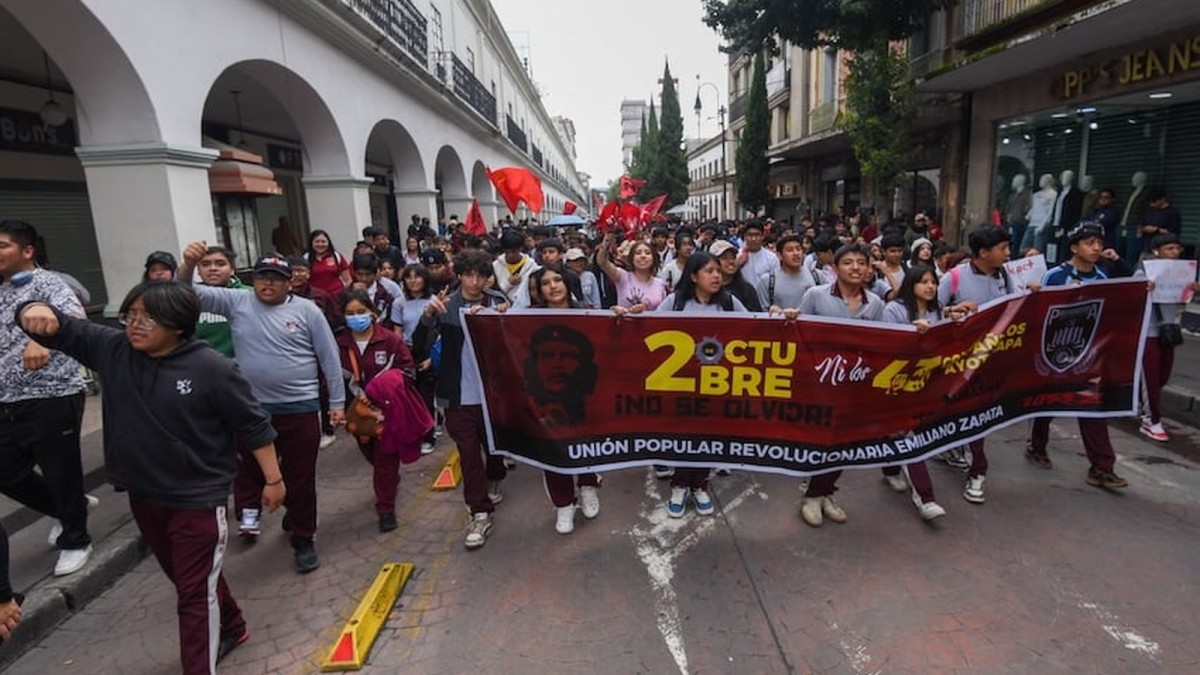
The 58th anniversary of the 1968 Tlatelolco massacre was marked by a massive march that began at Plaza de las Tres Culturas and ended at the Zócalo. Students, rural normalistas and parents of the 43 missing Ayotzinapa students walked together, demanding accountability for a crime that still haunts the nation. In Cuernavaca, parallel demonstrations by families of the slain youths echoed that same yearning for justice, even as some protesters set fire to the exterior of the state government palace—a symbolic act that caused no major damage but highlighted the intensity of public anger.
On the same day, federal authorities outlined four new lines of investigation into the 2014 Ayotzinapa disappearance. The first line, based on phone‑record analysis, identified 17 new suspects and revealed communications between Guerreros Unidos members and staff at funeral homes and the health sector. The second line linked three students’ phones to a municipal official, a police officer and close associates of a former public servant, reinforcing the hypothesis that the students were taken to the Iguala municipal lockup. A third line introduced a new suspect who was 14 at the time, and the fourth uncovered a cover‑up involving courthouse security video, leading to arrests of a former judge, an inspector and former Guerrero governor Ángel Aguirre. While only three remains have been identified and 168 people face judicial proceedings, the investigations underscore the lingering trauma of that night and the demand for truth that still drives families from the ejidos of Guerrero to the plazas of Mexico City.
Security Threats in the North: The Torreón School Attack
Violence against students was not confined to the central south. In Torreón, Coahuila, two 18‑year‑old twin brothers—former students of the Number 13 Secondary School—stormed the campus with machetes and rudimentary explosives, killing vice principal Nery Edith Narváez González and injuring four others. Security Minister Omar García Harfuch noted that students helped restrain the attackers, a testament to community solidarity even in moments of terror. The incident prompted Sheinbaum to announce a working group at her Friday mañanera, tasked with compelling social‑media platforms to remove content that glorifies or incites violence. Luisa María Alcalde, the president’s top legal adviser, will lead the effort, and a decree outlining platform obligations is slated for drafting next week.
The government’s response reflects a broader concern that digital spaces can amplify the tactics of local aggressors. Officials said the brothers were inspired by attackers abroad whose methods they learned online, linking the physical threat in Torreón to a transnational flow of extremist content. The proposed decree aims to curb that pipeline, though critics warn it could clash with free‑speech protections and raise questions about state surveillance.
Political Shifts: Dual Nationality Reform and Morena’s Candidate Slate
The Senate approved a constitutional reform requiring exclusive Mexican nationality for anyone seeking the presidency, governorships or the mayoralty of Mexico City. The vote, 86‑to‑42, saw Morena, the PT and the PVEM in favor, while the PAN protested, arguing the measure betrays migrants. The reform, which must be ratified by at least 17 state legislatures, would take effect in 2028 and would not affect current officeholders. Sheinbaum framed the change as a matter of national sovereignty, famously stating, “The presidents of Mexico can only have one flag.”
In parallel, Morena unveiled its slate of 17 presumptive candidates for the 2027 gubernatorial elections, including former Financial Intelligence Unit chief Santiago Nieto for Querétaro and Clara Luz Flores for Nuevo León. The party’s early positioning signals an attempt to consolidate power ahead of the June 6, 2027 vote, while also showcasing a new generation of leaders who will shape policies on security, economic development and social welfare across the country’s diverse regiones.
Economic Outlook: Growth, Employment and a Weaker Peso
Mexico’s economy posted a 3.3 % year‑over‑year expansion in July, the strongest monthly performance of 2026, driven by a 4 % rise in services and a 2.4 % increase in the secondary sector. Pantheon Economics’ Andrés Abadía noted that the July surge places the third quarter in a “much stronger position than expected,” though he cautioned that a single month does not guarantee a sustained recovery.
Labor Minister Marath Bolaños reported that employment reached 60.7 million at the end of August, up 1.2 million from a year earlier, yet more than half of workers remain in the informal sector. Export figures painted a picture of robust external demand: August exports rose 40.4 % year‑over‑year, and cumulative exports through the first eight months hit a record US $549.4 billion. Non‑automotive manufacturing, especially computer equipment, led the surge, with shipments of servers reaching nearly US $83 billion—93.9 % of which went to the United States. Analysts warned, however, that this dependence on Asian supply chains, particularly Taiwan’s 44 % share of key inputs, leaves Mexico vulnerable to geopolitical shocks.
The peso, meanwhile, slipped to 18 per dollar on Monday, a 6.2 % decline from its early‑September peak of 16.89. El Financiero attributed the slide to risk aversion, higher oil prices after President Donald Trump rejected an Iranian proposal on the Strait of Hormuz, and a tighter U.S. Federal Reserve policy that raised rates by 25 basis points to a range of 3.75‑4 %. Banco Base’s Gabriela Siller suggested the peso could finish the year near its 2025 close of 18.0080, noting that the MND Peso Index™ had previously flagged the currency as overvalued by 5.8 % in early September. The ongoing USMCA negotiations, especially discussions on Section 232 tariffs for autos, steel, aluminum and copper, will be closely watched for any impact on the peso’s trajectory.
Trade Talks with the United States and Emerging Partnerships
Economy Minister Marcelo Ebrard traveled to the United States for a G‑20 side meeting in Milwaukee, where he held a one‑hour discussion with U.S. Trade Representative Jamieson Greer. Ebrard expressed optimism, saying Mexico and the United States are getting “closer every day” to a new USMCA framework. His priorities include reducing Section 232 tariffs on Mexican autos, steel, aluminum and copper, and preserving preferential treatment for goods that meet USMCA compliance standards.
Ebrard credited President Sheinbaum’s diplomatic handling of relations with President Trump for Mexico’s advantageous position at the summit. An anonymous official told France 24 that Mexico is prepared to wait patiently for a deal, even if a final agreement does not materialize before the U.S. midterm elections on November 3. In addition to the North‑American talks, Ebrard announced a “new stage” in relations with India, where negotiations now include tequila—a product that currently faces a 150 % tariff. The diversification of trade partners reflects a broader strategy to cushion the economy against external shocks while leveraging Mexico’s manufacturing strengths.
Natural Disasters and Their Human Toll
While political and economic battles unfolded, nature reminded the nation of its vulnerability. Hurricane Polo, after lingering off the Pacific coast for a week, made landfall in Baja California Sur near Las Barrancas, Comondú, as a Category 2 storm—far weaker than its earlier Category 5 intensity that set a record for rapid intensification. The storm caused at least four deaths in Jalisco before reaching the peninsula, where it dropped 15‑30 centimeters of rain. Governor Víctor Manuel Castro Cosío described the event as “more water than wind,” noting that no deaths or injuries were reported in Baja California Sur.
After crossing the Gulf of California, Polo struck the Sonora coast as a Category 1 hurricane, bringing flooding, power outages and downed trees to Guaymas and Empalme. The episode underscores the ongoing challenge of disaster preparedness in coastal comunidades, where families often rely on informal networks and local tianguis to rebuild after storms. As climate patterns shift, the frequency and intensity of such events are likely to increase, adding another layer of complexity to the nation’s development agenda.
This article was produced with AI-assisted research and editorial support. Reporting is based on the source material cited below. Sources: Mexico News Daily; mexiconewsdaily.com; Global1.News (03 October 2026).
By Rosa Martinez, Staff Writer
What's Your Reaction?
 Like
0
Like
0
 Dislike
0
Dislike
0
 Love
0
Love
0
 Funny
0
Funny
0
 Wow
0
Wow
0
 Sad
0
Sad
0
 Angry
0
Angry
0
Latin America/Andes Correspondent at Global1.News. Based in Bogota, covering politics, environment, energy, and social movements across the Andean region. Passionate about environmental journalism and communities protecting their land.












Comments (0)