
The $165 Billion AI Campus Just Got Delayed by a Pipe
Oracle's $165 billion Project Jupiter AI campus in New Mexico just lost its power schedule: the Green Chile gas pipeline feeding it slipped from August 15 to February 1, 2027. The delay shows the AI buildout runs on permit clocks and fuel supply chains, not GPU timelines.
The $165 Billion AI Campus Just Got Delayed by a Pipe
Let me tell you something that happened Friday that tells you more about the AI buildout than any GPU shipment or earnings call you'll read this month. A natural gas pipeline in New Mexico — 17.7 miles of 24-inch steel nobody outside Doña Ana County had ever heard of — just slipped its in-service date by nearly six months. And because that pipe is the only fuel line for Oracle's $165 billion Project Jupiter AI campus in Santa Teresa, that little regulatory filing just pushed the power clock on one of the biggest construction projects on Earth into 2027.
I've been running infrastructure for over a decade, and I've learned one thing the market keeps forgetting: the AI buildout doesn't run on GPU clocks. It runs on permit clocks, pipe-laying clocks, water-rights clocks. And those clocks don't care how many billions you've committed. They tick at the speed of a FERC data request.
The Pipe — the Most Important 17.7 Miles in AI You've Never Heard Of
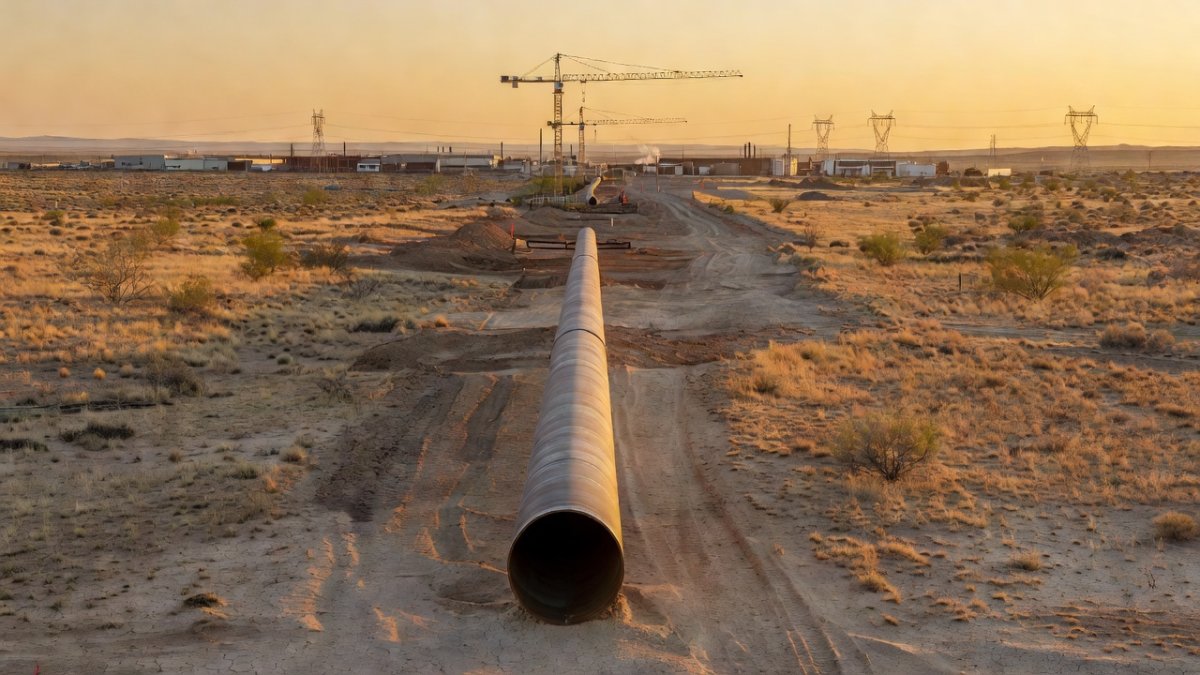
Here's the boring, beautiful truth: the Green Chile Project is not a data center. It's not a chip. It's a 24-inch natural gas lateral, about $60 million worth, proposed by Transwestern Pipeline, a subsidiary of Dallas-based Energy Transfer — the same Energy Transfer that built the Dakota Access Pipeline. It runs roughly 18 miles from El Paso into New Mexico, crossing mostly federal land, some private property, and a stretch of state trust land that has already caused the developer a world of pain.
The numbers are absurd. Four hundred thousand dekatherms a day. To put that in perspective: the average U.S. household used 0.694 dekatherms in all of 2020. That pipe moves almost 600,000 times a single home's annual gas use — every single day. It's enough gas to heat Española, a town of more than 10,000 people, for a year. And it has exactly one customer: Project Jupiter.
One pipe. One campus. That's the fragility the market refuses to price in.
The Campus — Project Jupiter Is Already Under Construction
Project Jupiter isn't a proposal. It's a construction site. Three million square feet of AI data center in Santa Teresa, a stone's throw from the New Mexico-Texas border, developed by BorderPlex Digital Assets with Oracle and OpenAI as the anchor tenants. The scale keeps getting revised upward — the numbers floating around now are $165 billion and up to 2.5 gigawatts of load. That's a campus the size of a small city, built in a county where water is a political flash point and the aquifer is the Mesilla Basin.
And here's the thing about the $165 billion number: it's the headline. The actual constraint is a 17.7-mile pipe that isn't finished.
The Redesign — When the Turbines Became a Political Liability
You need to understand the backstory to see why Friday's filing matters. Project Jupiter's original power plan was 2.8 gigawatts of natural gas combustion turbines plus diesel generators — the standard hyperscaler move when the grid can't keep up. But the New Mexico Office of the State Engineer estimated those turbines would need a million gallons of water a day, mostly for emissions control. In Doña Ana County, that's a political death sentence.
So in April, Oracle, Bloom Energy, and BorderPlex flipped the design: up to 2.45 gigawatts of Bloom solid-oxide fuel cells, configured as an on-site microgrid. No combustion. Ninety-two percent less nitrogen oxide than the turbine plan. The water requirement collapsed to basically nothing — Oracle now claims the whole campus, cooling included, uses about 168,000 gallons a year ongoing, roughly the annual use of two American households, after a one-time fill of about 11 million gallons.
Don't let the marketing fool you, though. Fuel cells still burn natural gas. The Santa Fe New Mexican calculated the new design would emit about 10.1 million tons of CO2-equivalent a year — better than the 14 million under turbines, but still a fossil-fuel footprint the size of a small city. Senator Bill Soules put it better than any analyst I've read: "They are more efficient than just gas turbines, but cleaner is not clean."
The Delay — What Friday's Filing Actually Says
Now the part that should worry anyone with a spreadsheet. On Friday, August 14, Transwestern Pipeline filed with FERC and quietly moved the Green Chile Project's in-service date from August 15 — as in tomorrow — to February 1, 2027. A six-month slip on the only fuel line for a campus that's already under construction. The filing came in response to a FERC data request dated August 11. The project still needs authorization under Transwestern's blanket certificate, and it's not there yet.
This was never going to be smooth. The state Land Office denied the pipeline's crossing of state trust land back in March, forcing a reroute. Land Commissioner Stephanie Garcia Richard denied the company's reconsideration request on July 14. Environmental groups filed formal challenges in April, and FERC staff flagged the application as incomplete — Transwestern had to chase down a missing historic-preservation review. BLM fast-tracked the federal portion using emergency permitting powers the Interior Department adopted in 2025, compressing a year-long environmental review into 14 days. Activists are now fighting FERC's whole blanket-certificate approach, and Green Chile is Exhibit A in their complaint. On top of all that, Project Jupiter is still waiting on its air quality permits from the New Mexico Environment Department, which is holding a public hearing and could push back the decision.
One filing, six months. That's what a regulatory clock looks like when it meets a $165 billion plan.
Let Me Be Fair to the Developers — Because the Logic Isn't Stupid
Before I give you the takeaways, let me say the thing nobody in the anti-data-center crowd wants to hear: the developer's logic isn't stupid. Oracle is building in Santa Teresa for a reason — cheap land, border-adjacent infrastructure, and a state where it can run its own microgrid instead of waiting a decade in a utility interconnection queue. The fuel-cell redesign was a genuine concession: 92 percent less NOx, a million gallons a day of water demand erased, $50 million committed to the county's water and wastewater systems, a partnership conserving about 21 million gallons a year with growers in the Rio Grande-Bravo watershed. That's not greenwashing; that's engineering responding to political reality.
And here's the other side of the two readings. A six-month pipe delay is not a cancelled project. Oracle isn't retreating — it's building. The fuel cells are being delivered. The community monitoring panel appointments are due by September 4. Seven thousand construction jobs are on the books. The pipe will get built; it'll just be late. If you only read the bear case — delay, protest, permit fight — you'll miss that the campus is coming. If you only read the bull case — jobs, fuel cells, water savings — you'll miss that the schedule is fiction. Both readings are true. That's the whole point.
What This Means for Independent Hosting Providers
So what do you do with this if you're running real infrastructure for a living? Same thing I'm doing — reading the filing, not the press release.
First, watch the fuel supply chain, not just the power meter. Every hyperscaler campus that's "solving" the grid problem with on-site gas, fuel cells, or diesel is creating a new dependency you can't see from the outside. When a pipe slips six months, the campus doesn't come online, capacity doesn't materialize, and the power that was supposed to flood the market never arrives. Track the pipelines, the water rights, and the air permits for the campuses near you — they're the real schedule.
Second, build for the six-month slip. I've never met a hyperscaler timeline that survived contact with a permitting authority. If you're planning capacity around a major campus coming online, add two quarters of buffer. The cheapest mistake in this industry is believing a ribbon-cutting date.
Third, price regulatory risk into your site decisions. Santa Teresa looked perfect on paper — right up until the state Land Office, the county, four state senators, and a coalition of environmental groups all got a vote. The land that's cheapest is often the land with the most contested infrastructure around it. Do the political math before you sign the lease, not after.
Fourth, position yourself on the honest-emissions side of this fight. The "cleaner is not clean" standard is coming for everyone. Oracle cut NOx by 92 percent and still took the criticism. Whatever your facility promises, someone is going to hold you to the CO2 math and the water math. Get your numbers straight before the backlash writes them for you.
The Bottom Line
Here's what I actually believe after watching this story break on a Friday afternoon: the AI buildout is not going to be stopped by a protest, a moratorium, or a pipe delay. It's going to be slowed — constantly, expensively, in ways no balance sheet can fully predict. The seven-trillion-dollar buildout runs through pipelines, permits, and water rights that move at the speed of government, not the speed of software.
And that's fine. It's actually the best news independent hosts have had in months. Every six-month slip on a $165 billion campus is deferred capacity, deferred competition, deferred pressure on your power prices and your labor market. The hyperscalers will get there. They always do. But between now and February 2027, the clock is on their side of the table — and yours.
Read the filings. Trust the pipes. And plan like the schedule is a lie, because it is.
— Allan Ali, Founder
This article was produced with AI-assisted research and editorial support. Sources: Bloomberg (Aug 14, 2026), finwire.io regulatory-filing coverage, Pipeline & Gas Journal, KFOX14/CBS4, Source NM, Oracle corporate blog (Aug 11, 2026), Data Center Richness, Santa Fe New Mexican (as cited).
What's Your Reaction?
 Like
0
Like
0
 Dislike
0
Dislike
0
 Love
0
Love
0
 Funny
0
Funny
0
 Wow
0
Wow
0
 Sad
0
Sad
0
 Angry
0
Angry
0

Publisher of Global1.News. Automation architect, systems builder, and the guy making sure the truth gets published.













Comments (0)