
Record Ocean Heat Fuels Sargassum and Lionfish Crisis in Mexico
In a recent DW News report, marine scientists warned that unprecedented ocean temperatures are reshaping life beneath the waves and fueling extreme weather across the planet.
In a recent DW News report, marine scientists warned that unprecedented ocean temperatures are reshaping life beneath the waves and fueling extreme weather across the planet. The warning landed on the same day the EU Copernicus Climate Change Service confirmed that global sea surface temperatures hit a record 20.96°C in July 2026 — a benchmark that hits home hard for Mexico's Caribbean coast, where record-warm seas are supercharging sargassum blooms and lionfish invasions that directly threaten fishing cooperatives and tourism-dependent families from Cancún to Mahahual.
Record Ocean Heat Threatens Mexico's Caribbean Coast
Cancún, Quintana Roo – Mexico — The numbers are stark, and they are not abstract statistics for the millions of Mexicans whose livelihoods depend on the sea. The Copernicus Climate Change Service (C3S) reported on Monday that the average sea surface temperature across extra-polar oceans reached 20.96 degrees Celsius in July 2026, beating the previous July record of 20.89°C set in 2023. This heat is not evenly distributed — it is exceptionally high across the tropical Pacific, where El Niño conditions are present and forecast to strengthen in the coming months, and it is boiling the waters of the Gulf of Mexico and the Caribbean that lap against Mexico's 11,122 kilometers of coastline.
Record Ocean Heat: A New Benchmark
The Copernicus data released this week paints a sobering picture of a planet in fever. Globally, July 2026 was the joint second-warmest July on record, tied with 2024 and trailing only 2023. The average surface air temperature reached 16.90°C, which is 1.47°C above the pre-industrial baseline (1850-1900). Samantha Burgess, strategic lead for climate at the European Centre for Medium-Range Weather Forecasts (ECMWF), noted in the report that the heat is not confined to the oceans — it is driving extreme temperatures across continents, including the brutal European heatwaves that dominated headlines this summer. But for Mexico, the ocean numbers are the ones that matter most, because warm water is the fuel that powers the twin crises now converging on the Riviera Maya.
The marine heat waves are not a localized phenomenon. Data from Climate Central, analyzed in early July, shows that every major ocean basin on Earth is experiencing unusually warm sea surface temperatures driven by climate change. The Pacific Ocean is suffering the largest marine heat wave ever recorded — a staggering 58 million square kilometers, roughly 16% of Earth's oceans, an area larger than North and South America combined. Climate Central's attribution analysis concludes that 85% of that marine heat wave area would not have occurred without human-caused warming. The Atlantic is not far behind, with 18.8% of the basin affected and 93.8% of that heat wave area directly attributable to climate change. Most critically for Mexico, the Gulf of Mexico and the Caribbean region is seeing 46.4% of its area experiencing marine heat wave conditions, with 44.7% of that heat attributable to climate change. Tropical sea surface temperatures in the region are running in the upper 70s to upper 80s Fahrenheit (24-32°C), with broad areas sitting 2 to 5 degrees Fahrenheit above the 1991-2020 normal.
Sargassum: The Brown Tide Choking Mexico's Beaches
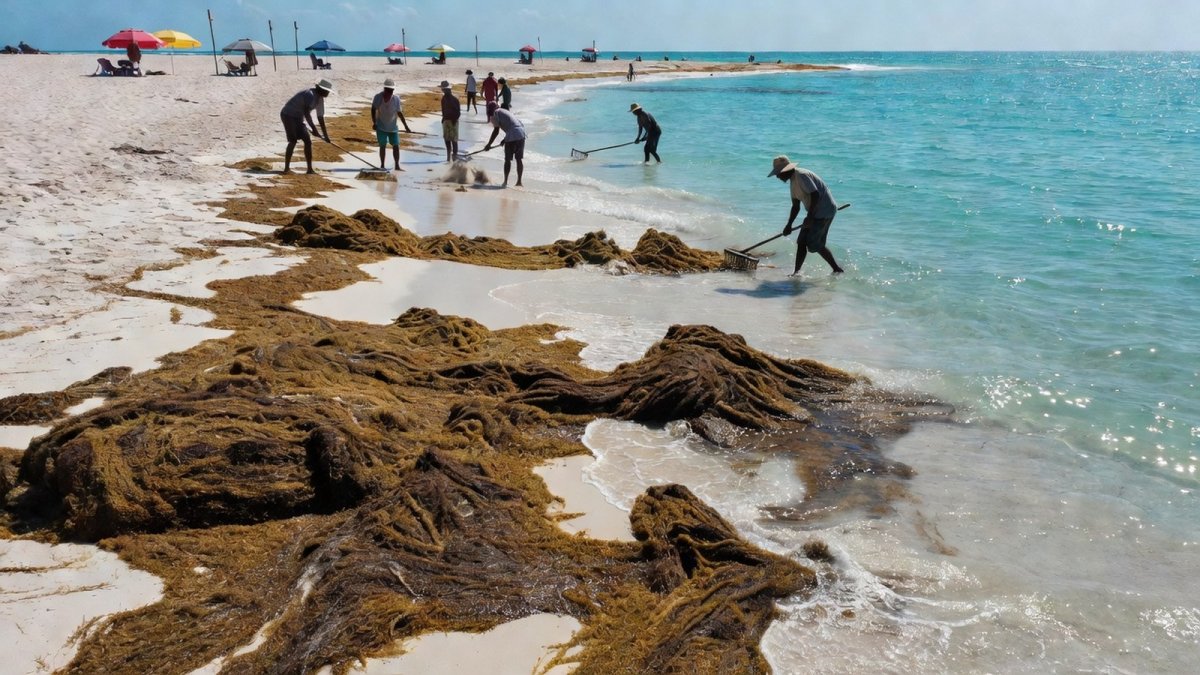
The warm water is not just a number on a chart — it is a biological accelerant. The 2026 sargassum season in the Atlantic is now the second-highest ever measured, according to NASA Earth Observatory and the University of South Florida College of Marine Science. Satellite tracking, which has monitored the Great Atlantic Sargassum Belt since 2000, shows that this June's bloom was surpassed only by the catastrophic 2025 season. The western Caribbean and Gulf of Mexico basins both broke their own records this year: 9 million metric tons in the eastern Caribbean, 3.6 million in the western Caribbean, and a staggering 5 million metric tons in the Gulf of Mexico — a Gulf figure that nearly doubled its previous record set just a year earlier.
For Quintana Roo, the numbers translate directly into tons of rotting seaweed on the sand. State environment ministry (SEMA) data shows that crews have already collected 93,238 tons of sargassum across eight coastal municipalities through late July. Playa del Carmen accounts for roughly 36% of that total, Cancún about 23%, and Tulum approximately 12% — some 10,943 tons in the pueblo mágico alone. Officials now expect 119,000 tons to wash ashore in Quintana Roo in 2026, surpassing last year's record of 96,000 tons. Óscar Rébora Aguilera, the state's environment secretary, has warned that the strongest arrivals are expected between August and October, and at least 70 beaches in Quintana Roo are currently under red alert designation. The rotting algae releases hydrogen sulfide — that rotten-egg smell that drives tourists away — and can carry arsenic and heavy metals, causing eye and respiratory irritation for beachgoers and workers alike. As USF marine scientist Brian Barnes put it, the belt is a basin-scale phenomenon capable of "devastating local-scale impacts throughout the Caribbean and Gulf."
Lionfish and Coral: Life Below the Surface Under Threat
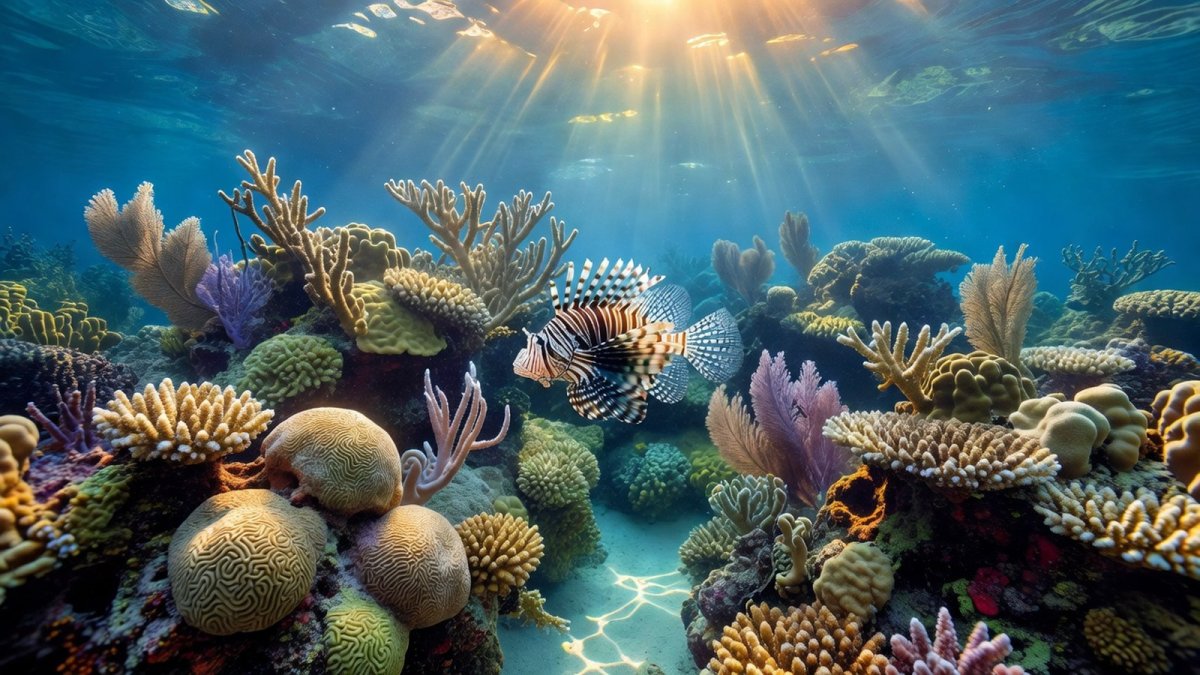
While sargassum chokes the surface, an invasive predator is decimating life below. The Indo-Pacific lionfish (Pterois volitans and Pterois miles) first appeared along Florida coasts in the mid-1980s, likely released from aquariums, and populations have swelled dramatically over the past 15 years, with widespread establishment across the Atlantic, Gulf of Mexico, and Caribbean by the early 2000s. The numbers are terrifying for Mexican fisheries: NOAA research shows that a single lionfish residing on a coral reef can reduce recruitment of native reef fish by 79%. In the Mexican Caribbean, native fish populations have been reduced by up to 60% in some areas, according to the North American Invasive Species Management Association. These invasive predators compete directly with commercially important species like snapper and grouper — the very fish that sustain Mexico's cooperativas pesqueras.
The lionfish threat is compounded by the collapse of the coral reefs that serve as fish nurseries. The Mesoamerican Reef, the second-largest barrier reef system in the world, runs from Mexico's Yucatán Peninsula through Belize, Guatemala, and Honduras. NOAA Coral Reef Watch is currently projecting a 60% probability of bleaching alert level 2 in Belize — the highest alert level — over the next 12 weeks, with bleaching alerts beginning as early as mid-June and spiking in severity and length through August. Warm water causes corals to expel the symbiotic algae (zooxanthellae) that give them their color and nutrition, turning them white. If heat stress persists, bleached corals die. The 2023 Caribbean-wide bleaching event already devastated corals off Florida and the region, and Healthy Reefs for Healthy People warns that each successive bleaching event is more extensive and extreme than the last. For Mexican fishers, a dead reef means no fish — and no income.
The Sheinbaum Administration's Response
The federal government is not standing idle. President Claudia Sheinbaum's administration has presented a national sargassum strategy backed by 2 billion pesos — a significant escalation from the ad-hoc, reactive approach that characterized the AMLO years. The plan includes more containment barriers, expanded harvesting at sea, and a circular-economy park in Puerto Morelos designed to turn the algae into fertilizer and commercial products. In a notable policy shift, sargassum has been added to the Carta Nacional Pesquera as a resource rather than classified as waste, opening the door for commercial harvesting and processing. The Secretaría de Marina (SEMAR) has kept approximately 350 personnel working on beach and open-water collection off Quintana Roo throughout the summer, a visible federal presence on the sand.
The political stakes are high for the Sheinbaum government. Sargassum is not just an environmental issue — it is an economic and electoral one. Quintana Roo welcomed roughly 21 million visitors in recent pre-pandemic years, and tourism is the state's main economic engine. When beaches turn brown and smell like rotten eggs, hotel occupancy drops, and the economic pain spreads through every colonia and ejido that depends on the tourism supply chain. The 2-billion-peso strategy is a bet that Mexico can manage this crisis proactively, but the scale of the 2026 season — with 119,000 tons expected to hit Quintana Roo shores — will test whether the infrastructure can keep up with the biology.
Impact on Mexican Coastal Communities
The human cost is measured in lost wages and empty nets. Fishing cooperatives across the Mexican Caribbean — from Puerto Morelos to Punta Allen to Xcalak — are reporting reduced catches of snapper and grouper, the direct result of lionfish predation and coral death destroying fish nurseries. The lionfish themselves are not commercially viable in local markets, though some cooperatives are beginning to sell them to restaurants as a novelty dish. Hotel workers in Cancún's hotel zone, tour guides in Tulum's archaeological site, waiters in Playa del Carmen's quinta avenida, and vendors in tianguis markets across the Riviera Maya are all watching the sargassum forecasts with dread. A bad sargassum season in August and October — the expected peak — could cast a shadow over the crucial Christmas tourism season, when many seasonal workers earn the bulk of their annual income.
The impact is not uniform. Playa Norte on Isla Mujeres, the west side of Cozumel, and parts of Holbox have been relatively spared, while Tulum's hotel zone, Akumal Bay, Puerto Morelos, Mahahual, and Costa Maya have been hit hardest. This uneven distribution creates a patchwork of economic winners and losers within the same state, straining local solidarity. Families that depend on both fishing and tourism — a common combination in coastal communities — are facing a double blow, with their income sources under attack from above (sargassum) and below (lionfish and coral death).
Reactions and Calls for Action
The scientific community is unified in its assessment. In the DW News report, Callum Roberts, Professor of Marine Conservation at the University of Exeter's Centre for Ecology and Conservation, emphasized that rising ocean temperatures are reshaping life beneath the waves in ways that will accelerate. Matthew Cappucci, Senior Meteorologist at MyRadar, highlighted how warm oceans influence weather patterns, including the rapid intensification of hurricanes — a direct threat to Mexico's Caribbean and Gulf coasts. The state government, through SEMA and Secretary Rébora Aguilera, is calling for more federal resources and for international cooperation, since sargassum does not respect national borders. Environmental groups like Healthy Reefs for Healthy People and the MAR Fund are running lionfish control programs that train fishers in capture and handling techniques, with communication campaigns and field control activities across the Mesoamerican Reef region.
The international dimension is critical. The sargassum blooms are fueled not just by warm water but by nutrient runoff from rivers like the Amazon, which carries nitrogen and phosphorus from fertilizer and wastewater into the Atlantic. Saharan dust and nitrogen-fixing bacteria also play a role. This means that Mexico's sargassum crisis is partly a consequence of agricultural practices in Brazil and the Sahel — a reminder that ocean health is a collective responsibility. NASA's PACE satellite mission, launched to monitor ocean color and phytoplankton, is providing new data that could improve sargassum forecasting, but prediction is not prevention.
What to Watch For
The coming months will be decisive. The University of South Florida's monthly sargassum outlook for August is expected to confirm whether the belt continues to grow or begins its seasonal decline. The August-to-October window is the peak arrival period for Quintana Roo, and officials are bracing for the heaviest weeks. El Niño conditions in the tropical Pacific are forecast to strengthen into the winter, which could mean another record-warm year for the oceans in 2027. The hurricane season, supercharged by record-warm Atlantic waters, remains a wildcard — a major storm could both disrupt sargassum collection efforts and churn up more seaweed from the deep. The 2-billion-peso national strategy will face its first full-season test, and the coral bleaching alerts for the Mexican Caribbean will tell us whether the Mesoamerican Reef can survive another summer of heat.
For Mexican readers, the message is clear: the ocean that sustains us is changing, and the changes are accelerating. The sargassum on the beaches of Tulum and the lionfish in the reefs of Cozumel are not isolated nuisances — they are symptoms of a global system in distress. The question is whether Mexico's response — from the federal strategy to local cooperatives — can adapt fast enough. The stakes are nothing less than the livelihoods of millions of Mexican families and the future of one of the most biodiverse marine regions on Earth. The ocean is not waiting, and neither can we.
By Rosa Martinez, Staff Writer
This article was produced with AI-assisted research and editorial support. Reporting is based on sources cited in the article.
What's Your Reaction?
 Like
1
Like
1
 Dislike
0
Dislike
0
 Love
0
Love
0
 Funny
0
Funny
0
 Wow
0
Wow
0
 Sad
0
Sad
0
 Angry
0
Angry
0

Latin America/Andes Correspondent at Global1.News. Based in Bogota, covering politics, environment, energy, and social movements across the Andean region. Passionate about environmental journalism and communities protecting their land.















Comments (0)