
Putin’s First-Ever Visit to Disputed Kuril Islands Ignites Japan-Russia Row
Putin's first-ever visit to the disputed Kuril Islands drew fierce Japanese protests, with PM Takaichi calling it "absolutely unacceptable" and FM Motegi summoning Russia's ambassador. The trip underscores an 80-year territorial impasse now hardened by the Ukraine war.
A Symbolic Landing on Contested Shores
Russian President Vladimir Putin made his first-ever visit to the disputed Kuril Islands on Thursday, August 13, 2026, a move that has sent shockwaves through Tokyo and further poisoned an already frozen bilateral relationship. The visit, confirmed by multiple international wire services including the Associated Press, Reuters, and AFP, took Putin to Iturup Island—known in Japan as Etorofu—the largest of the southern Kuril chain, located roughly 100 kilometers from Japan’s northern island of Hokkaido.
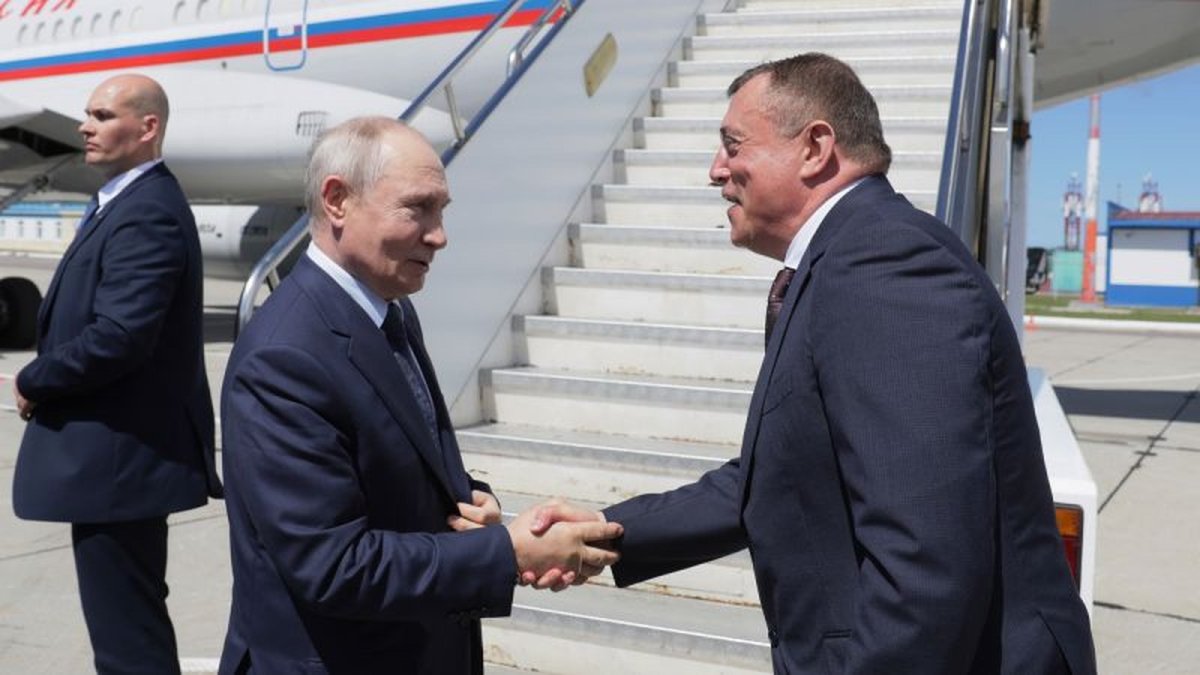
According to Russian state media reports carried by Politico, Al Jazeera, and the AP, Putin’s itinerary on Iturup was a mix of economic showcase and local engagement. He toured the Yasny fish-processing plant, where he sampled locally produced fish roe, and was briefed on the surrounding waters now holding tuna weighing up to 300 kilograms. The president also visited a hospital and a school, spoke briefly with residents, and met with Sakhalin Region Governor Valery Limarenko in Kurilsk, Iturup’s main town. The carefully choreographed visit was designed to project normalcy and Russian sovereignty over territory that Japan has claimed for decades.
The timing was anything but accidental. The day before, on Wednesday, August 12, Putin was on the nearby Russian island of Sakhalin, where Russia’s Pacific Fleet was conducting military drills. From the missile cruiser Varyag, he observed the exercises and chaired a meeting "on ensuring the security of Russia's eastern borders," according to Reuters and Al Jazeera. The juxtaposition of military muscle and civilian outreach sends a clear signal: Moscow considers the Kurils non-negotiable, and it is willing to back that position with force.
Tokyo’s Fury: "Absolutely Unacceptable"
Japan’s response was swift, sharp, and unequivocal. Prime Minister Sanae Takaichi called the visit "absolutely unacceptable," stating that it "offends the sentiments of the Japanese people." In a post on X, she declared the move "incompatible with Japan's consistent position on the Northern Territories," and warned that it "can only be said to have further hardened anti-Russia sentiment within Japan and made medium- to long-term recovery of relations more difficult." Takaichi also stressed that "even amid the harsh state of Japan-Russia relations following Russia's invasion of Ukraine, Japan has made every possible effort."
Foreign Minister Toshimitsu Motegi went further, issuing a formal statement that reiterated Japan’s core legal claim. "The Northern Territories, including Etorofu (Iturup) Island, are Japan's inherent territory both historically and from the perspective of international law," Motegi said, adding that "the Government of Japan strongly protests this visit." In a rare diplomatic escalation, Motegi summoned Russia’s ambassador to Japan, Nikolay Nozdrev, to the foreign ministry in Tokyo to lodge a formal protest in person, asking him to "promptly report the message back to Moscow."
The Russian response was dismissive. The Russian embassy in Japan called the protest "unfounded," with Nozdrev explaining that "the southern Kuril Islands are an integral part of the Russian Federation." The exchange underscores the depth of the impasse: both sides are speaking past each other, with no apparent room for compromise. For Tokyo, the visit is a deliberate provocation; for Moscow, it is a routine exercise of domestic sovereignty.
The Islands: A Legacy of World War II
To understand the fury in Tokyo, one must look back more than eight decades. The Soviet Union seized the four southernmost islands—Kunashir (Kunashiri), Iturup (Etorofu), Shikotan, and the Habomai islets—in the final days of World War II in 1945. The seizure was accompanied by the deportation of roughly 17,000 Japanese residents, a wound that has never fully healed in Japanese public consciousness. Today, approximately 20,000 Russian citizens live on the islands, a demographic reality that Moscow uses to reinforce its claim.
The dispute is not merely symbolic; it has had profound legal consequences. Because of the unresolved territorial question, Moscow and Tokyo have never signed a formal peace treaty ending World War II hostilities. More than 80 years later, the two nations remain technically at war, a legal anomaly that continues to shape their diplomatic relations. Talks held since the fall of the Soviet Union in 1991 have produced no settlement, and the gap between the two positions has only widened over time.
The islands themselves are strategically and economically significant. They sit in a volcanic archipelago arcing from Russia’s Kamchatka Peninsula to Hokkaido, and they hold mineral deposits including gold and silver, as well as rich fishing grounds. Control of the islands also gives Russia a forward military position in the Pacific, a fact that has become increasingly important as Moscow seeks to project power in the region.
A Military Buildup That Japan Calls "Unacceptable"
Moscow has steadily bolstered its military presence on the islands over the past decade, a trend that has alarmed Tokyo. Russia operates a strategically important base on Iturup, and in 2025, Japan formally protested a Russian live-fire drill in the area—including in Japan’s territorial waters—and called the Kremlin’s military buildup "unacceptable." The August 2026 visit, coming on the heels of the Pacific Fleet drills, is seen in Tokyo as a further escalation of that pattern.
Putin’s presence on the islands is not without precedent, but it is historically significant. In 2010, then-President Dmitry Medvedev became the first Russian leader to visit the disputed territory, a move that sparked outrage in Japan at the time. Medvedev returned in 2015 as prime minister. Putin, however, had never visited before Thursday, making this a carefully calculated first. The choice to break that precedent now, amid heightened tensions, is widely interpreted as a deliberate signal of Moscow’s intransigence.
The military dimension cannot be separated from the broader geopolitical context. Russia’s invasion of Ukraine in February 2022 fundamentally altered the security landscape in Europe and beyond, and it had a direct impact on Japan-Russia relations. Japan joined its G7 partners in imposing sanctions on Moscow and provided both money and non-lethal defense aid to Kyiv. Those actions, from Moscow’s perspective, transformed Japan from a potential economic partner into a hostile actor.
Putin’s Counter-Narrative: "We Are Not Threatening Japan"
Putin addressed the deteriorating relationship head-on during his Wednesday meeting on Sakhalin, framing Japan’s actions as the root cause of the current tension. "Japan has identified Russia as a main source of threats," Putin said, according to reports from the meeting. "I would like to point out that we are not threatening Japan... On the contrary, it has territorial claims against our country." The statement inverts the Japanese narrative, casting Tokyo as the aggressor and Moscow as the aggrieved party.
This framing is consistent with Russia’s broader approach to the Kurils dispute. Moscow has long argued that the islands were legitimately transferred to the Soviet Union as a result of World War II and that the current situation is settled under international law. Japan’s continued claims, from this perspective, are anachronistic and unreasonable. Putin’s visit is thus not a provocation but a reaffirmation of an established reality.
Yet the timing of the visit suggests a more calculated motive. With Russia’s military resources heavily committed to the war in Ukraine, Moscow may be seeking to demonstrate that it retains the capacity and will to defend its far-eastern interests. The Pacific Fleet drills, the meeting on eastern border security, and the presidential visit to Iturup all serve to project strength and resolve. For Tokyo, however, the message is clear: Russia is not going to compromise, and the window for negotiation is closing.
What This Means for the Future
The immediate fallout from Putin’s visit is likely to be a further freeze in Japan-Russia relations, which were already at their lowest point in decades. Prime Minister Takaichi’s statement that the visit has "made medium- to long-term recovery of relations more difficult" is a candid acknowledgment that the path to reconciliation is now longer and steeper than ever. The summoning of Ambassador Nozdrev and the formal protest lodged by Foreign Minister Motegi are strong signals that Tokyo will not let the matter pass quietly.
But the longer-term implications are more complex. The Kuril Islands dispute has been a persistent irritant in Japan-Russia relations for over 80 years, and it has survived multiple shifts in the global order—from the Cold War to the post-Soviet era to the current great-power competition. The fundamental positions of both sides have remained remarkably consistent: Japan insists on the return of the Northern Territories, while Russia insists on its sovereignty over the islands. Neither side has shown any willingness to move.
The visit also complicates Japan’s broader strategic posture. As Tokyo deepens its security ties with the United States and other allies, and as it confronts an increasingly assertive China in the East China Sea, the Kurils dispute adds another layer of tension to Japan’s security environment. The islands sit astride key sea lanes and are within striking distance of Hokkaido, making them a potential flashpoint in any future crisis. For now, the dispute remains diplomatic, but the military buildup on both sides raises the stakes.
A Dispute Frozen in Time
What is most striking about the Kuril Islands dispute is its durability. The Soviet Union seized the islands in 1945, and the basic parameters of the disagreement have not changed since. Japan has consistently maintained that the islands are its "inherent territory," while Russia has consistently maintained that they are an "integral part" of the Russian Federation. The language used by both sides in August 2026 is nearly identical to the language used in 1991, 2001, and 2011.
This stasis is not for lack of effort. Numerous summit meetings, working groups, and diplomatic initiatives have been attempted over the decades, all without success. The fundamental obstacle is that both sides view the islands as non-negotiable, and neither is willing to accept a compromise that would be seen as a concession at home. The result is a dispute that has outlasted multiple generations of leaders on both sides and shows no signs of resolution.
Putin’s first-ever visit to the islands is thus both a symptom and a cause of the impasse. It is a symptom because it reflects Moscow’s confidence that it faces no real pressure to change its position. It is a cause because it further entrenches the Russian position and makes any future compromise politically more difficult for Moscow to accept. For Japan, the visit is a bitter reminder that its claims, however justified historically and legally, have not translated into diplomatic leverage.
The Road Ahead: No Easy Answers
Looking forward, the prospects for a breakthrough appear remote. Russia’s war in Ukraine has fundamentally altered the relationship between Moscow and the West, and Japan, as a G7 member, is firmly on the Western side of that divide. The sanctions Japan has imposed on Russia, and the aid it has provided to Ukraine, have created a level of animosity that will not dissipate quickly. Putin’s visit to the Kurils is likely to deepen that animosity further.
For Prime Minister Takaichi, the challenge is to balance a firm response to Russia’s provocation with the need to keep diplomatic channels open. Her statement that Japan has "made every possible effort" suggests a government that feels it has exhausted its options. The summoning of the Russian ambassador is a strong diplomatic gesture, but it is unlikely to change Moscow’s calculus. Russia has weathered far more severe international pressure over Ukraine, and it shows no signs of bending on the Kurils.
In the end, the Kuril Islands dispute is a reminder that some conflicts are not resolved but merely managed. Both Japan and Russia have learned to live with the absence of a peace treaty, and both have built their respective policies around the status quo. Putin’s visit does not change the fundamental dynamics of the dispute, but it does make the status quo more entrenched. For the roughly 20,000 Russian residents of the islands, and for the Japanese who still consider them their homeland, the wait for a resolution goes on.
By Jessica Ali, Staff Writer
This article was produced with AI-assisted research and editorial support. Sources: Associated Press, Reuters, AFP, Al Jazeera, DW, Politico.
What's Your Reaction?
 Like
0
Like
0
 Dislike
0
Dislike
0
 Love
0
Love
0
 Funny
0
Funny
0
 Wow
0
Wow
0
 Sad
0
Sad
0
 Angry
0
Angry
0

Editor-in-Chief at Global1.News. Atlanta-based journalist who cuts through the BS and tells it like it is. Lead anchor, host, and the voice you hear when the spin stops and the truth starts.














Comments (0)