
Israeli government minister uses racist slurs against Arab lawmakers in Knesset
In a stark display of hostility that reverberated through Israel’s parliamentary chamber, Heritage Minister Amichai Eliyahu addressed Arab members of the Knesset with slurs that invoked centuries‑old stereotypes.
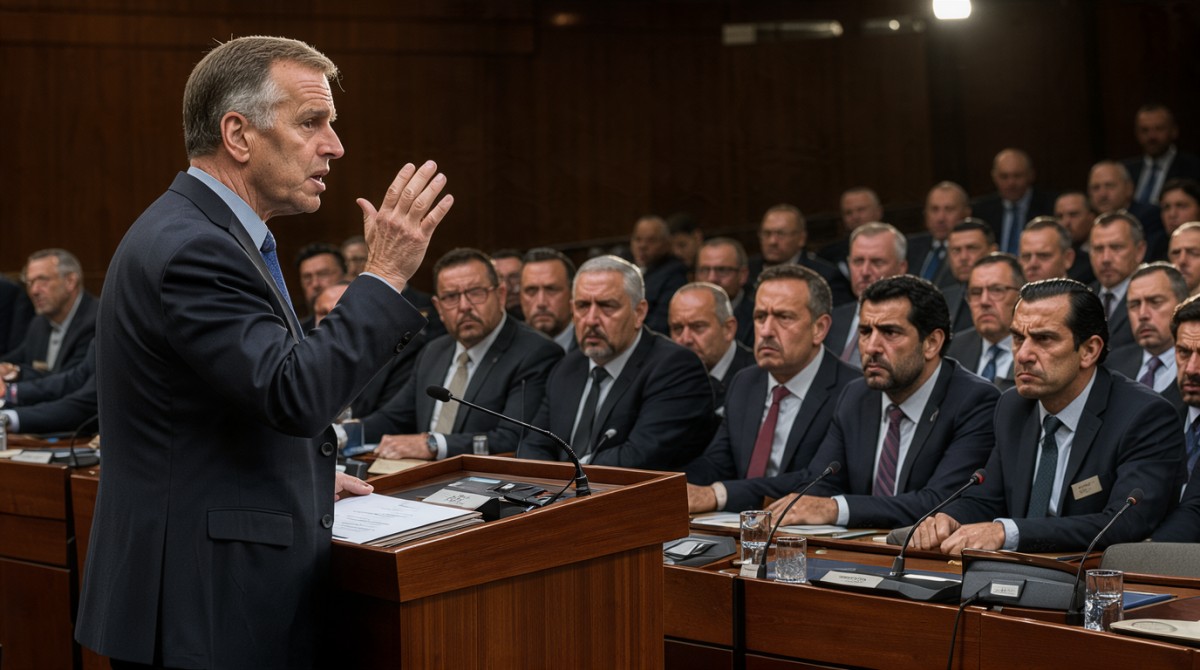
In a stark display of hostility that reverberated through Israel’s parliamentary chamber, Heritage Minister Amichai Eliyahu addressed Arab members of the Knesset with slurs that invoked centuries‑old stereotypes. Referring to them as “savages” and “camel riders,” the far‑right minister’s tirade, captured on widely circulated video, sparked immediate protests from Arab lawmakers and drew condemnation from human‑rights observers. The incident, which unfolded during a debate on a proposal to create a committee aimed at curbing violence in Arab communities, underscores a deepening rift between Israel’s Arab minority and a government increasingly dominated by extremist rhetoric.
Racist Rhetoric in the Knesset
The language used by Eliyahu was not an isolated outburst but part of a pattern of demeaning remarks that have marked his public career. In the heated session, he declared, “You savages, you camel riders; you need to learn,” before adding a reference to the September 11 attacks, accusing Arab citizens of having “destroyed the Twin Towers” and “destroyed Europe.” When Arab lawmakers objected, the minister dismissed their concerns, framing the issue as one of “education” rather than discrimination, insisting that “your education needs to be fixed, and you need to be re‑educated, not only here in the country, but everywhere in the world.”
Such statements betray a view that reduces an entire community to a caricature, conflating political grievances with ethnic identity. By invoking “Western Jewish morality” as a benchmark, Eliyahu positioned Arab citizens as inherently inferior, a stance that fuels marginalization and undermines the democratic principle of equal representation in Israel’s legislature.
Historical Context of Arab Marginalization
Arab citizens, who constitute roughly 21 percent of Israel’s more than ten‑million‑strong population, have long voiced complaints of incitement, discrimination, and neglect across political, economic, and civil spheres. Their grievances have intensified as successive governments have struggled—or refused—to address the spread of unlicensed weapons and rising crime in Arab towns and villages. The minister’s remarks echo a broader narrative that frames Arab communities as problem areas rather than partners in the nation’s civic life.
These tensions are not merely rhetorical. The call for a committee to combat violence in Arab communities, the very debate during which Eliyahu’s slurs were uttered, reflects a policy approach that isolates Arab citizens as a security issue. Such framing risks justifying harsher policing measures while sidestepping the underlying socio‑economic disparities that fuel unrest.
Eliyahu’s Record of Inflammatory Statements
The minister’s recent outburst fits within a documented history of extremist language. In November 2023, he suggested that dropping a nuclear bomb on Gaza was a viable option, claiming the enclave contained no uninvolved civilians. By May 2025, he advocated bombing food and fuel depots to force Palestinians to leave, and in 2026 he told a public broadcaster that Israel’s ultimate aim was to “restore control over the Gaza Strip, including establishing settlements.”
These statements reveal a consistent willingness to dehumanize Palestinians and, by extension, Arab citizens of Israel. The pattern demonstrates how extremist rhetoric can translate into policy proposals that threaten basic human rights, reinforcing a climate of fear and hostility that reverberates beyond the Knesset walls.
Human Cost of Ongoing Conflict
Since October 2023, the war in Gaza has inflicted staggering human suffering. Palestinian authorities report more than 74,000 deaths and over 176,000 injuries, the majority being women and children. Even after a ceasefire announced in October 2025, Israel has continued to restrict humanitarian aid, leaving around 2.4 million Palestinians, including roughly 2.15 million displaced persons, in dire conditions. The continued blockade and periodic strikes exacerbate the trauma experienced by families already scarred by loss and displacement.
This humanitarian crisis deepens the sense of injustice felt by Arab citizens within Israel, who see the same patterns of collective punishment applied to Palestinians across the border. The perception that the state tolerates, or even encourages, such policies fuels resentment and erodes trust in governmental institutions, creating a feedback loop that fuels the very violence the proposed committee purports to address.
International Legal Scrutiny
The international community has begun to hold Israel accountable for alleged violations of international law. The International Court of Justice is currently hearing a case brought by South Africa accusing Israel of genocide in Gaza, a case now joined by several other nations. In November 2024, the International Criminal Court issued arrest warrants for Prime Minister Benjamin Netanyahu and former Defense Minister Yoav Gallant on charges of war crimes and crimes against humanity. These legal actions signal growing global concern over Israel’s conduct and underscore the importance of adhering to international humanitarian standards.
For Arab citizens of Israel, the mounting legal scrutiny adds another layer of complexity. While the ICC and ICJ focus on actions in Gaza, the rhetoric of ministers like Eliyahu suggests a broader ideological stance that may influence domestic policies toward Arab communities, potentially inviting further international criticism if discriminatory practices are codified into law.
Political Repercussions Within Israel
The minister’s remarks have already sparked visible dissent inside the Knesset, with Arab lawmakers protesting loudly. Their resistance highlights a growing willingness among Arab representatives to confront overt racism, even at the risk of political marginalization. However, the broader coalition, dominated by right‑wing parties such as Jewish Power, appears unperturbed, suggesting that Eliyahu’s language may not jeopardize his standing within the governing bloc.
Nevertheless, the public outcry and media coverage could pressure moderate elements within the coalition to distance themselves from such extremist discourse. International attention on Israel’s internal treatment of its Arab minority may also compel the government to reconsider policies that could be construed as discriminatory, especially as the nation faces mounting legal challenges abroad.
Pathways Toward Reconciliation
Addressing the deep wounds opened by Eliyahu’s slurs requires more than a condemnation of his words; it demands structural reforms that recognize the equal citizenship of Arab Israelis. Policies must shift from punitive security measures to inclusive development programs that improve education, infrastructure, and economic opportunities in Arab towns. Genuine dialogue, facilitated by neutral mediators, could help bridge the mistrust between Arab legislators and the government.
International law offers a framework for protecting minority rights, and Israel’s obligations under treaties such as the International Covenant on Civil and Political Rights call for the elimination of discrimination. By aligning domestic policies with these standards, Israel can begin to heal the fissures that extremist rhetoric exploits. For the families of Gaza’s victims and the Arab citizens who hear echoes of that suffering at home, a commitment to equality and justice is the only path toward lasting peace.
This article was produced with AI-assisted research and editorial support. Reporting is based on the source material cited below. Sources: Middle East Monitor; middleeastmonitor.com; Global1.News (24 November 2026).
By Fatima Al-Rashid, Staff Writer
What's Your Reaction?
 Like
0
 Dislike
0
 Love
0
 Funny
0
 Wow
0
 Sad
0
 Angry
0
Gulf/MENA Correspondent at Global1.News. Based in Doha, covering Gulf politics, energy markets, diplomacy, and development across the Middle East and North Africa. Tracks the economic transformation of the Gulf states.













Comments (0)