
North Korea Missile Barrage Defies Trump Overture, Tests Alliance
North Korea fired a barrage of short-range ballistic missiles Thursday, a day after Pyongyang dismissed President Trump's decision to scale back US-South Korea joint drills. Seoul condemned the launch as a grave violation of UN resolutions and convened an emergency security meeting.
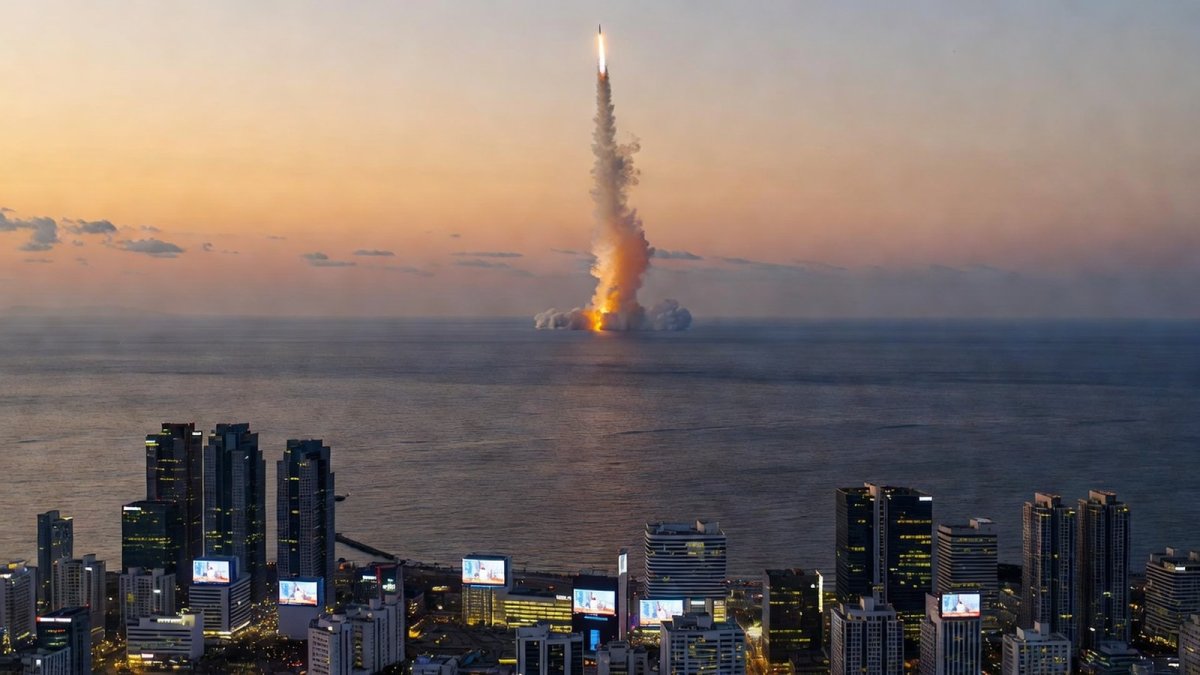
It was a familiar, terrifying rhythm for the region: a flash of launch, a plume of smoke, and the stark warning from Seoul that yet another volley of missiles had been fired from Pyongyang. But the timing of Thursday’s barrage—a direct rebuttal to a personal overture from a sitting American president—elevates this from routine provocation to a high-stakes geopolitical chess move. As the United States and South Korea scramble to recalibrate an alliance strained by Washington’s unilateral concessions, North Korea has made it brutally clear that it will not be placated by gestures alone.
North Korea Missile Barrage Defies Trump Overture, Tests Alliance
Washington, D.C. – August 20, 2026 — Article continues...
Pyongyang’s Thunder: A Barrage Over the East Sea
Folks, let’s cut straight to the scene. At approximately 5 p.m. Korean Standard Time on Thursday, the quiet was shattered. According to South Korea's Joint Chiefs of Staff (JCS), North Korea launched between 10 and 12 short-range ballistic missiles from the Pyongyang area, sending them screaming toward the sea east of the Korean Peninsula. The missiles traveled roughly 186 miles—about 300 kilometers—before splashing down in the Sea of Japan, also known as the East Sea.
The JCS confirmed the flight data, but it was Japan’s Defense Ministry that provided the real-time drama. A coast guard alert was issued at 5:08 p.m., warning vessels to watch for falling objects. Eleven minutes later, a second alert noted that a suspected missile appeared to have "already fallen," a clear indication this was not a long-range weapon aimed at U.S. soil, but a tactical, pointed message aimed squarely at Seoul and Washington.
This isn't a one-off event. This marks the third ballistic missile test by North Korea in August 2026 alone, following an SRBM launch off the east coast on August 12. The pattern is familiar: Pyongyang has long denounced U.S.-South Korea joint exercises as invasion rehearsals and consistently responds with missile launches. But this time, the context is different, and the stakes are significantly higher.
Seoul on High Alert: The Nuclear Shadow
South Korea’s response was swift and severe. The presidential office in Seoul condemned the launch in the strongest terms, convening an emergency National Security Council meeting that brought together defense ministry and military authorities. The official statement was unambiguous: "The ballistic missile launch is a grave act that violates U.N. Security Council resolutions." The presidential office also ordered the military to maintain full readiness during the ongoing joint exercises with the United States.
But here is where the intelligence gets chilling. South Korean Defense Minister Ahn Gyu-back told lawmakers that the missiles launched today are believed to be 600 mm multiple rocket launchers, known externally as the KN-25. This is not just a conventional artillery piece — North Korea has repeatedly described the KN-25 as capable of delivering tactical nuclear warheads. The choice of weapon is a deliberate escalation.
And the numbers behind that threat are staggering. Earlier in the day, Minister Ahn provided a stark assessment to the National Assembly: North Korea possesses between 80 and 120 nuclear warheads. That is not a rogue state fumbling in the dark; that is a nuclear power with a significant arsenal. When Pyongyang fires a system designed for tactical nukes, it is not just testing a missile; it is testing the resolve of an alliance that is currently showing cracks.
The Trump Factor: A Drastic Concession
To understand why this launch happened today, you have to look at what happened yesterday. This barrage came a day after Pyongyang shrugged off President Donald Trump's order to scale back U.S. military drills with South Korea. Folks, this was not a minor tweak. President Trump ordered the Pentagon to "substantially reduce" the 11-day Ulchi Freedom Shield exercises just before they began on Monday. The drills, originally scheduled to run through August 27, are now set to end early, on Friday.
Why? President Trump cited his "very good" relationship with North Korean leader Kim Jong Un. On Wednesday, he went further, stating he WILL meet Kim this year. He even claimed on Monday that he had received a response from Kim Jong Un after the reduction. On his Truth Social platform, Trump framed the exercises as "inappropriate and hostile," writing, "These exercises are not only costly, with much of these costs paid for by the United States of America (as usual!), but send a signal that is totally inappropriate and hostile, to a country that, as long as Donald J. Trump has been president, has been unthreatening and respectful."
This is a stunning reversal of decades of U.S. policy. The president is essentially arguing that the very presence of U.S. troops and their training with allies is the provocation, not the North Korean nuclear program. He has denied claims that he is prioritizing North Korea's interests over regional allies, but the optics are damning. South Korean lawmakers described Trump's move to cut the alliance drills as an "inane, haphazard decision." You don't gut your deterrence posture to appease a leader who just fired a salvo of missiles at your ally.
Kim Yo Jong’s Cold Rejection
And how did Pyongyang respond to this unprecedented concession? With contempt. Kim Yo Jong, the influential sister of Kim Jong Un and a key voice in the regime, dismissed Trump's overture as "not worthy of comment." The President of the United States cut military exercises, praised the North Korean leader, and promised a summit — and got a dismissive shrug.
Kim Yo Jong was precise in her rebuke. "The provocative, aggressive nature of the drills won't change even though their duration and size were reduced," she said, according to state media. She warned Washington directly: "If the US calculates that it can propagate its recent measure as one of so-called good faith, they will not get the desired answer." She went on to highlight a series of other military drills by the U.S. and South Korea earlier this year, as well as Seoul's push to introduce nuclear-powered submarines, as evidence that the "hostile policy" remains unchanged.
However, there is a nuance here that shouldn't be lost. She refrained from the typical fiery rhetoric that usually accompanies these statements. She even noted that personal relations between her brother and Trump were "still excellent." It suggests Pyongyang is not slamming the door shut, but keeping it open just a crack, waiting to see if it can extract even bigger concessions from a U.S. president who has shown he is willing to give them up. She also claimed she was unaware of any recent communications between the two countries' leaders, a subtle way of saying that the "good relationship" Trump brags about might not be as solid as he thinks.
Analyst Verdict: A Message of Sovereignty
So, what is the strategic calculus here? Yang Moo-jin, a professor at the University of North Korean Studies in Seoul, sees this launch as a direct follow-through on Kim Yo Jong’s warning. The launch, he argued, was aimed at underscoring that her statement a day earlier was "not mere rhetoric."
Professor Yang suggests the launch served multiple purposes. First, it signals opposition to the South Korea-U.S. military exercises, even in their reduced form. Second, it expresses displeasure over recent public discussion of North Korea's nuclear arsenal—likely a reference to Minister Ahn's comments about the 80 to 120 warheads. Third, and perhaps most importantly, it serves as a warning to outside powers against speculation about Pyongyang's security affairs. "It is a message that matters concerning North Korea's security are for North Korea to decide," Yang said. He also noted the launch could have been used to test improved missile systems, a technical objective that often accompanies the political signaling.
This is the key takeaway, folks. North Korea is telling the United States that they will not be managed or manipulated by a U.S. president who thinks a personal relationship can override structural hostility. They are asserting their agency. They are the ones who decide when and how to negotiate, and they will not be seen as having been bought off by a reduction in exercises that they still view as a threat.
Regional Chessboard: China and Russia Loom
This missile test doesn't happen in a vacuum. It is happening against a backdrop of shifting alliances and great power competition. Chinese Foreign Minister Wang Yi visited Seoul this week, and his message was a direct challenge to the U.S.-South Korea alliance. He urged South Korea not to take sides between Beijing and Washington, and he explicitly called on the United States to abandon its "hostile" policy toward North Korea to ease tensions on the peninsula. That is Beijing publicly backing Pyongyang’s narrative and trying to pull Seoul out of Washington’s orbit.
Meanwhile, North Korea's growing ties with Russia are reshaping the balance of power on the peninsula, complicating any U.S. response. South Korea, feeling the pressure, has proposed talks to officially end the Korean War, a move that would fundamentally alter the legal status of the U.S. troop presence in the country. The ground is shifting under our feet, and the old rules of engagement no longer apply.
What Happens Next: A Reckoning for the Alliance
So, where do we go from here? The immediate future is fraught with danger. The Ulchi Freedom Shield exercises are set to end tomorrow, a day early, thanks to President Trump’s intervention. The question is whether that will be enough to satisfy Kim Jong Un, or if it will be seen as a sign of weakness that invites further provocation. The fact that North Korea fired missiles during the scaled-back drills suggests they are not interested in de-escalation right now.
For President Trump, this is a political and diplomatic minefield. He has staked his reputation on his personal diplomacy with Kim Jong Un. He has now made a major concession—cutting military exercises—and received a missile barrage in return. He will be under immense pressure to respond, but his options are limited. A military response risks igniting a conflict with a nuclear-armed state. A return to the previous exercise schedule would be an admission that his overture failed. And doing nothing further emboldens Pyongyang.
For South Korea, this is a crisis of trust. The emergency NSC meeting today was not just about the missiles; it was about managing an alliance that suddenly looks unreliable. The coming days will be critical. Will Trump double down on his outreach, or will he be forced to walk it back? One thing is certain: North Korea has driven a wedge between Washington and Seoul — and they are not done yet. Stay with Global 1 News as we continue to track this developing story.
This article was produced with AI-assisted research and editorial support. Sources: The Guardian, AP, USA Today, ABC News, DW, NK News, Reuters.
By Jessica Ali, Staff Writer
What's Your Reaction?
 Like
0
Like
0
 Dislike
0
Dislike
0
 Love
0
Love
0
 Funny
0
Funny
0
 Wow
0
Wow
0
 Sad
0
Sad
0
 Angry
0
Angry
0

Editor-in-Chief at Global1.News. Atlanta-based journalist who cuts through the BS and tells it like it is. Lead anchor, host, and the voice you hear when the spin stops and the truth starts.















Comments (0)