
Japan's East Coast Shakes Again: A 5.9 Offshore, and Four Big Quakes in Under Three Days
Japan's east coast shook again on Monday when a magnitude 5.9 earthquake struck offshore from Ibaraki Prefecture, registering intensity 3 across four prefectures with no tsunami concern, the fourth quake of magnitude 5.6 or more in under three days.
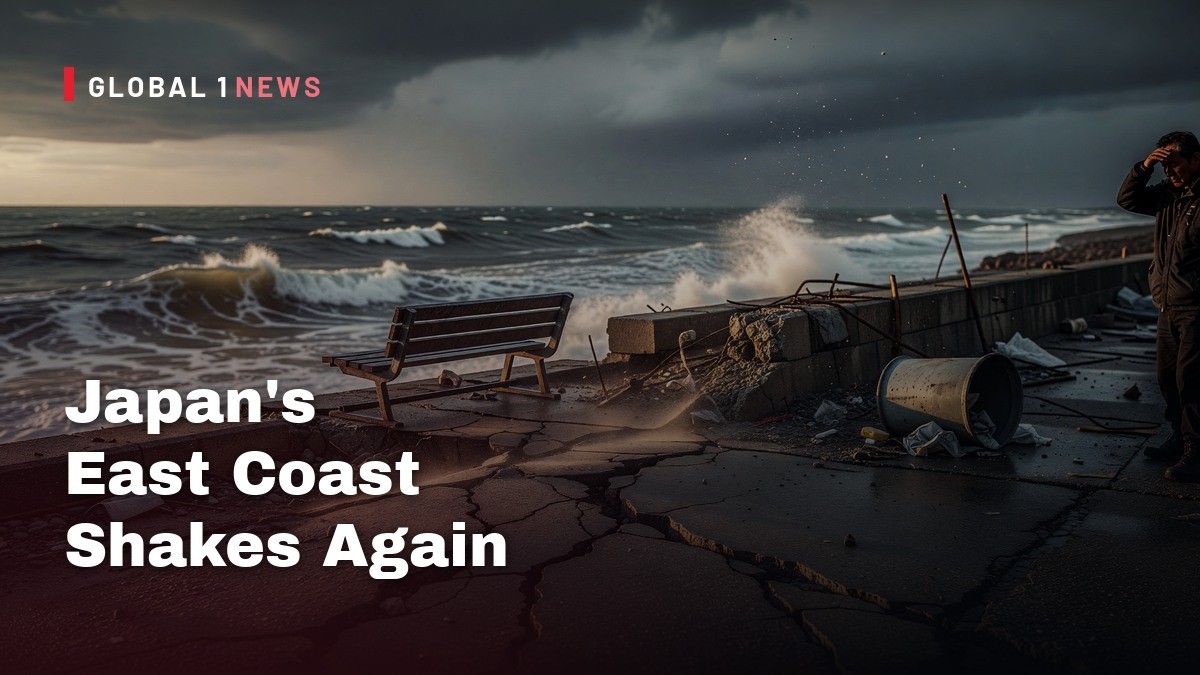
The ground beneath Japan's east coast moved again on Monday afternoon. A magnitude 5.9 earthquake struck offshore from Ibaraki Prefecture at 1:52 p.m. local time, shaking parts of Miyagi, Fukushima, Ibaraki and Tochigi hard enough to register at 3 on the country's seven-point intensity scale, and raising no tsunami concern at all. It was the fourth earthquake of magnitude 5.6 or more in less than three days.
Japan's East Coast Shakes Again: A 5.9 Offshore, and Four Big Quakes in Under Three Days
Ibaraki Prefecture, Japan — The Japan Meteorological Agency placed the epicentre at 36.2 degrees north and 142.2 degrees east, roughly 10 kilometres below the seabed, and estimated the magnitude at 5.9.
A 5.9 in the Afternoon, and No Tsunami to Fear
The agency's preliminary warning went out at 1:55 p.m., three minutes after the rupture, with the first full bulletin a minute behind it. The strongest shaking, intensity 3, was recorded in central Miyagi, in Fukushima's Nakadori and Hamadori districts, in northern Ibaraki and in southern Tochigi. The towns that reached that level read like a map of the Tohoku and Kanto corridor: Ishinomaki, Fukushima City, Tamura, Nishigo, Futaba, Mito, Hitachiota, Tokai and Mashiko.
"There is no concern of a tsunami from this earthquake," the agency said, while telling residents to keep watching for further information. Business Today reported no immediate casualties, no property damage and no disruption to transport or essential services. In a country that measures its earthquakes by the hundred each year, a 5.9 that breaks nothing is a warning shot rather than a disaster — but it lands on a coastline that has been shaking since Thursday.
What Intensity 3 Means, and What It Does Not
Japan does not report earthquakes in one number. Magnitude describes the size of the rupture at its source; shindo describes how hard the ground actually shook at a given place, on a scale that runs from zero to seven. One earthquake therefore produces a different reading on every street it reaches, which is why an offshore 5.9 shows up as a 3 in Mito and a 1 somewhere else.
Two smaller earthquakes had already been logged on Monday before dawn. At 3:15 a.m. a magnitude 3.5 in northern Ibaraki, about 10 kilometres down, reached 2 in Hitachi and 1 across Mito, Hitachiota, Takahagi, Kasama, Hitachiomiya, Shirosato, Chikusei, Sakuragawa and Goka. At 5:16 a.m. a magnitude 4.5 offshore from Miyagi Prefecture, at a depth of about 50 kilometres, reached intensity 3. Neither produced a tsunami concern. Neither was unusual. Both were logged, mapped and published within minutes.
What Sunday Did: Chita's Hardest Shaking in Thirty Years
The event that actually hurt people came at 1:04 a.m. on Sunday, and it came inland. A magnitude 5.7 beneath western Shizuoka Prefecture, about 40 kilometres down, drove intensity 5-upper into Chita in Aichi — the strongest shaking recorded there in roughly three decades. Lower-5 readings followed across parts of Aichi, Shizuoka, Nagano and Gifu, and the tremor was felt in Hamamatsu, Kyoto, Nara and Yamanashi, where Mount Fuji sits. Greater Tokyo registered only low-intensity shaking; the capital proper barely noticed.
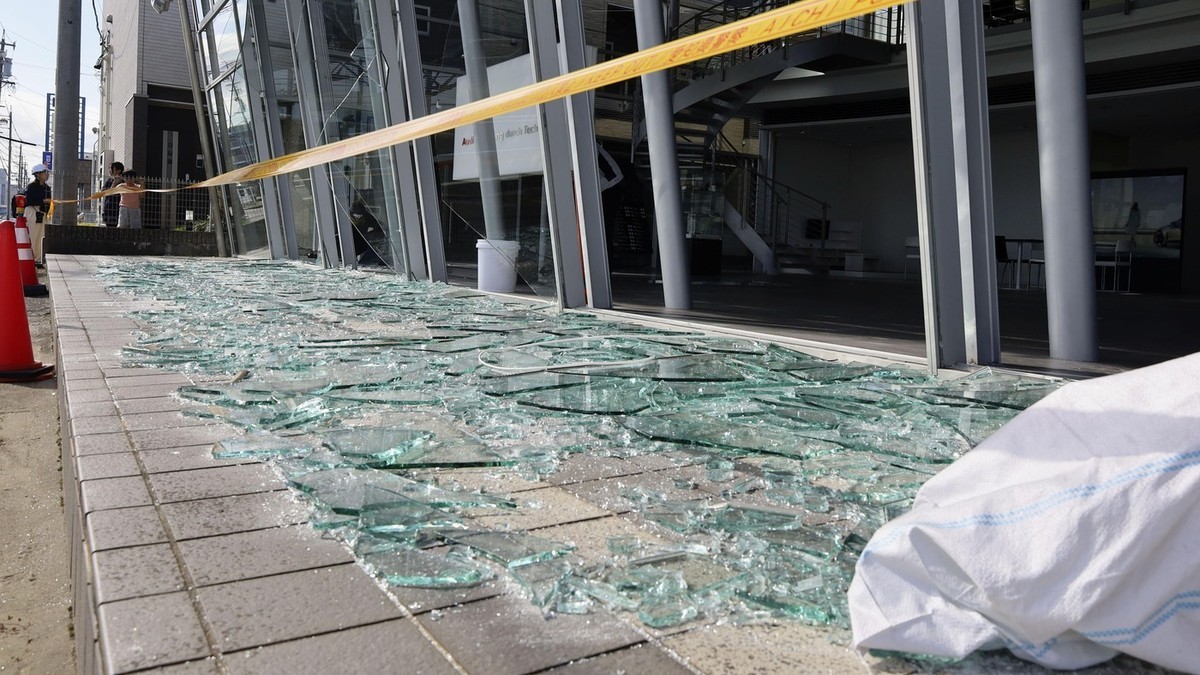
The physical record is specific. In Toyohashi, the large window of the Audi Toyohashi dealership facing the prefectural road shattered and glass scattered as far as the pavement, and part of a nearby house's concrete block wall collapsed. A 55-year-old civil servant living close by told the Chunichi Shimbun he heard "pane, pane" from outside during the quake and came out to find glass across the walkway. At the Seibundo Shoten store in Toyota city, books came off the sales-floor shelves and covered the floor, fire-prevention glass broke, and the employee who arrived about 40 minutes later said, "I can't bear to look."

In Kasugai a water pipe burst and the city set up a warning headquarters immediately after the quake; parts of Higashiura reported temporary water supply problems. In Chita's Shinchihigashimachi, a 24-year-old said he woke to about ten seconds of side-to-side movement, and a convenience store employee there said one small bottle of whisky broke and that he was worried about aftershocks.
Twenty-Four Injuries, and a Number That Kept Moving
There were no deaths. The injury count, however, moved all day. An Aichi emergency official said authorities had received 16 reports, mostly minor. Shizuoka said at least three women sought emergency medical care, including a woman in her nineties who injured her shoulder after falling from her bed.
The Chunichi Shimbun and Tokai Television separately reported at least 24 hurt across the two prefectures, against earlier reports of 22. TBS News Dig carried at least 21. The Yomiuri Shimbun surveyed fire department headquarters across Aichi and concluded at least 24, most from falling. Local media also reported a foreign resident in Osaka taken to hospital after falling from a second-floor apartment when the shaking startled them; Osaka officials could not be reached for comment.
None of those figures contradicts the others. They are snapshots taken at different hours by different agencies counting different things — reports received, patients treated, people transported. The number that matters is the one the prefectures reconcile, and that does not exist yet.
The Bullet Trains Stopped Twice in Four Days
The most visible consequence of a Japanese earthquake is usually the railway. On 6 November at 7:39 p.m., a magnitude 6.1 earthquake off the east coast of Kanto, about 10 kilometres deep, reached intensity 3 across Miyagi, Fukushima and Ibaraki. JR Central and JR East halted the Tokaido, Tohoku and Joetsu Shinkansen on some sections and ran the rest late. The agency warned of slight sea-level changes and no damage.
On Sunday at 1:04 a.m. it happened again, inland. The Tokaido Shinkansen was suspended or run at reduced speed between Shizuoka and Gifu-Hashima stations while crews walked the track and inspected structures, and some local services stopped as well. The Yomiuri Shimbun reported that JR Central and other operators suspended services from the first trains of the day for safety inspections.
That is the system doing what it was built to do, and it is also why a 5.7 in Shizuoka can empty a platform in Nagoya: Japan's railways treat every shindo 5 as a physical question about steel and concrete, and answer it with people on foot rather than with a timetable.
Hamaoka, and the Question Japan Always Asks
Every earthquake near the Nankai Trough pulls the same question to the surface, and on Sunday the answer was clean. Chubu Electric Power Co., which operates the Hamaoka Nuclear Power Station in Shizuoka Prefecture, reported no abnormalities at the plant after the tremor. Hamaoka sits in the region associated with the trough, the offshore boundary where Japan has long expected a major earthquake.
The agency was equally careful. It said it had detected no unusual changes indicating that Sunday's earthquake had altered conditions along the Nankai Trough, assessed the event as occurring within the Philippine Sea Plate, and said its magnitude did not indicate a significant change in the state of the plate boundary. Monitoring of seismic activity and crustal movement continues.
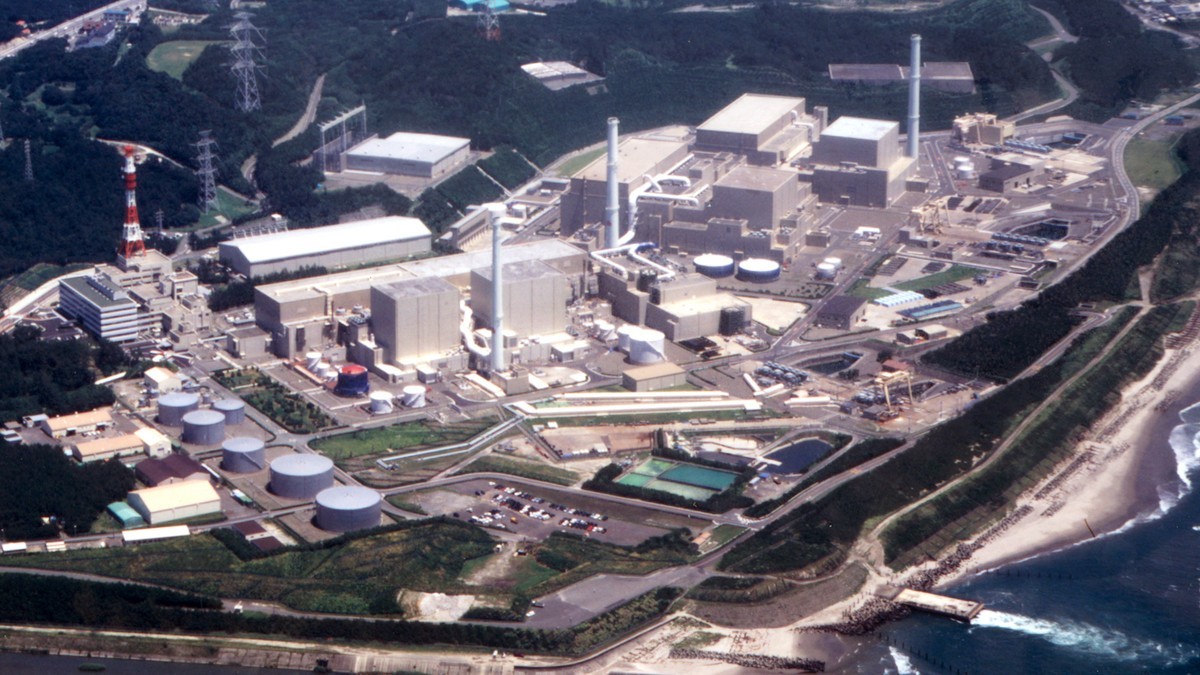
The stakes of that paragraph are not abstract. Japan's 2011 magnitude 9.0 undersea earthquake drove a tsunami that killed or left missing around 18,500 people and wrecked the Fukushima nuclear plant. When the agency says a plate boundary has not changed, it is answering a question the whole country learned to ask.
A Week, a Ten-to-Twenty Per Cent, and Two to Three Days
After Sunday's quake the agency did not forecast anything. It gave residents in the affected areas a timeframe and a probability, which is a different and more honest thing. People should prepare for further earthquakes over approximately one week, it said, with the risk of another substantial tremor particularly elevated during the first two to three days after a main earthquake.
It put a number on the historical pattern: earthquake sequences indicate a 10 to 20 per cent occurrence rate of a similarly large event following a significant earthquake. Further shaking could reach intensity 5-upper in the most affected areas. Strong shaking destabilises slopes, which raises the risk of landslides and rockfalls, particularly once rain arrives. At least one smaller aftershock was recorded shortly after the main quake.
What the agency has not done is present the November earthquakes as a single linked sequence, or describe any of them as an aftershock of another. It has attributed the run of events to no single cause. Monday's 5.9 offshore from Ibaraki is its own entry in the catalogue, with its own epicentre, its own depth and its own intensity map.
The Alert That Was Withdrawn in Eight Minutes
All of this is arriving three and a half weeks after the agency's credibility took its hardest knock in years. At 12:40 p.m. on 16 October, the Japan Meteorological Agency issued an Emergency Earthquake Warning for Hokkaido through the Tokai region, forecasting shaking up to intensity 7 from an earthquake it estimated at magnitude 9.9. It cancelled the warning at 12:48.
The real earthquake was about magnitude 6.9, near the Kamchatka Peninsula, at roughly 12:38. The only shaking observed in Japan was intensity 1 in Hakodate. The system had placed the epicentre about 680 kilometres north-east of the true location and recalculated intensities using the Kuril Islands, producing a prediction of strong shaking over a wide area; the nearest observation station, in Nemuro, was about 1,200 kilometres from the actual epicentre.
The agency held three press conferences and apologised, and denied that a cyber attack was involved, the Yomiuri Shimbun reported. Its own third release explained that using stations far from the epicentre in the magnitude calculation inflated the estimate to 9.9, and that a safeguard introduced after a similar over-estimate on 30 July 2020 near Torishima — excluding stations more than 700 kilometres out — was found not to be operating normally. An emergency fix went in at about 21:30, and the agency confirmed the warning would not have been issued under it. It was the first retraction of an Emergency Earthquake Warning.
Why the Second Number Matters More Than the First
Monday's earthquake also came with two magnitudes, and neither is wrong. The Japanese agency estimated 5.9 at a depth of about 10 kilometres. The United States Geological Survey measured 5.7 at 24.2 kilometres, with an epicentre at 36.247 degrees north and 141.830 degrees east — about 123 kilometres south-east of Iwaki, population 357,000, and 113 kilometres east of Hitachi, population 186,000. The European-Mediterranean Seismological Centre also listed 5.7 at 24 kilometres.
The same divergence appeared on Sunday, when the agency put the Shizuoka earthquake at 5.7 with a preliminary depth of 41 kilometres and the USGS measured 5.5. Different networks read different stations and invert for different things, and a shallow offshore rupture is among the hardest cases to pin down.
What a person standing in Mito needed to know was not the magnitude. It was that the ground would move enough to rattle the crockery and not enough to bring anything down — and by Sunday's standard, a magnitude 4.3 in Kumamoto that reached intensity 4 showed how little the first number tells you about the second.
What a Week of Aftershocks Actually Asks of People
The practical instructions this week are boring, and they are the ones that work. Secure what can fall. Know how you would leave your building. Watch the slopes behind houses after rain, because the agency has flagged landslides and rockfalls as a downstream risk of strong shaking. Expect the possibility of intensity 5-upper in the areas that took the worst of Sunday, and do not treat a quiet Tuesday as an all-clear.
Japan sits on the Pacific Ring of Fire, where the plates that make this archipelago keep doing what they have always done. The country has spent decades turning that fact into building codes, warning systems, inspection regimes and drills. It has not turned it into a reason for panic, and the agency's 10-to-20 per cent is a number for planning, not a prophecy.
So here is what matters, folks. Check on the neighbour who lives alone and the older relative on the fourth floor. Charge the phone before you sleep. Learn where the nearest designated evacuation point is, even if you never need it. A country that cannot stop the ground from moving can still decide, in advance, what it will do when it does.
By Jessica Ali, Staff Writer
This article was produced with AI-assisted research and editorial support. Sources: Japan Meteorological Agency bulletins and press releases, Kyodo News, The Japan Times, Sankei Shimbun, Chunichi Shimbun, Yomiuri Shimbun, TBS News Dig, Weathernews, Chiba Nippo, The New York Times, USGS, EMSC, Business Today. Cover: Global 1 News editorial image. Photographs: The Sankei Shimbun (Toyohashi dealership); TV Asahi (bookshop interior); Chubu Electric Power Co. via Wikimedia Commons, CC BY-SA 2.0 (Hamaoka aerial).
What's Your Reaction?
 Like
0
 Dislike
0
 Love
0
 Funny
0
 Wow
0
 Sad
0
 Angry
0

Editor-in-Chief at Global1.News. Atlanta-based journalist who cuts through the BS and tells it like it is. Lead anchor, host, and the voice you hear when the spin stops and the truth starts.














Comments (0)