
Netanyahu government launches AI plan amid doubts over budget, infrastructure
The National AI Directorate presented its long-awaited plan on Wednesday at a press conference in its new offices in a flashy Ramat Gan building, with head Brig. Gen. (res.) Erez Askal surrounded by staff recruited from the Ministry of Defense, the Prime Minister's Office, and the Accountant General's office in the Ministry of Finance. The presentation came after weeks of promotion by the Prime Minister's Office, with elections drawing nearer and Prime Minister Benjamin Netan
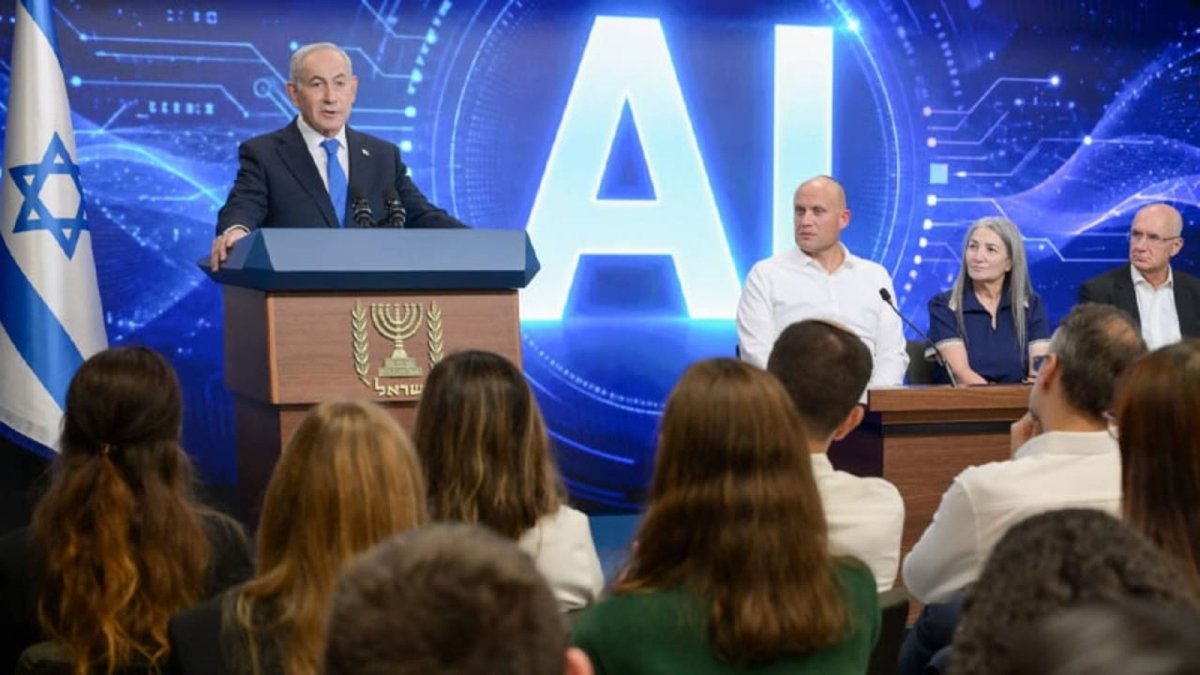
The National AI Directorate presented its long-awaited plan on Wednesday at a press conference in its new offices in a flashy Ramat Gan building, with head Brig. Gen. (res.) Erez Askal surrounded by staff recruited from the Ministry of Defense, the Prime Minister's Office, and the Accountant General's office in the Ministry of Finance. The presentation came after weeks of promotion by the Prime Minister's Office, with elections drawing nearer and Prime Minister Benjamin Netanyahu having held a ceremonial launch event earlier this month.
Behind the polished packaging, however, lies a cautious plan that pales in comparison with past promises. Instead of a national revolution to put Israel at the forefront of global technology, the new initiative involves mostly inconsequential measures and leaves the weightiest questions in the AI sector unanswered.
A modest plan with vague numbers
The plan's initiatives include 30 hours of AI lessons a year for 8th and 9th graders; bringing 100 scientists back to Israel, with only three having undertaken to return so far; publication of a document of intentions for founding a "physical AI city" containing a complex with a hospital, a school, and other public buildings; examination of robotics technologies; issuing a tender with an unknown budget for the construction of a quantum computer; and a statement of intentions for the purchase of up to 100,000 Nvidia processors within a few years at an undisclosed cost. The Directorate also plans to found a special institute with a budget in the tens of millions of shekels to coordinate ventures in cooperation with the private sector, to be headed by Orit Korman Negri, former planning department head in the IDF C41 Directorate. The items in this extremely modest plan are general, and it contains no itemized budget.The contrast with Nagel's masterplan
This stands in stark contrast to the grandiose plan presented last year by Brig. Gen. (res.) Prof. Jacob Nagel, whom Netanyahu asked to form a defense budget plan and later a strategic plan for the AI Directorate before Askal was appointed. Nagel's plan included an NIS 18 billion budget for the construction of a supercomputer equipped with 60,000 Nvidia microchips within two years for use by academic researchers and startup entrepreneurs; a NIS 2 billion AI plan for bringing brainpower back to Israel and developing AI researchers; NIS 1 billion for AI training programs for high schools and the IDF; the founding of an AI directorate; and the construction of a language model in Hebrew. Nagel's plan envisioned a NIS 25 billion budget spread over five years. The Directorate, which was to have been formed when the National Committee for Accelerating the Field of AI submitted its recommendations a year ago, was scheduled to begin investing billions of shekels in October 2025. Instead, it presented its new plans only now, at the outset of the election campaign.Key questions left unanswered
In practice, these plans virtually ignore the main questions on the agenda. Construction of a supercomputer is not seriously addressed, with no specific budget or location mentioned. Arguments are taking place in the Prime Minister's Office over whether it should be built in Israel or in a foreign country. The Directorate has yet to decide whether to establish an original Israeli language model. No solution has been offered to a problem that has caused an uproar in the AI sector: the temporary halt in connecting server farms to the electrical grid, which has frozen the planning and construction of dozens of prospective server farms. The Directorate's 2026 budget is NIS 3 billion, and its senior executives hope it will grow after the elections in line with the Nagel Commission's proposed NIS 5 billion budget, but there is no guarantee the Directorate will remain the same when the next government is formed.Fourth national AI plan in seven years
If this sequence of events sounds familiar, it is because this is the fourth time in the past seven years that Netanyahu's governments have presented a national AI plan, with no results to date. In 2018, Netanyahu asked Maj. Gen. (res.) Prof. Isaac Ben-Israel and Eviatar Matania to devise the first plan after the two men had proved themselves by composing a similar plan to further the cybersecurity sector. Their plan, which recommended a NIS 10 billion allocation for the sector, was ready to be put into effect in 2019, but it was not submitted until 2020 because of the multiple election campaigns that year and was discarded during the course of the political upheavals. The Israel Innovation Authority undertook to pursue the matter and assembled a voluntary association for the purpose, the National Research and Development Infrastructure Forum, known as the TELEM Forum. In late 2020, the Forum hired former Chief Scientist and Google Israel executive Orna Berry to formulate another plan. She recommended investing NIS 5 billion in the sector. In the end, only a few of her recommendations were adopted, and the budget for them was a mere NIS 1 billion.Failed initiatives and lost talent
One of those recommendations, development of a Hebrew language model, was shelved after millions of shekels had been invested when OpenAI launched ChatGPT in 2022. Another recommendation, the development of a supercomputer, was eventually accomplished under Innovation Authority sponsorship with a miniscule budget of only NIS 160 million and a quite small number of graphic processors, about 1,000 Blackwell processors, rendering it inadequate for the needs of industry and academic institutions. The capacity of the national supercomputer is estimated at 4,000 graphic processors leased from Nebius, far short of Nagel's target of 60,000 processors. Last year, the TELEM Forum, which had been responsible for most AI activity up until then, ran afoul of the prime minister and people in the office of the Accountant General in the Ministry of Finance. Together with then-Prime Minister's Office director general Yossi Shelley, they decided to found a National AI Directorate. Dovi Frances, another star of "The Sharks" program and an investor who like Dobronsky began his investment career with Oren Zeev, provided advice in starting the directorate, but he has had very little involvement over the past year. Prof. Nagel was then brought in to prepare a masterplan. Meanwhile, key people who were part of the Innovation Authority program, such as its scientific consultant Prof. Yoav Shoham, a leading AI lecturer at Stanford University and a cofounder of AI21, and Ziv Katzir, who headed the TELEM Forum, resigned their positions.Leadership questions and industry skepticism
Askal is a renowned officer who was awarded the Israel Defense Prize for satellite developments when he commanded Unit 9900 and was also responsible for tech upgrading of IDF systems. He is nevertheless regarded as inexperienced in the management of civilian concerns, has never worked in high-tech, and possesses no scientific degrees. "The mission entrusted to him is huge: to move the AI industry in Israel forward while simultaneously encourage all of the major systems, the Ministries of Education, Health, and Transport, to adopt AI. It is easy to become overwhelmed by this, so the Directorate is starting on a small scale with sporadic ventures," a senior industry source says. "What the Directorate presented this week is too little and too late; it is a drop in the ocean." The plan unveiled on Wednesday included no details of how the budget will be subdivided. The Directorate's leaders used vague expressions such as "dozens" and "hundreds" of millions of shekels for the ventures they presented.The supercomputer dispute and processor costs
The Directorate's largest expense item, the purchase of Nvidia processors for what is called "the Israeli supercomputer," is still a matter of dispute. While Prof. Nagel presented a request for 60,000 processors, the Directorate wants 100,000, compared with a mere 4,000 at present serving the sole civilian supercomputer in Israel maintained by the Innovation Authority. The Directorate and the Ministry of Finance are taking a realistic view: the purchase of 100,000 Vera Rubin processors from Nvidia at $135,000 per unit translates to an astronomical expense of $13.5 billion that is high even in terms of a multiyear plan. It is believed that sources in the office of the Accountant General in the Ministry of Finance and the Directorate are willing to settle for buying 3,000-6,000 more processors for government and academic needs, coupled with the encouragement of private parties such as Mega Or Group and Shonfeld Data Services, owned by Yossi Shonfeld, to purchase tens of thousands, or even 60,000, additional processors for the needs of industry. At this stage, the government is planning to establish Israel's supercomputer in a foreign country. This decision has been criticized as making a critical government resource dependent on a foreign country. Its supporters, on the other hand, explain that government data centers can be built much more quickly abroad than in Israel.Budget cuts and the electricity bottleneck
The Directorate has meanwhile experienced its first budget cut. It was due to receive a NIS 2.5 billion budget for the purchase of graphic processors, in addition to NIS 1.1 billion that was approved for the Council for Higher Education in Israel Planning and Budget Committee and then inserted into the Directorate's budget. The Ministry of Finance, however, notified the Directorate that instead of being raised to NIS 3.6 billion, its budget would be consolidated, meaning that its budget increase would be only NIS 1 billion. Even if the Directorate and the Ministry of Finance manage to bring tens of thousands of additional graphic processors to Israel, the data centers sector that is supposed to absorb them now faces a problem. The Public Utilities Authority (Electricity) has decided to stop granting approvals for connecting data centers during a four-month "reconsideration" period. The logjam created by the Authority has trumped all the cards and caused potential customers of data center developers to renegotiate their contracts. Several of these, including new players who wanted to enter the Israeli market, such as CoreWeave, have now decided against it. Existing players have also been affected, among them Mega Or, controlled by co-CEO Zahi Nahmias, whose share price has tumbled 22% in the past month. The AI Directorate explains that it is becoming involved in the process and is confident that Israel will be able to supply 2 gigawatts to meet most of the demand. It says it is acting in tandem with the Ministry of Finance and the Authority to formulate new criteria for granting electricity approvals based, for example, on financial proof of construction of large and expensive data centers and good relations with Nvidia that make it possible to obtain the newest processors in the industry. The industry, on the other hand, is critical of the reactive nature of this activity, which is not defined as a core mission for the AI Directorate.Quantum computing overlap and coordination failures
Another act by the Directorate that is being severely criticized in the industry is the publication of the tender for Israeli quantum computing, without any budget being presented. According to the plan's details, the aim is to build a computer that does not constitute a gamble on a specific quantum technology, such as trapped ions or superconductors. Instead, it will facilitate access on the cloud to quantum calculation capabilities for the benefit of national research and development. This has been criticized because the Innovation Authority has had a well-organized national quantum plan for years involving a NIS 1.1 billion investment in national quantum technology. The Innovation Authority itself issued a call for proposals for the construction of an Israeli quantum computer by 2029 with an initial budget of NIS 100 million for 2026 alone. Sources in the sector are expressing deep concern about the lack of coordination between the Directorate and the Innovation Authority, which is sowing confusion about overlapping authority among potential suppliers and partners. The sources assert that this is a typical case of the right hand being ignorant of what the left hand is doing. In addition to creating unnecessary duplication, it is also "embarrassing potential foreign partners," according to an anonymous senior quantum sector source. While the government stipulated with the support of the Ministry of Finance Budget Department that the Innovation Authority would take the lead in quantum computing policy, with the aim of renewing the national quantum plan budget with an additional NIS 1.25 billion for the next five years, the Directorate in the Prime Minister's Office is now acting on its own.Ministry of Finance ambivalence and the Israeli language model
The Ministry of Finance's attitude towards the Directorate is also ambivalent. The office of the Accountant General is taking an active part in guiding the Directorate's activity, including the purchase of processors, but the Budget Department finds the plan presented to the public unconvincing, believing that while it is laden with good intentions, it is also bombastic and contains unfounded declarations. The Budget Department is especially skeptical when it comes to the duplication in responsibility for microchip purchasing policy between the TELEM Forum, which represents the Directorate of Defense Research and Development; the Council for Higher Education in Israel Planning and Budget Committee; the Ministry of Science, Technology, and Space; and the Innovation Authority, and the new Directorate, which currently has a staff of 20 people. Senior public sector sources familiar with the Ministry of Finance say, "The result of the Budget Department's conservative policy, combined with the coalition political pressure, is that only a few enterprises are being approved and the few that are approved are being pursued fanatically for want of anything else to do. The result is a collection of eclectic plans that do not necessarily constitute a coherent strategy." There is no better example of the state of the national AI plan than the initiative to develop an internal Israeli language model, not necessarily in Hebrew. This enterprise, which dates back to Orna Berry's plan, was discarded after ChatGPT was launched in 2022. The new National AI Directorate has published a call for proposals for development of the model and is definitely discussing the need to develop an Israeli model that will not be dependent on Anthropic, OpenAI, and other foreign companies. The goal is to prevent dependence on these companies and prepare for the possibility of arbitrary decisions to deny Israeli institutions access to AI models under future political circumstances. Nonetheless, even today, following seven years of plans, the Directorate still does not know who will develop the model and whether it will be private Israeli or foreign companies. Israeli startups such as AI21, which have developed their own models, have encountered reverses, gone out of business, or been acquired. Decart, the latest Israeli hope, is on the road to a gigantic acquisition by Anthropic.Outlook: Can Israel still become an AI superpower?
The political timing of the plan's unveiling is hard to ignore. With elections approaching, Netanyahu has been promoting the Directorate aggressively, presenting Oren Dobronsky, the Likud candidate in the 11th spot on the party list, as the man responsible for AI in the next government. Dobronsky, a cofounder of browser toolbar company Hotbar which was acquired for $50 million in 2006, has become a household name through his appearances on "The Sharks," Israel's version of Shark Tank. Netanyahu's personal advisor and Aleph venture capital fund cofounder Michael Eisenberg has also been backing the declarations with posts on his social media management accounts. While the Israeli government continues to formulate national plans and make swaggering election campaign declarations, the local industry has had to go on searching for answers from the private sector and international companies, regardless of the Directorate's promises. The question of whether Israel can still become an AI superpower remains open, but the gap between rhetoric and substance grows wider with each successive plan. The private sector, meanwhile, continues to operate in a reality shaped by global players, electricity grid constraints, and the persistent lack of a coherent national strategy. This article was produced with AI-assisted research and editorial support. Sources: The Jerusalem Post. By Hannah Berg, Staff WriterWhat's Your Reaction?
 Like
0
Like
0
 Dislike
0
Dislike
0
 Love
0
Love
0
 Funny
0
Funny
0
 Wow
0
Wow
0
 Sad
0
Sad
0
 Angry
0
Angry
0

Israel Correspondent at Global1.News. Based in Tel Aviv, covering Israeli politics, security, technology, and society. Provides balanced, deeply-sourced reporting on one of the most closely-watched regions in the world.













Comments (0)