
Software squeezes more data out of Webb Telescope for imaging exoplanets
When the James Webb Space Telescope (Webb) started delivering data, we all thought the biggest bottleneck would be the hardware. Turns out the software stack is still the wild west, and a new package called FLIP is shaking up how we squeeze signal out of those pricey pixels.
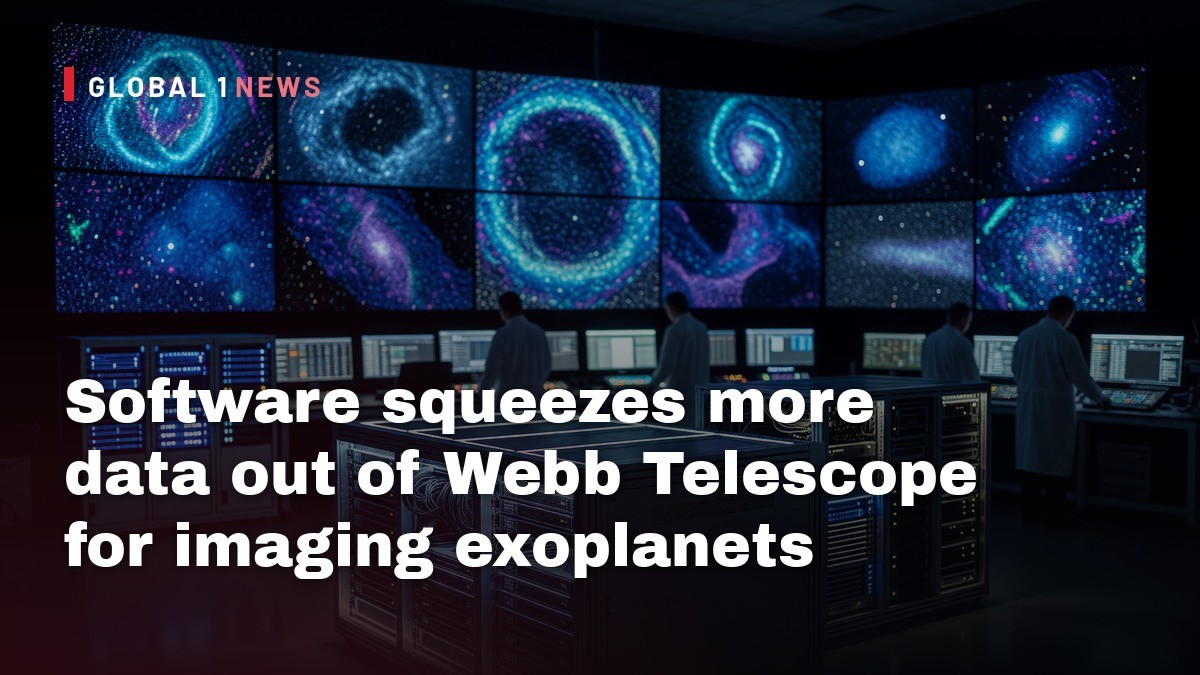
When the James Webb Space Telescope (Webb) started delivering data, we all thought the biggest bottleneck would be the hardware. Turns out the software stack is still the wild west, and a new package called FLIP is shaking up how we squeeze signal out of those pricey pixels. As a founder who’s been wrestling with noisy hardware for a decade, I’m watching this like a hawk. If you can boost signal‑to‑noise by a factor of two with a half‑hour GPU run, you better ask yourself why your own stack isn’t pulling similar tricks. The lesson? Don’t let “best practice” hype lock you into a static point spread function (PSF) model when the telescope itself is a moving target.
Why the PSF matters more than you think
The point spread function is the fingerprint of any optical system. In an ideal world, a star would appear as a perfect dot, but imperfections in mirrors, detectors and even minute pointing jitter spread that light into a blurry halo. Webb’s NIRCam is no exception – its PSF drifts with wavelength and with the subtle flexing of the telescope structure.
Historically, astronomers have tackled PSF estimation by imaging a known calibrator and fitting a mathematical description. That works until the hardware changes, which it does all the time. The article points out that “the behavior of the telescope hardware can change over time, and the point spread function may vary with the wavelengths being imaged.” In a production environment, that’s a red flag: you’re building a service on a moving baseline and hoping the model stays accurate. My own experience with legacy hosting platforms tells me that any static model will crumble under real‑world variance.
From static calibration to physics‑based learning
Enter FLIP – “Physics‑based Learning for Imaging Planets.” The team behind it took a physics model of NIRCam, loaded it with roughly ten‑to‑the‑six parameters, and let gradient descent do what it does best: tune billions of knobs in minutes. The article notes that the optimization “starts with a simulated point spread function, then uses gradient descent to optimize its performance on data from an actual star.” In plain English, they’re letting the data tell the model how the telescope behaved at that moment.
The kicker is the runtime: “Run on a current GPU, this process only takes a bit more than half an hour.” For a research team, that’s a win. For a hosting provider, it’s a reminder that modern GPUs can crunch massive parameter spaces fast enough to keep up with hardware drift. If you’re still relying on CPU‑only pipelines for log aggregation or traffic shaping, you’re leaving performance on the table.
Real‑world gains: 1.5‑2× SNR and a 15× boost for noisy targets
The proof is in the numbers. Using Webb data on two young stars with known exoplanets – HIP 65426 and 51 Eridani – the FLIP pipeline lifted the signal‑to‑noise ratio by “a factor of 1.5 to 2, depending on the observations.” That’s enough to turn a marginal detection into a solid one. More impressive, the method boosted sensitivity for a highly variable star, TYC 5899, by “a factor of 15.” That kind of jump can be the difference between a missed detection and a headline‑making discovery.
From a business‑risk perspective, those gains translate directly into cost savings. If you can extract more science per hour of telescope time, you reduce the need for repeat observations – a huge budget saver for any agency or private consortium. The same principle applies to any data‑intensive service: better models mean fewer compute cycles, lower cloud bills, and a tighter margin.
Why gradient descent is the secret sauce
Gradient descent is the workhorse of modern AI, and the article highlights that “people have put a lot of work into optimizing the performance of gradient descent on GPUs.” That investment pays off when you have a model with millions of parameters, as FLIP does. The optimization process iteratively nudges each parameter to reduce the error between the simulated PSF and the observed star image.
In the hosting world, we’ve seen a similar trend: using gradient‑based optimizers for traffic routing, cache eviction policies, and even power management in edge data centers. The lesson is clear – if you can frame a problem as a differentiable loss function, you can let the GPU do the heavy lifting. The hype around “AI‑only” solutions often obscures the fact that the underlying math is the same, whether you’re training a language model or fine‑tuning a telescope’s PSF.
Beyond exoplanets: broader applications of low‑noise imaging
The researchers themselves note that “the applications go beyond getting a better view of known planets.” By lowering noise, FLIP could reveal dimmer, older, or lower‑mass exoplanets that have so far evaded detection. That’s a classic example of a tool built for one niche unlocking value in adjacent markets.
For independent hosting providers, the parallel is obvious. A tool that reduces noise in one data stream often improves signal extraction across the board – think anomaly detection in logs, fraud spotting in transaction streams, or even quality‑of‑service monitoring in video delivery. If you can adapt a physics‑based learning framework to your own telemetry, you might uncover patterns that static thresholds simply miss.
Practical steps for founders: adopt the mindset, not the exact code
First, audit your pipelines for static models that assume hardware or network conditions are fixed. If you’re still using a single PSF‑like calibration for a load balancer, you’re overdue for a dynamic alternative. Second, evaluate whether you have GPU resources that sit idle – many edge sites have spare capacity that can be repurposed for gradient‑based optimization tasks.
Third, prototype a “FLIP‑lite” on a small data set. Use a physical model of your system (e.g., a queueing model for request latency) and let gradient descent adjust parameters in real time. The article shows that a half‑hour run on a modern GPU yields measurable gains; you can achieve a useful iteration in minutes on a modest accelerator.
Bottom line: software can out‑perform hardware, if you let it
The Webb story is a reminder that the most expensive hardware in the world can be made more productive with clever software. The FLIP package demonstrates that a physics‑based model, paired with modern GPU‑accelerated gradient descent, can squeeze out a 1.5‑2× SNR boost and a 15× sensitivity lift for noisy targets. For founders running real‑world hosting infrastructure, the take‑away is simple: stop treating your hardware as a black box and start modeling it dynamically. The payoff is lower operational costs, higher service quality, and a competitive edge against hyperscalers who rely on generic, one‑size‑fits‑all tooling.
In short, if you’re not already using physics‑informed learning to tune your own stack, you’re leaving money on the table and risking service degradation as your hardware ages. Get the right talent, allocate some GPU budget, and start iterating. The universe is full of noise – it’s up to us to filter it out.
— Allan Ali, Founder
This article was produced with AI-assisted research and editorial support. Reporting is based on the source material cited below. Sources: Ars Technica; arstechnica.com; Global1.News (06 November 2026).
By Allan Ali, Global1.News
What's Your Reaction?
 Like
0
 Dislike
0
 Love
0
 Funny
0
 Wow
0
 Sad
0
 Angry
0

Publisher of Global1.News. Automation architect, systems builder, and the guy making sure the truth gets published.












Comments (0)