
Physicl raises $10M to make the digital world real enough for robots
Physicl’s fresh $10 million seed round may look like another hype‑driven AI cash‑in, but from a founder’s chair it reads more like a reality check for anyone trying to stitch together synthetic data pipelines for robots.
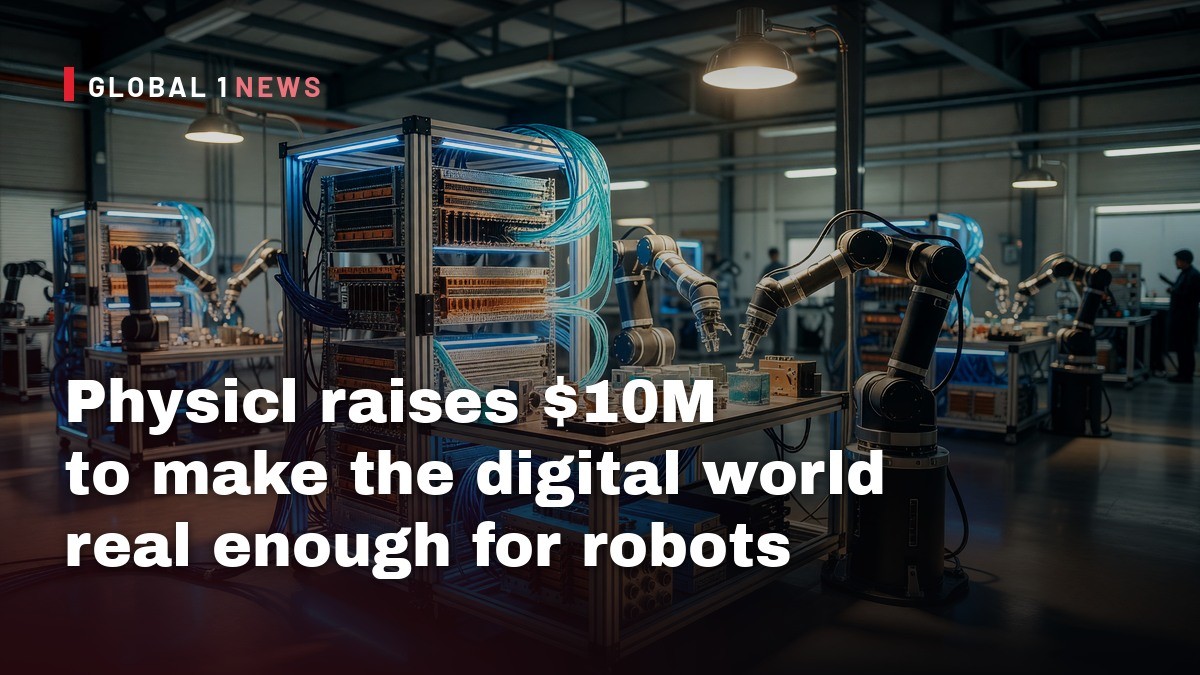
Physicl’s fresh $10 million seed round may look like another hype‑driven AI cash‑in, but from a founder’s chair it reads more like a reality check for anyone trying to stitch together synthetic data pipelines for robots. Alex de Vigan, the guy who spent a decade building the e‑commerce 3‑D platform nfinite, is now pitching his old tech as the antidote to the “sim‑to‑real” gap that’s been choking robot training labs worldwide. The question isn’t just whether his Studio product can churn out 10,000 environments and 100,000 assets – it’s whether that data can survive the brutal churn of production robotics without blowing a hole in an independent provider’s balance sheet.
From E‑Commerce 3‑D to Robot‑Ready Worlds
De Vigan’s résumé reads like a case study in pivoting. He built nfinite to let brands spin up 3‑D product renders for online catalogs, then watched transformer‑based AI eat that market and force a shift toward generative imagery. The core of that platform – a pipeline that turns “unstructured, incomplete, heterogeneous real‑world information into a high‑fidelity physical representation” – is now being rebranded as a robot‑training engine. The claim is simple: if you can render a shoe in a browser with correct geometry, materials and physics, you can render a kitchen counter with a cup in it for a robot to learn from.
What matters for us in the hosting world is the underlying architecture. The original nfinite stack was built to serve millions of product pages, so it already handles massive concurrent rendering workloads. That kind of scale is exactly what a synthetic data service needs when you start feeding “trillions of images” or “millions of hours of LIDAR” into the system. The real test, however, is whether the physics fidelity holds up when you move from visual fidelity to force‑feedback fidelity – the kind of detail that makes a robot actually pick up a cup without dropping it.
The Real Cost of “Better” Simulations
Robotics labs have been whining about the expense of gathering real‑world data for years. Remote operation rigs, high‑end motion capture, and the sheer manpower to label video frames add up fast. Physicl’s pitch is that synthetic data can replace a chunk of that spend. The $10 million seed round, led by Inovia Capital, is a clear signal that investors think the economics could work – but the math is still fuzzy.
From a hosting perspective, the hidden cost is the compute horsepower needed to generate physics‑accurate scenes at scale. Running a physics engine that can simulate material properties, friction, and contact forces across 10,000 environments is not cheap. If you’re a small provider, you’ll be looking at GPU clusters that can easily outstrip the budget of a typical VC‑backed startup. The reality is that many “best practice” pipelines that promise “on‑the‑fly” data generation end up with a bottleneck in the rendering farm, forcing you to over‑provision hardware and eat up margins.
Edge Cases: The Real Test of Synthetic Data
Physicl’s Studio product is positioned as a tool for “post‑training models on difficult edge cases.” The idea is to let users spin up a scene – say a cluttered countertop with a cup in shadow – and generate synthetic frames to fill the gaps in a robot’s perception model. In theory, that’s a neat way to avoid the endless loop of manual data collection.
In practice, edge cases are where most synthetic pipelines break. A robot that can recognize a cup in a clean scene will still stumble when the cup is partially occluded, reflected off a glossy surface, or sitting on a textured fabric. The fidelity of the physics and lighting models must be high enough to capture those subtleties, otherwise the model learns a false reality and fails in the field. Independent hosting providers must therefore ask: can we guarantee that the synthetic data we serve meets the precision required for these edge scenarios, or will customers end up discarding it after a costly pilot?
Collaboration or Competition? The Startup Landscape
The article notes that Physicl is entering a “crowded category” of data‑and‑tooling startups serving foundation model builders and robot operators. One early customer, SpAItial, uses Physicl’s high‑fidelity assets to improve its own world‑model builder, Echo‑3. That partnership is a good proof point – it shows that at least one peer in the space finds the data valuable enough to integrate.
But the broader market is saturated with companies that collect, label, or generate data in various modalities. Many of these are VC‑backed and promise “secret sauce” solutions that crumble when you push them into production. For a hosting provider, the risk is double‑fold: you could become a data pipeline for a startup that fails, or you could be forced to support multiple competing APIs, each with its own SLA and compliance demands. The smarter play is to lock in flexible, standards‑based ingestion points and keep the infrastructure agnostic, so you can pivot if a partner’s product fizzles.
Automation Claims vs. Manual Curation
Matthias Niessner, CEO of SpAItial and professor at the Technical University of Munich, is quoted saying the real challenge is the “very long cycle” of manual data curation. He envisions a future where an AI agent like Claude can request new synthetic data on the fly, based on training state. Physicl’s vision aligns with that – an “agentic workflow” that auto‑generates data as needed.
That sounds great until you remember that every auto‑generation loop still needs a human‑validated feedback channel. If the generated data is off‑by‑a‑millimeter in friction coefficients, the robot will learn the wrong grip strength and fail in the field. The automation promise is therefore a double‑edged sword: it can accelerate iteration, but it also amplifies the impact of any underlying model bias. Hosting providers should therefore embed robust validation pipelines – think automated physics checks, visual diff tools, and statistical sanity tests – before serving the data downstream.
Business‑Risk Lens: What Independent Providers Should Do Now
So where does that leave a small to midsize hosting outfit watching this space? First, treat synthetic data services as a high‑margin add‑on, not a core revenue stream. The capital outlay for GPU‑heavy rendering farms is significant, and the market is still figuring out pricing models. Second, negotiate clear SLAs with any data partner – you need guarantees on data fidelity, update cadence, and support for edge‑case generation. Third, build a modular ingestion layer that can swap out one data provider for another without a full re‑architect of your stack.
Finally, keep an eye on the “on‑the‑fly” automation narrative. If you can integrate a feedback loop where a model flags a gap and your platform auto‑spins a synthetic batch, you’ll differentiate yourself. But only do it after you’ve hardened the validation stage; otherwise you’ll be feeding your customers junk that breaks their robots and burns your reputation.
Bottom Line: Synthetic Data Is a Tool, Not a Silver Bullet
Physicl’s $10 million seed round and its Studio offering are exciting signals that the industry is finally taking the sim‑to‑real problem seriously. The fact that they can ship 10,000 environments and 100,000 assets out of the gate is impressive, but the real test will be in the trenches – where robots have to pick up a cup on a cluttered, shadowed counter without blowing a fuse.
For independent hosting providers, the takeaway is clear: the synthetic data market is promising, but it’s also a minefield of hidden compute costs, validation headaches, and partner risk. Approach it with a pragmatic, risk‑aware mindset: start small, validate rigorously, and keep your infrastructure flexible enough to pivot as the technology matures. If you can do that, you’ll be in a position to ride the wave without getting swept under it.
— Allan Ali, Founder
This article was produced with AI-assisted research and editorial support. Reporting is based on the source material cited below. Sources: TechCrunch; techcrunch.com; Global1.News (06 November 2026).
By Allan Ali, Global1.News
What's Your Reaction?
 Like
0
 Dislike
0
 Love
0
 Funny
0
 Wow
0
 Sad
0
 Angry
0

Publisher of Global1.News. Automation architect, systems builder, and the guy making sure the truth gets published.












Comments (0)