
Mystery Drones Over Diego Garcia as Island Becomes US Navy Lifeline
Mystery drones over Diego Garcia put the remote US-UK base in the spotlight as the US Navy's wartime logistics lifeline after Iran's attack on Bahrain. Officials stay tight-lipped as analysts warn of sea-launched drone threats amid the US-Iran war.
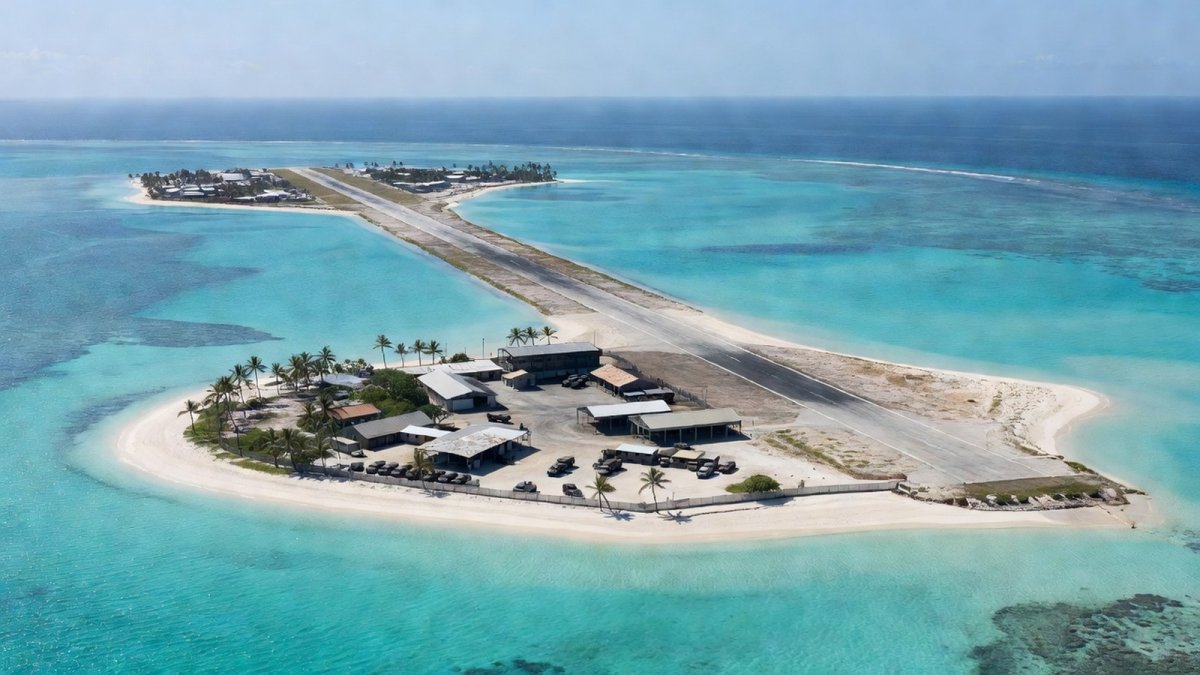
Folks, something is buzzing over one of the most remote — and now most critical — military outposts on Earth. For the past week, unidentified drones have been spotted over Diego Garcia, the joint US-UK base in the middle of the Indian Ocean, and officials are staying tight-lipped. This comes as the Pentagon has quietly turned this tiny atoll into the Navy's main logistics hub after Iran knocked out a key base in Bahrain — and that makes this place a target.
Mystery Drones Over Diego Garcia as Remote Base Becomes US Navy's Wartime Lifeline
Washington, D.C. — August 17, 2026 — The Indian Ocean is suddenly the center of the world's attention. Between August 10 and 14, unidentified drones — officially called UAS, or unmanned aerial systems — were reported flying over Diego Garcia, the joint US-UK military base roughly 1,600 kilometers south of India. US and UK officials have acknowledged the sightings but are refusing to say anything else. The UK Ministry of Defence issued a statement that reads like a masterclass in saying nothing: "We are aware of reported sightings of drones (UAS) over Diego Garcia" and "We are unable to provide any details about a situation which may affect the security or operation of the joint U.K.-U.S. base on Diego Garcia."
That's it. No confirmation of origin, no threat level, no details on what was done about them. But here's the thing, folks: this isn't a random flyover. We are in the middle of a hot war with Iran — and analysts warn these could be sea-launched drones probing a base that Iran has already targeted with ballistic missiles during what has been called Operation "Epic Fury."
What's Happening Over Diego Garcia
Let's break down what we actually know. The sightings were first reported by Stars and Stripes on August 12, then picked up by outlets like Firstpost and The War Zone by August 14. The drones are of "unknown origin," which is military-speak for "we don't know whose they are, or we're not telling you." Officials acknowledged the reports but declined to discuss security measures — that tells me this is being taken seriously.
Here's the context: we are in the middle of a hot war with Iran. The War Zone's analysis points out that these sightings highlight concerns about attacks from the sea — specifically, sea-launched drones, a tactic Iran has been developing throughout this conflict. And Diego Garcia isn't some random island; it's a heavily fortified installation supporting long-range bombers, naval operations, space activities, and surveillance missions.
Why This Remote Atoll Matters
Let me give you a geography lesson. Diego Garcia is the largest atoll of the Chagos Archipelago in the Indian Ocean — a joint US-UK installation under British command, part of the British Indian Ocean Territory. It's about 2,200 miles from the Gulf of Oman, roughly 1,600 kilometers south of India. Remote, isolated, and absolutely vital.
Why? Because it's a staging ground for B-52 bomber runs, naval resupply, and surveillance missions — a runway long enough for the biggest aircraft in the US inventory, deep-water anchorage for carriers and submarines, and far enough from the combat zone to have been a safe haven for logistics. The war has changed that calculus.
The New York Times reported on August 14 that early in the war, Iranian drone and missile attacks heavily damaged the Navy's main logistics hub in Bahrain. When it became unusable, the Pentagon moved the entire operation thousands of miles away — designating Diego Garcia as the replacement shipment point. That's a massive shift, and it puts a giant target on this island.
From Bahrain to Diego Garcia: A Logistics Gamble
Let's talk about what this logistics shift actually means. Bahrain was the hub — close to the action, close to the Strait of Hormuz, close to everything the Navy needed to keep ships fueled, armed, and supplied. When Iran hit it hard, the Navy had to find a new home base for its supply chain — and chose Diego Garcia.
That's a huge deal: moving the entire supply operation that used to run out of Bahrain to an island more than 2,000 miles from the Gulf of Oman. Every ship, every plane, every piece of equipment that needs resupply now has to travel thousands of miles further — longer transit times, more vulnerability to attack, and a massive strain on the crews doing the work.
This wasn't a choice; it was a necessity. And it's a gamble — instead of a rear-area support base, Diego Garcia is now the lifeline. If it goes down, the Navy's ability to sustain operations in the region goes with it.
The Carrier at the End of the Line
Here's where this gets personal. The aircraft carrier USS Abraham Lincoln has been at sea for nearly nine months without a liberty port — nine months, that's not a typo. According to The New York Times, the carrier is facing reported supply shortages and crew strain because of the logistics disruption. The sailors are stretched thin, and they can't pull into port because the one that would have serviced them — Bahrain — is damaged and unusable.
So they rely on Diego Garcia. Supply ships have to travel from the atoll to the carrier, wherever it is in the Arabian Sea or the Gulf of Oman — a long, exposed supply line, especially with Iranian drones and missiles in the area. The crew of the Lincoln is paying the price for this logistics shift. But make no mistake: this is a crisis within a crisis.
US military officials, speaking anonymously to The New York Times, confirmed the shift. The Lincoln is just the most visible example of the strain. Every ship in the region is feeling it — sailors working longer hours, stretching supplies further, hoping the next resupply convoy makes it through.
Iran Has Already Tested This Base
Wondering whether Iran knows about Diego Garcia's new role? Stop. They've already acted on it. On March 20, 2026, Iran fired two medium-range ballistic missiles at the island. According to reports, one missile fell into the Indian Ocean short of its target; a US Navy warship shot down the other. That's not a random act of aggression; that's a deliberate strike on a specific target.
Analysts say the use of Diego Garcia as the new logistics hub may explain why Iran struck the island. They knew Bahrain was out of commission and the Navy had to move its supply operation somewhere — so they took a shot at the replacement. The fact that the missiles were intercepted or fell short doesn't change the message: Iran is willing to go after this base, and they're going to keep trying.
Now, with the drone sightings this week, is Iran probing for weaknesses? Sea-launched drones are a known Iranian tactic — they've used them against tankers and naval vessels throughout this conflict. If they can figure out how to get drones over Diego Garcia, they can figure out how to hit it with something bigger. The drones might be reconnaissance, a test of air defenses, or the precursor to something worse. We don't know. But the fact that officials are staying silent tells me they're taking it seriously.
The War That Won't Quit
Let's step back for the bigger picture, because this doesn't happen in a vacuum. The United States and Israel have been at war with Iran and its regional allies since February 28, 2026, when US-Israeli airstrikes killed several Iranian officials, including Supreme Leader Ali Khamenei. Yes, you read that right — the Supreme Leader is dead, and the war has continued through the summer. As of August 16, we're on Day 170 of this conflict.
There was a ceasefire window, but it didn't hold. On June 2, Iran's Islamic Revolutionary Guard Corps fired ballistic missiles at US bases in Kuwait and Bahrain — described as the first salvo in the post-ceasefire window. In mid-August, the US was weighing an indefinite naval blockade in the Strait of Hormuz, where a third tanker affiliated with the Abu Dhabi National Oil Company was attacked in just 48 hours. This war is not winding down. It's escalating.
Diego Garcia is now squarely in the middle of that escalation — no longer just a support base, but a strategic asset both sides know is critical. The drones over the island are a reminder that no base is safe, no matter how remote. And the Chagossian angle adds another layer of complexity. According to Fox News on August 16, a lawyer serving as attorney general for the self-described Chagossian government-in-exile said the Iran war proves Diego Garcia's strategic value. The Chagossian people were displaced in the 1960s and 70s when the US built the base, and the sovereignty of the islands has been disputed for decades, with the UK agreeing to hand the Chagos Islands to Mauritius under international pressure. Now, in the middle of a war, that question is more urgent than ever.
What to Watch
So where does this leave us? Here's what I'm watching. First, any official statement from the Pentagon or the UK Ministry of Defence about the drone sightings. The silence is deafening, and it won't last forever. Someone will have to explain what those drones were doing and whether they're still in the area.
Second, the USS Abraham Lincoln. If the Navy can't get that carrier resupplied, we'll see more reports of shortages and crew strain — and that's not just a logistics problem, it's a combat readiness problem. A tired, undersupplied carrier is a vulnerable carrier.
Third, movement in the Strait of Hormuz. The US is weighing an indefinite naval blockade while Iran attacks tankers. If it goes into effect, the entire region lights up — and Diego Garcia will be the supply line that makes it possible, or the weak point that breaks it.
Finally, watch the Chagos Islands sovereignty story. The UK's agreement to hand the islands to Mauritius is still on the table, but the war is complicating everything. If Diego Garcia is this critical to US operations, the Pentagon won't give it up without a fight — a diplomatic crisis waiting to collide with the military one.
Folks, this is a story about a tiny island in the middle of nowhere that has become the linchpin of a global war. The drones over Diego Garcia are a warning shot. The question is whether we're paying attention. Keep your eyes on the Indian Ocean — that's where this war is going to be won or lost.
This article was produced with AI-assisted research and editorial support. Sources: The New York Times, Stars and Stripes, Fox News, Al Jazeera, GlobalSecurity.org, The War Zone.
By Jessica Ali, Staff Writer
What's Your Reaction?
 Like
0
Like
0
 Dislike
0
Dislike
0
 Love
0
Love
0
 Funny
0
Funny
0
 Wow
0
Wow
0
 Sad
0
Sad
0
 Angry
0
Angry
0

Editor-in-Chief at Global1.News. Atlanta-based journalist who cuts through the BS and tells it like it is. Lead anchor, host, and the voice you hear when the spin stops and the truth starts.














Comments (0)