
West Bengal Adopts Ayushman Bharat: 6 Crore Covered
West Bengal CM Suvendu Adhikari launches Ayushman Bharat PM-JAY alongside the Mukhyamantri Swasthya Bima Yojana on August 16, 2026, covering 1.5 crore families with Rs 5 lakh cashless cover and access to 38,600 hospitals nationwide, ending the state's 15-year gap from the national scheme.
West Bengal finally closed the last major gap in India's national health coverage map on Sunday, August 16, 2026, when Chief Minister Suvendu Adhikari launched the Ayushman Bharat Pradhan Mantri Jan Arogya Yojana (AB PM-JAY) alongside a new state-specific scheme at the Netaji Subhas Chandra Bose Indoor Stadium in Kolkata. The dual launch, observed as 'Ayushman Diwas', brings approximately 1.5 crore families — nearly 6 crore people — under the Centre's flagship insurance umbrella, ending a 15-year political standoff that had left the state as the sole holdout against the national programme.
West Bengal's Ayushman Bharat Rollout: A Dual-Scheme Model That Covers 6 Crore People and 1,867 Hospitals
Kolkata, West Bengal – August 17, 2026 — The numbers behind Sunday's launch are staggering by any measure. Around 1.5 crore families in West Bengal are now eligible for cashless health coverage of up to Rs 5 lakh per year under AB PM-JAY, with an additional 80 lakh families covered under the parallel Mukhyamantri Swasthya Bima Yojana for residents who fall outside the Centre's eligibility criteria. Health Minister Sharadwat Mukherjee, who announced the rollout on Friday, August 14, framed the move as a "new chapter" for the state, while alleging that Bengalis had been deprived of central welfare schemes for 15 years under the previous administration. The combined network spans 1,240 private hospitals and 627 government medical facilities — roughly 1,867 institutions — with access to around 38,600 empanelled hospitals nationwide.

The Funding Architecture: Rs 1,000 Crore Central Outlay and a 60:40 Split
The financial mechanics of this rollout carry significant implications for West Bengal's state exchequer and its taxpayers. The Centre has allocated approximately Rs 1,000 crore for implementation in the state, covering 60 per cent of the total cost, with the remaining 40 per cent borne by the state government. This 60:40 ratio mirrors the standard funding pattern for AB PM-JAY in other states, but for West Bengal it represents a fresh fiscal commitment at a time when the state's health budget is already stretched. The state's contribution — approximately Rs 667 crore, reflecting the 40 per cent state share of the total programme cost — will now flow into a system that also supports the new Mukhyamantri Swasthya Bima Yojana.
For Indian taxpayers, this dual-scheme model raises a critical question: why maintain two parallel insurance architectures when one national scheme already exists? The answer lies in eligibility. PM-JAY targets families identified through the Socio-Economic Caste Census (SECC) 2011 database, which excludes many urban poor and lower-middle-class households in West Bengal. The Mukhyamantri Swasthya Bima Yojana fills that gap, ensuring that residents who do not meet the Centre's criteria still receive identical Rs 5 lakh coverage. This layered approach, while administratively complex, ensures near-universal coverage — a model that other states with large informal workforces may need to study closely.
Hospital Access: From 1,700 Procedures to 1,950 Treatment Packages
The clinical scope of the new schemes represents a substantial upgrade over the state's earlier Swasthya Sathi programme. Beneficiaries now have access to around 1,950 treatment packages, up from more than 1,700 procedures under the previous scheme. This expansion includes high-cost interventions such as knee replacement surgery. The inclusion of these packages means that a patient in a district hospital in Cooch Behar can now access the same treatment protocols as a patient at AIIMS Delhi, with the cost covered cashlessly.
Critically, the portability of coverage has changed the healthcare geography for Bengali patients. "Earlier, the state government's scheme was limited to West Bengal. Now, you will get the benefits across India," Adhikari said at the launch. This is a transformative shift for the lakhs of Bengali migrant workers employed in Delhi, Mumbai, Bengaluru and other cities: a worker hospitalised away from home can now walk into any of the 38,600 empanelled hospitals nationwide and receive treatment without upfront payment. The first patient registration under the new system was completed at Medicare General Hospital in Bankura's Kotulpur.
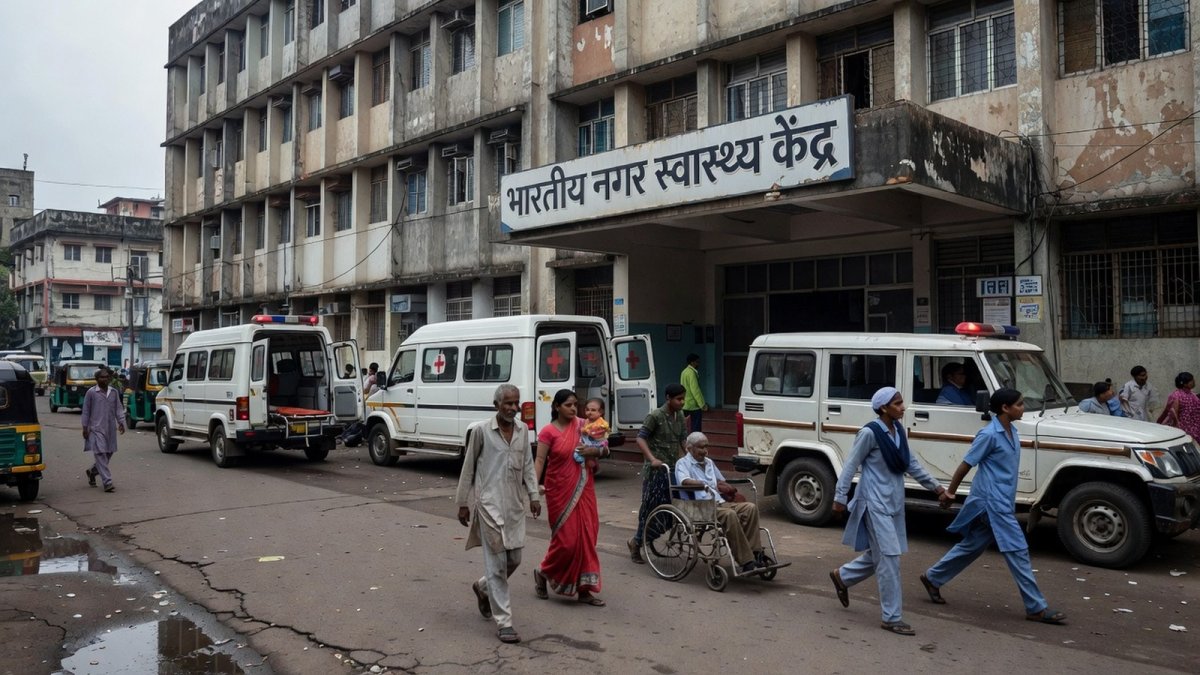
Transition Logistics: Swasthya Sathi's 60-Day Phase-Out and Fortnightly Audits
The operational transition from the TMC-era Swasthya Sathi scheme to the new dual model has been carefully choreographed to avoid disruption. The existing scheme will run alongside the two new programmes for 2-3 months, then be gradually withdrawn after a 60-day review confirming that services work without problems. This staggered approach is designed to prevent a coverage gap — a real risk when switching insurance platforms mid-year. A nodal team from the state Health Department will hold review meetings every fortnight to monitor implementation, with a specific mandate to prevent unreasonable billing and excessive package charges at private hospitals.
This oversight mechanism is not merely bureaucratic caution; it responds to documented patterns of overbilling under AB PM-JAY in other states. The National Health Authority (NHA) has repeatedly flagged cases of hospitals inflating package rates or performing unnecessary procedures to claim higher reimbursements. West Bengal's fortnightly review structure, combined with agreements with private hospitals finalised for the next 90 days, creates a short-term accountability window. Health Minister Mukherjee's warning to hospitals was unambiguous: "No one can be turned away on the grounds that there are no beds. Let someone try turning a patient away!" The 90-day agreement period allows the state to renegotiate terms based on actual performance data, a pragmatic approach given the concerns raised by some private institutions.
Private Hospital Dynamics: Reimbursement Rates and the Ramakrishna Mission Factor
Not all private hospitals greeted the rollout with unqualified enthusiasm. Several institutions, including those run by the Ramakrishna Mission, raised concerns over reimbursement rates — specifically, the Category B rates offered under PM-JAY, which are lower than the rates paid in Mumbai, Chennai, and CMC Vellore. These concerns are not trivial: for a private hospital in Kolkata or Howrah, lower package rates directly affect the viability of admitting PM-JAY patients. Adhikari assured the hospitals that the government would look into their concerns, but the underlying tension remains unresolved.
This dynamic has broader implications for India's mixed healthcare economy. West Bengal's private hospital sector, which includes both large corporate groups and charitable institutions like the Ramakrishna Mission, operates on thin margins in semi-urban areas. If reimbursement rates are perceived as inadequate, hospitals may limit the number of PM-JAY beds they allocate, recreating the access problems the scheme was designed to solve. The state's decision to include 1,240 private hospitals in the network — up from earlier announcements citing 1,303 — suggests some institutions may have opted out during negotiations. The 90-day review window will be crucial in determining whether the final network remains viable.
Political Context: Ending a 15-Year Standoff and the 'Ayushman Diwas' Symbolism
The political significance of Sunday's launch cannot be overstated. PM-JAY was launched nationally in 2018 by the Narendra Modi government, but West Bengal under the Trinamool Congress (TMC) had long declined to adopt it, citing opposition to the Centre's policies. This refusal left the state's poorest citizens without access to the national scheme, even as neighbouring states like Odisha, Bihar, and Jharkhand enrolled their populations. Health Minister Mukherjee's allegation that Bengalis were "deprived" of central welfare schemes for 15 years directly references this period of non-participation.
With the BJP now in power in the state, the dual-scheme model ends this gap. The presence of Minister of State for Health Anupriya Patel at the ceremony, along with the distribution of health cards at the event, underscores the political capital both the Centre and the state government are investing in this rollout. Around 3.4 crore people in the state were already in the Ayushman Bharat database and could avail services from August 16 itself, meaning the scheme's infrastructure was pre-positioned for immediate activation. The launch also included access to 100 'Amrit' pharmacies and around 480 Pradhan Mantri Jan Aushadhi centres at government hospitals, plus a new eye care programme — a comprehensive package that goes beyond hospitalisation coverage.
Patient Experience: Aadhaar, Card Issuance, and the No-Denial Guarantee
For the average beneficiary in districts like Bankura, Nadia, or South 24 Parganas, the practical details matter as much as the policy architecture. No money will be charged for issuing Ayushman Bharat cards, and beneficiaries are advised to carry Aadhaar for verification. Those without cards can be enrolled at the hospital itself, a provision that addresses the reality that many elderly and rural residents lack formal documentation. This on-the-spot enrolment mechanism, already tested in other states, reduces the risk of exclusion for the most vulnerable populations.
The schemes cover around 1,950 treatment packages nationally, with the national AB-PMJAY expanded in 2024 to cover all citizens aged 70 and above. For West Bengal's ageing population — the state has one of India's highest proportions of senior citizens — this expansion is particularly relevant. The inclusion of knee replacement surgery in the package list means that a common age-related condition among the state's senior citizens is now treatable without catastrophic out-of-pocket expenditure. The state's nodal team will monitor whether private hospitals honour the no-denial guarantee, particularly during the 90-day pilot period when patient volumes are expected to surge.
The Bottom Line
West Bengal's entry into AB PM-JAY on August 16, 2026, completes the national mosaic of health coverage that began in 2018. With 6 crore people now covered under the central scheme and an additional 80 lakh families under the state's parallel programme, the dual-scheme model offers a template for states with large informal workforces that fall outside SECC criteria. The Rs 1,000 crore central allocation, the 60:40 funding split, and the fortnightly audit mechanism provide a robust framework, but the real test lies in the 90-day review period. If private hospitals honour the no-denial guarantee and the state's nodal team effectively curbs overbilling, West Bengal could emerge as a model for universal health coverage in India. For the patient in Kotulpur or Cooch Behar, the promise is simple: a Rs 5 lakh safety net, valid across 38,600 hospitals nationwide, with no upfront payment and no one turned away. The infrastructure is now in place; the next 90 days will determine whether the promise holds.
This article was prepared with the assistance of AI tools for research and drafting.
— By Dr. Raj Patel, Staff Writer
This article was produced with AI-assisted research and editorial support. Reporting is based on sources cited in the article.
What's Your Reaction?
 Like
0
Like
0
 Dislike
0
Dislike
0
 Love
0
Love
0
 Funny
0
Funny
0
 Wow
0
Wow
0
 Sad
0
Sad
0
 Angry
0
Angry
0

India/South Asia Correspondent at Global1.News. Analytical voice with a background in science and health journalism. Based in New Delhi, covering Indian politics, education, healthcare, technology, and policy. Breaks down complex data into clear, actionable reporting.













Comments (0)