
Wall Street Wipes Out $2.5 Trillion in a Day as Voters Put the AI Boom on Notice
A $2.5 trillion wipeout on the Nasdaq 100, the worst day for chip stocks in six and a half years and a trading halt in Seoul: investors repriced the AI buildout after voters moved against data centres.
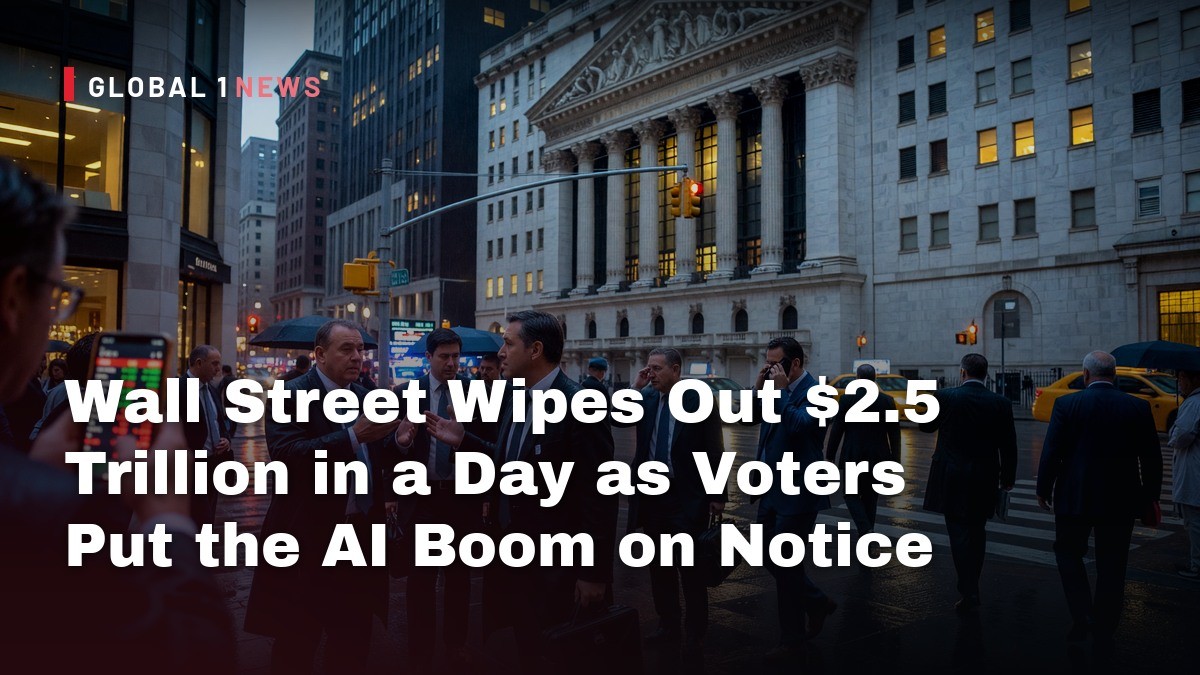
Folks, the ink was barely dry on the blue wave when Wall Street decided it had heard enough. One day after the Dow celebrated the midterms with its best post-election session in 44 years, investors did an about-face so violent it erased that entire rally and kept going — some $2.5 trillion in market value gone from the Nasdaq 100 in a single Thursday, with the selling rolling straight into Asia before sunrise.
Wall Street Wipes Out $2.5 Trillion in a Day as Voters Put the AI Boom on Notice
New York, United States — The panic was not about a recession, a war or a bank failure. It was about permits.
Wednesday's Triumph, Thursday's Reversal
Start with the whiplash, because the whiplash is the story. On Wednesday the Dow Jones Industrial Average soared 1,569 points, or 3%, its best performance after a midterm election in 44 years, while the S&P 500 rose 1.6% to 7,688.62 and oil dropped more than 8%. Investors seemed to hope, as Fortune put it, that divided government would mean steadier policy.
By Thursday's close the Dow had given back 1,833 points, about 3.4%, and every one of those gains was gone. The S&P 500 fell roughly 4.4% and the Nasdaq Composite 5.52%, its worst single day since April 2025, when President Donald Trump unveiled sweeping global tariffs. All three major indexes posted their steepest one-day declines since that April 2025 shock, according to CNBC.
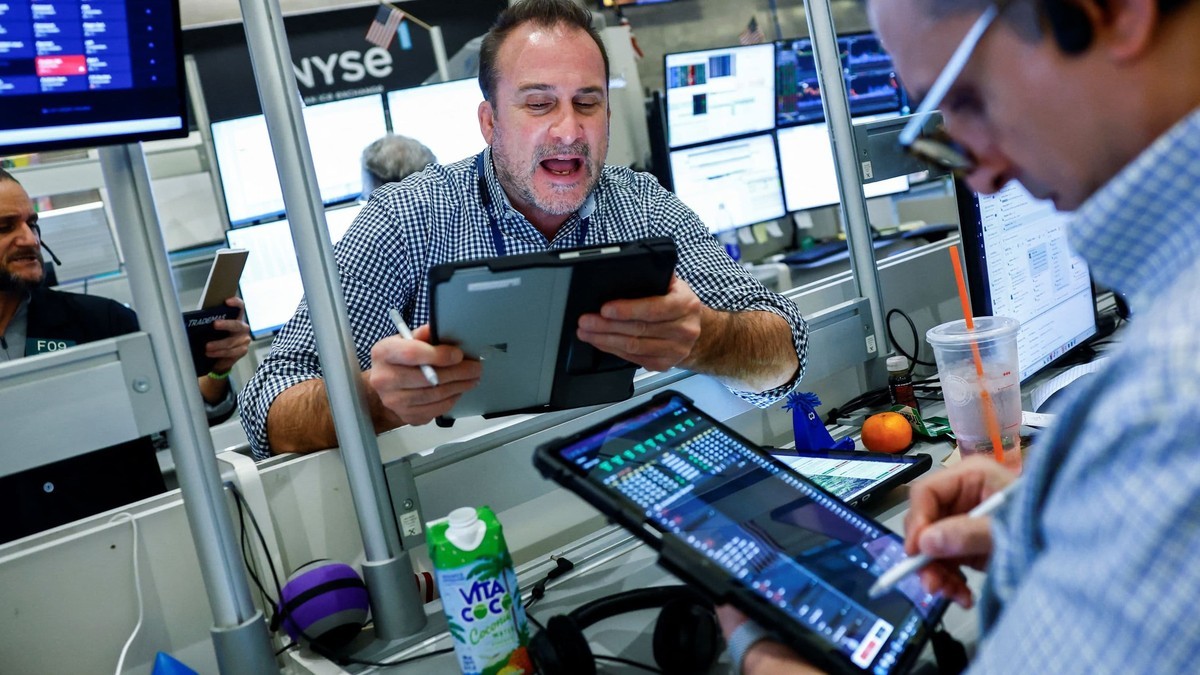
The tell came from CNN's own read of Wednesday's tape: while the headline indexes rose, shares of semiconductor chipmakers and companies involved in the AI data center buildout were already falling. Thursday simply made the whole market read the same page.
The Number Depends on What You Are Counting
The size of the damage depends on the tape you read, and it is worth being precise about it. The Nasdaq 100 shed $2.5 trillion in market value, on Reuters' count. Fortune put the broader figure at roughly $3 trillion across U.S. stocks. NPR reported more than $2 trillion. All three can be true at once, because they measure different baskets, and some were measured while the session was still running.
What is not in dispute is the concentration of the pain. The group traders call the "Magnificent Seven" lost more than $1 trillion in aggregate market cap, with Nvidia alone accounting for more than $440 billion, per CNBC. Nvidia fell more than 9% and turned negative for the year, down 2.6%.
The Nasdaq Composite closed in correction territory, roughly 12% below its record close on October 6. The S&P 500 sits about 6% off its October peak and the Dow about 5% below its August high. A rally that took 44 years to beat lasted one trading session.
Texas Was the Tripwire
If you want the single reason the AI trade cracked, start in Texas. Democrat Gina Hinojosa defeated longtime Republican Governor Greg Abbott after campaigning on a moratorium on data center development until lawmakers establish additional protections for residents.
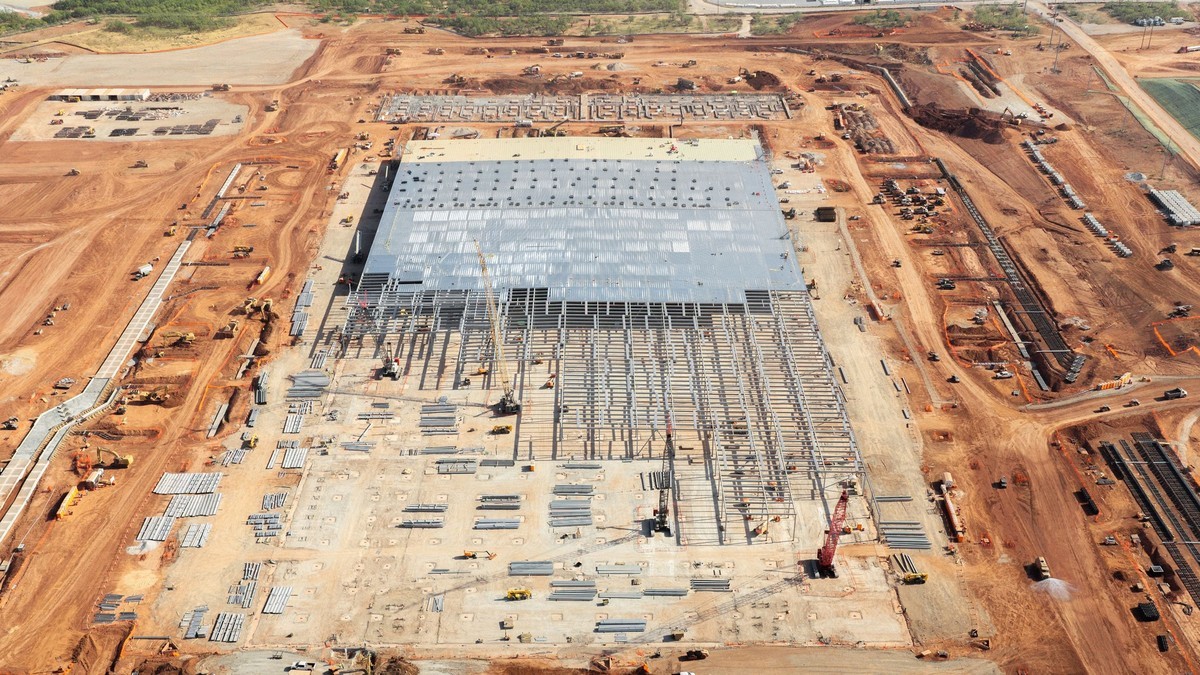
Texas is not a footnote in this story. The state has more than 400 data center facilities, according to the American Edge Project and Technology Councils of North America, with many more under construction. It is also where Google, Meta, Oracle and OpenAI have planted enormous bets, and Oracle's Stargate campus in Abilene has become the showpiece of the buildout.
A moratorium in Texas is not a zoning quarrel. It is a question mark hanging over the physical foundation of the artificial intelligence boom — the land, the power contracts and the permits that everything else is priced against. Investors did not wait for a bill. They repriced the ground underneath it.
The Voters Who Said No
Hinojosa did not invent this backlash. She surfed it. Voters sided against data center development in all but one of 38 local ballot contests with complete counts tracked by Redbud Consulting, a Washington polling and data science firm, according to preliminary results reported by Fortune. Fortune separately counted 41 ballot measures aimed at slowing the buildouts and found most of them passed.
In Piqua, Ohio, a city of about 20,000 where Meta plans to spend $1 billion on a campus of up to 1.4 gigawatts, residents voted to recall the mayor and two city commissioners who backed the project. At least 14 Ohio municipalities approved data center bans or other restrictions.
This is what a political ceiling looks like when it is built out of water bills, substations and school-board meetings. There is no single national campaign behind it. There are 38 small elections that all pointed the same way, and a market that finally counted them.
Chips and the Picks and Shovels
The Philadelphia SE Semiconductor Index fell about 12%, its worst day in roughly six and a half years, and touched its lowest level in more than six months. Advanced Micro Devices slumped 17% in Reuters' closing count, after AMD and Micron had each been down roughly 15% intraday according to Fortune, while Qualcomm fell 11.2% and Arm Holdings 11% after weaker technology earnings.
The neoclouds — the companies that rent out compute — were savaged. CoreWeave lost 10% and Nebius 15%. CoreWeave's five-year credit default swap spreads, the market's price for a possible default, widened to a record 1,267.9 basis points according to S&P Global Market Intelligence data, and Intel's hit a record 149.7.
Applied Digital, Cipher Digital and IREN each tumbled more than 14%. The power trade followed the chips down: Vistra fell 14% and Vertiv 13% intraday, while GE Vernova closed 7.4% lower and Constellation Energy 2.5%.
Asia Opened With a Circuit Breaker
Seoul did not wait for an explanation. At 9:03:33 a.m. local time Friday, the Korea Exchange halted trading on the main board for 20 minutes after the KOSPI fell 460.33 points, or 8.55%, to 4,923.47 — the first time the index had traded below 5,000 in about nine months, and the tenth circuit breaker the exchange has triggered this year, according to Yonhap. Samsung Electronics dropped 9.98% to 181,400 won and SK Hynix 11.79% to 1,115,000 won.
That came on top of a 5.28% fall at Thursday's close in Seoul, when foreign investors sold nearly 2 trillion won, about $1.4 billion, on the main board alone.
In Tokyo the Nikkei 225 was down 4,057.55 points, or 6.64%, at 9:26 a.m. to 57,020.35, below the 60,000 line for the first time since May, and the broader Topix fell 5.43% to 3,726.42, according to Kyodo. CNBC reported the Nikkei had entered a bear market, more than 20% below its June peak. A circuit breaker is a planned pause, not a collapse — but it is the exchange telling you the order book broke.
What Is Actually at Risk
Strip out the panic and there is a real estimate underneath it. UBS analysts calculated that around 30% of expected U.S. data center capacity additions in 2028 could be at risk from potential construction pauses, Reuters reported. That is the number that matters, because the AI trade has been a bet on steel, concrete, transformers and megawatts as much as on models.
The corporate reaction is already visible. Microsoft is tightening oversight of some data center projects it buys capacity from — Nebius, IREN and Nscale — Bloomberg News reported.
"Although there are a number of data centers already approved, there are still a lot to be permitted," said Bruce Zaro, managing director at Granite Wealth Management. "There's going to be a difficult road to get those permitted forthcoming." That is the sentence the index cannot price: not a ban, just a longer road.
From the Promise of AI to the Price of AI
Here is the part the bulls keep missing. This was not a healthy market finding religion overnight. The AI trade had been wobbling for weeks under the weight of its own arithmetic — higher interest rates, tighter financing and the small matter of whether anybody makes the money back on the enormous sums being poured in.
"The market's moving from the promise of AI to the price of AI," said Ted Parkhill, founder and chief executive of Incline Investment Management. "There's no question that AI is going to be transformative for the world in the long run. But that doesn't mean every AI-related stock is currently priced appropriately. There's going to be a lot of turmoil."
The fear gauge agreed. The CBOE Volatility Index jumped 11.57 points, its biggest single-day gain since April 2025, and hit its highest level since March 31. All 11 S&P 500 sectors closed lower, led by information technology at 7.30%, its worst day since March 2020. On the Nasdaq, decliners beat advancers 4,166 to 855.
The Politics Have Not Caught Up Yet
Now for the honesty the tape will not give you. No AI law has passed. No moratorium is in force in Texas. The new Congress is not seated until January, and a governor-elect cannot sign anything until she is sworn in. What repriced $2.5 trillion on Thursday was a mandate, not a statute — a market front-running a promise nobody has written into code yet.
Corporate America is already hedging. Meta's Dina Powell McCormick said at a Wall Street Journal conference on Wednesday that building data centers in the United States is "going to be harder," adding that "every hyperscaler is now thinking about 'Do we need to build outside the United States?'"
"There is some concern regarding AI regulation, and fears that there could be far more regulations coming to AI technology, as well as a pushback on the buildout of data centers across the country," said David Busch, chief investment officer of Trajan Wealth.
That is not a forecast. It is companies telling you they are rethinking where the concrete goes. Multiply that rethink across an industry, and you get Thursday.
What Friday Will Tell Us
Three things to watch. First, whether Seoul's halt holds as a pause or becomes the opening of a rout — a second circuit breaker inside a week would change the character of this from repricing to something worse.
Second, whether Friday's U.S. session finds buyers, because 174 stocks in the S&P 500, or 34.6%, are already 20% or more below their 52-week highs, and 310 are at least 10% below, according to CNBC.
Third, whether any Democrat actually puts a bill on the table. Markets can forgive a bad day. They do not forgive an empty promise, and the gap between what voters approved on Tuesday and what Washington has enacted is currently the widest part of this trade.
Baron Fung, senior research director at Dell'Oro Group, framed it without drama: "Most definitely, there will be challenges — two or three steps forward, one step back."
The Bottom Line
Folks, do not let anybody tell you this was about one governor or one bad earnings call. What broke this week is the assumption that the AI buildout was politically frictionless — that the land would be zoned, the power would be generated and the water would be found because the money was big enough. Voters in Piqua and Ohio and Texas just proved otherwise, and the market believed them faster than the pundits did.
If you hold chip or AI funds, look at what you own this weekend, not next month. If you live near a proposed campus, your county commission meeting is now a market event. And if you are one of the people who voted this way, understand what you did: the market read your ballot as a warning about the buildout, and repriced $2.5 trillion in a single afternoon.
By Jessica Ali, Staff Writer
This article was produced with AI-assisted research and editorial support. Sources: CNN Business, CNBC, Reuters, Fortune, NPR, Kyodo News via The Mainichi, Yonhap News Agency, Seoul Economic Daily, Bloomberg News, S&P Global Market Intelligence and Redbud Consulting. Photographs: Reuters and Getty Images. Cover: Global 1 News editorial image.
What's Your Reaction?
 Like
0
 Dislike
0
 Love
0
 Funny
0
 Wow
0
 Sad
0
 Angry
0

Editor-in-Chief at Global1.News. Atlanta-based journalist who cuts through the BS and tells it like it is. Lead anchor, host, and the voice you hear when the spin stops and the truth starts.















Comments (0)