
Macron Hosts Carney on French Islands Off Canada With Sovereignty and Energy on the Table
Macron hosted Carney on Saint Pierre and Miquelon in the first visit by a sitting Canadian prime minister, with sovereignty, LNG and critical minerals on the table and no agreements signed.
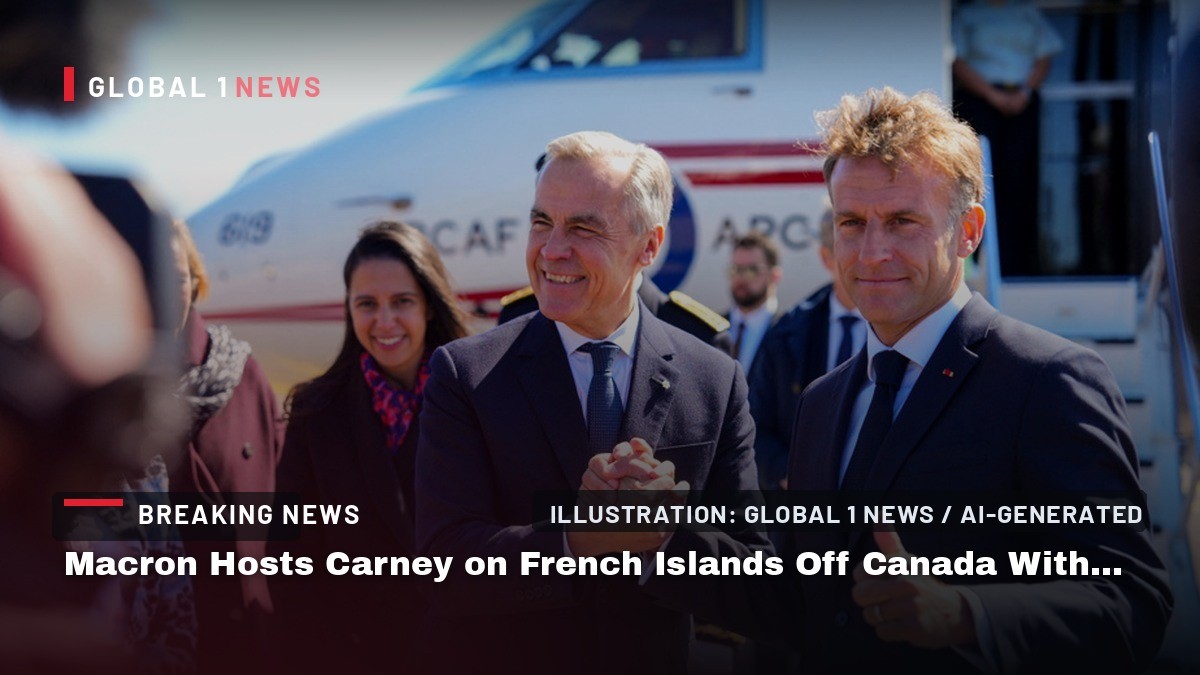
Emmanuel Macron became the first French president in more than a decade to set foot on Saint Pierre and Miquelon. Mark Carney became the first sitting Canadian prime minister ever to visit. The two men met on a tarmac 4,300 kilometres from Paris, on islands that Washington drew inside the United States on a map earlier this month, and Macron had a one-word answer for that map: obvious.
Macron Hosts Carney on French Islands Off Canada With Sovereignty and Energy on the Table
Saint Pierre, France - French President Emmanuel Macron hosted Canadian Prime Minister Mark Carney on the French archipelago of Saint Pierre and Miquelon on Sunday, the first visit by a sitting Canadian prime minister in the territory's history and Macron's first as president.
A Territory of 5,800 People and Two Firsts
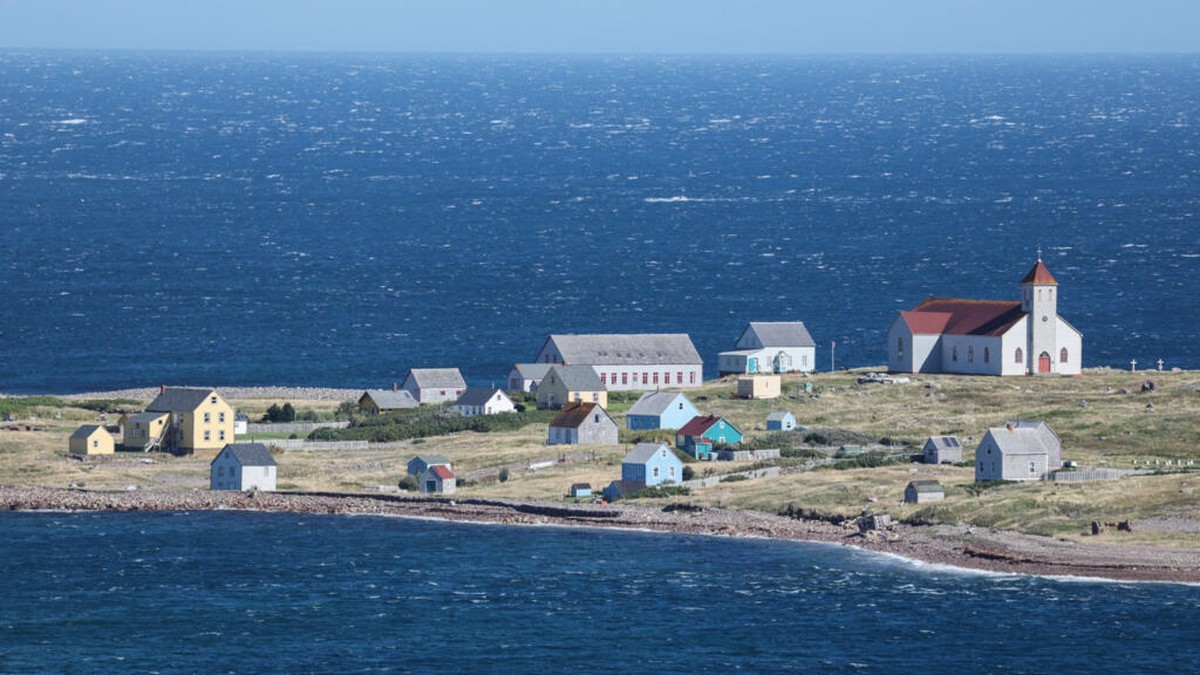
Saint Pierre and Miquelon is the last French territory in North America, a vestige of the vast holdings Paris once controlled in what is now Canada and the United States. Reuters puts it 4,300 kilometres from metropolitan France, with a population of about 5,800; AFP and France 24 put the population under 6,000. The archipelago covers 240 square kilometres across three islands, per Le Dauphine Libere.
Its distance from Newfoundland is reported two ways. Euronews, Ouest-France, La Presse and Le Devoir say about 20 kilometres off the south coast. AFP, France 24, RFI and the Canadian government's own news release say approximately 25 kilometres.
Macron landed at Saint-Pierre Pointe-Blanche airport at 19:08 local time Saturday aboard a Falcon 8x. The last French president to visit was Francois Hollande, in December 2014. Carney arrived Sunday at about 12:30 pm local time, according to his office, and AFP reported the two greeted each other with a warm handshake and a long embrace in bright sunshine. They held a working lunch and laid a wreath at the memorial to the volunteers of Free France - the force that took these islands from the Vichy regime in December 1941 without a shot, against the wishes of Washington.
The Map That Started It
Earlier in September, Trump posted an image on Truth Social showing a map of North America draped in the US flag and labelled "United States of America." It covered the United States, Canada, Greenland, Iceland, Mexico, Central America and the Caribbean. It also swallowed Saint Pierre and Miquelon and several French Caribbean territories, including Guadeloupe and Martinique.
The exact date is reported differently. France 24, Euronews and Le Dauphine Libere place it in early September. Reuters says Macron's visit came weeks after the post and that France did not respond publicly at the time. One AFP wire copy carried by RFI rendered it as "on Monday."
Asked about the map on arrival, Macron said: "There's no doubt (it is French)." He added: "We are not going to affirm it every day because people have strange ideas or say strange things." French outlets render the same answer as "It's obvious" and "no discussion." He also said the trip "sends a strong message."
Trump's Greenland Deal Hangs Over the Table
The United States and Denmark announced on Friday that they had reached an agreement over Greenland. Trump said the deal would give Washington "permanent control" of the island's security, and AP reported it would expand the US military presence there while keeping the island under Danish control. It followed months of threats by Trump to seize the semiautonomous territory of a NATO ally, and it is expected to be signed at the UN General Assembly.
Macron, speaking on Saturday: "Danish sovereignty is being respected, international law is being respected. Anything that helps ease tensions is a good thing." He declined to say whether it amounted to Trump backing down.
The Elysee Palace called the archipelago not a peripheral outpost but "a territory, an archipelago that is central to today's France," and said France meant to reaffirm a "geostrategic presence, at the gates of the United States and the Arctic," whose new routes are also coveted by Russia and China.
What Was Actually on the Table
Carney's office said the two leaders would discuss deepening the Canada-France partnership in strategic sectors, including aerospace, energy and critical minerals, and advanced technologies such as quantum, satellites and supercomputing.
Macron put the energy case plainly: "Canada is a country with significant resources of critical minerals and rare earths. It is also a major oil and natural gas producer. What we want to do is conclude agreements to secure more liquefied natural gas that can be shipped to Europe's Atlantic coast." France's government is under pressure at home over rising fuel prices, and the war with Iran has unsettled global energy markets.
Euronews reported Macron noted Canada's reserves of critical raw materials and rare earths and said France and the EU would be seeking contracts and arrangements to secure supplies of strategic minerals and LNG. A Macron official told journalists on Thursday that the meeting would also promote regional cooperation on fishing, transport, passenger transit, university exchanges and trade.
No agreement, treaty, contract or memorandum was signed at the meeting. Nothing was concluded on LNG volumes, prices or timelines, and no project was named.
Canada's European Turn
Four days before the meeting, European Commission President Ursula von der Leyen told the European Parliament in her State of the Union address that she wanted Canada to become the European Union's first "associate member." She said the two sides had to "urgently rethink" their partnership and go beyond a free trade agreement, taking the relationship to the "highest possible level."
Carney addressed the same parliament in Strasbourg on Thursday and welcomed the ambition, saying the name and nature of any new agreement remained to be determined, that it would be debated and voted on in the Canadian Parliament, and that he wanted stronger links on youth mobility and financial services. French outlets quoted him saying Canada and Europe are "stronger together." Trump called the idea "laughable" and warned that if he judged it "at all a hostile act," he would impose "very serious tariffs or stop trading with Europe on many things."
Any deeper integration still has to clear a hurdle. Nine years after CETA, the EU-Canada trade agreement, began provisional application, several member states including France have not ratified it.
The economics are already deep. Bilateral merchandise trade between Canada and France totalled $15.2 billion in 2025, with Canadian exports worth $5 billion against $10.2 billion of imports, according to the Prime Minister's office. Trade has grown by nearly two-thirds over the past decade and France is now Canada's third-largest export market in the European Union.
Two Framings That Do Not Agree
Reuters headlined the visit "in signal to Trump." France 24 said the first-ever visit by a Canadian prime minister "comes as Carney marks a shift in Ottawa's foreign policy toward Europe amid growing tensions with the US."
But Macron himself, speaking to reporters from the archipelago, gently pushed back on the idea that the trip was a statement. "We shouldn't be so obsessed with sending messages," he said, adding that France had "close friends" including Canada in the region. He called the meeting "a very strong gesture of friendship."
Frederic Lasserre, director of the Conseil quebecois d'etudes geopolitiques, told AFP the "main message is aimed at Washington." For Canada, threatened with annexation, the interest is also to show that Ottawa "is not isolated," he said, in a country where "the feeling is mostly one of humiliation" since Trump's return to power. Except for Greenland, he said, Trump's map amounts to "symbolic rhetoric." And: "I'm not sure he knows that Saint-Pierre is a French territory."
The Sentinel in the North Atlantic
The Fulmar (P 740) is an ex-trawler converted into a patrol vessel, armed by the French navy since 2009. It is the only French military ship based in the zone, and it was moored in the port of Saint-Pierre two days before Macron landed.
Its captain, Lieutenant de vaisseau Thibault, describes the job as being "the French sentinel" in the North-West Atlantic. "Our mission of presence and French sovereignty lets us show everyone that we hold the ground." The Fulmar trained with regional partners all August around Greenland, Thibault said, in an exercise organised by the Canadians that also drew American authorities to Nuuk. "Union is strength, and that is what we demonstrated in the different exercises we do," he said.
Macron is due to make announcements on the archipelago's military means. French outlets say the vessel is old and its replacement is taking time. The Elysee says the Fulmar is due to be replaced, and has not said with what, at what cost, or when.
An Island Looking for Its Next Act
The cod-fishing golden age is over. Canada's moratorium on cod gutted the industry, France's exclusive economic zone was cut back by a 1992 ruling, and Macron recalled "the very hard year" of 1992 that sealed the archipelago's fate, along with the violent "cod war" with Canada in the 1980s. A dispute over the delimitation of France's continental shelf in the zone has run for years.
Population is falling, deaths outnumber births, and young people leave to study in mainland France or Canada and often do not come back. The economy is marked by high living costs.
Space is the new bet. The archipelago already hosts a ground station for the European satellite navigation system Galileo, and two French start-ups, Skynopy and Look up, are making announcements during the visit. Macron said such investments "show the strategic character of the island." Saint Pierre also hopes to sit on the route of a digital cable linking Brittany to New York.
They Are Moving a Village
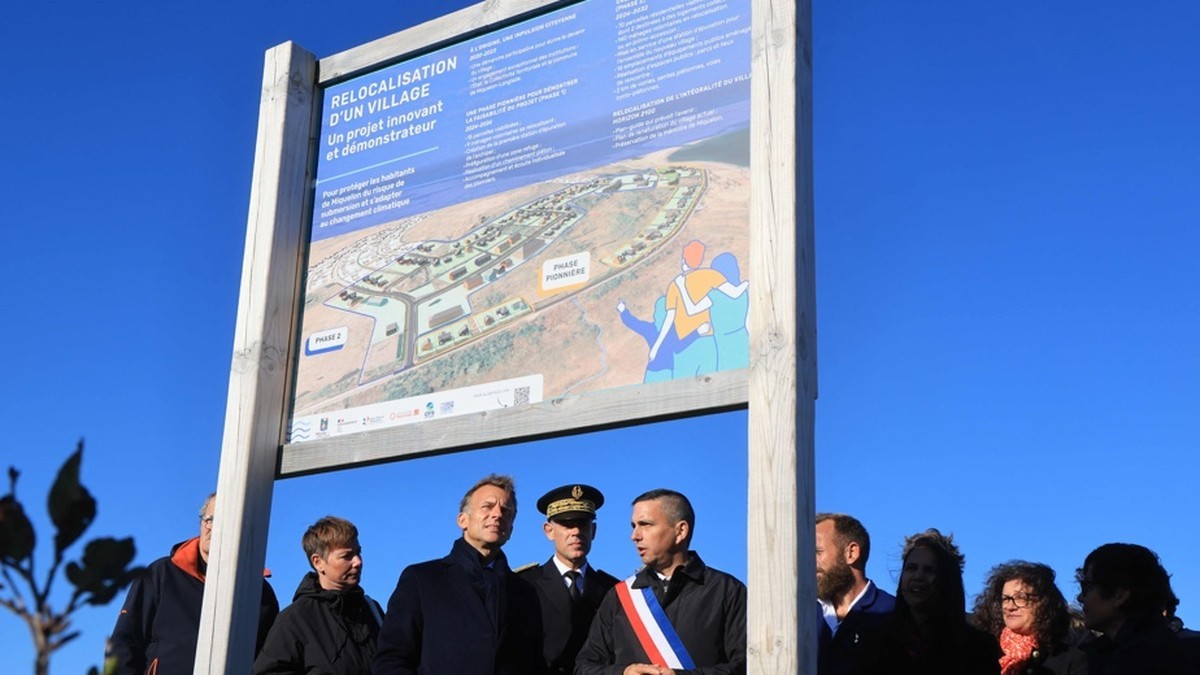
The village of Miquelon-Langlade sits on a narrow strip of sand only two metres above sea level, and it is being moved inland to escape rising seas. It is widely regarded as France's first climate-driven community relocation. Macron visited the new village site on Sunday morning, a two-hour stop on the smaller island.
About a dozen houses have been built at a new site 1.5 kilometres away. The second phase is about to begin and requires 25 million euros, according to local elected officials. The project will be long, and it is far from unanimous. Franck Detcheverry, the mayor of Miquelon, said: "We hope he will make announcements to tell us that the state will continue to support the project in the coming years."
The archipelago's senator, Annick Girardin, a former French overseas territories minister, put the stakes bluntly: "Saint Pierre and Miquelon is not some insignificant remnant of empire to be managed piecemeal. It is France and Europe in North America." Calling for France to press its rights over the seabed, she said: "France must decide whether it wants to be a subarctic power or a mere spectator."
What Happens Next
Macron stays on the islands until Monday. His morning is given to the sea and the strategic sectors: a defence briefing aboard the Fulmar, exchanges with fishers and divers at the Interpeche quay, then a presentation of Galileo satellite antennas at the airport and meetings with space, satellite and digital companies. He leaves for New York at 11:30, and Carney is bound for the UN General Assembly as well.
The two were expected to confirm Canada's close relations with France and the European Union in a joint statement after lunch, though whether that statement was delivered is not confirmed in the accounts available. Macron posted on X on Sunday: "In a world in crisis, our friendship is a strength." He added: "Together, we affirm our sovereignty, our freedom to decide and our willingness to build a future of peace and prosperity." Carney, quoted by his office, said the two were working "to deepen and expand" the relationship across AI, critical minerals and energy.
What was not announced was any agreement to do it.
By Jessica Ali, Staff Writer
This article was produced with AI-assisted research and editorial support. Sources: Reuters, Associated Press, Agence France-Presse, France 24, Euronews, franceinfo, Prime Minister of Canada, La Presse, Le Devoir, RTL, Le Dauphine Libere, RFI.
What's Your Reaction?
 Like
0
Like
0
 Dislike
0
Dislike
0
 Love
0
Love
0
 Funny
0
Funny
0
 Wow
0
Wow
0
 Sad
0
Sad
0
 Angry
0
Angry
0

Editor-in-Chief at Global1.News. Atlanta-based journalist who cuts through the BS and tells it like it is. Lead anchor, host, and the voice you hear when the spin stops and the truth starts.










Comments (0)