
Jamaica Lists 60 Free Public Beaches as Campaigners Challenge Colonial-Era Access Laws
The debate over who truly owns Jamaica's coastline has been reignited after the Ministry of Tourism published a list of 60 free public bathing beaches. Campaigners say colonial-era access laws still keep ordinary Jamaicans from the sea.
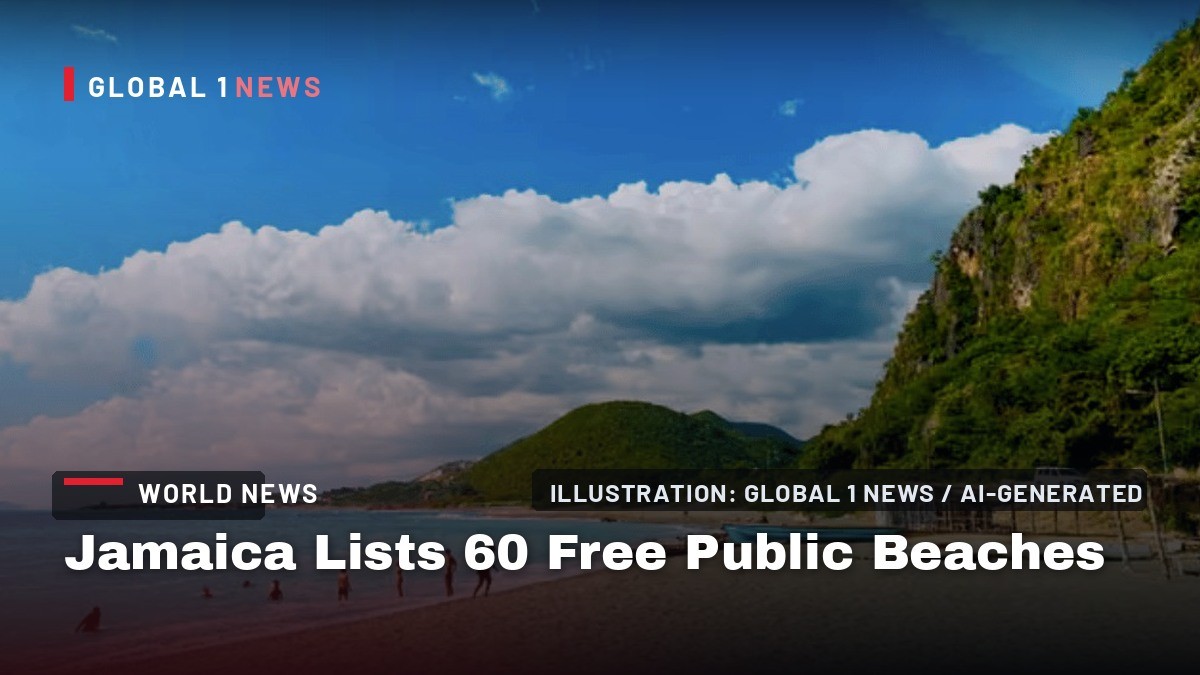
The debate over who truly owns Jamaica's coastline has been reignited with the publication of a government list of 60 free public bathing beaches, a move that officials say proves access is widespread but which campaigners argue masks a deeper, unresolved legal problem rooted in colonial-era legislation.
The Ministry of Tourism released the list in 2026, spanning ten parishes and including well-known spots such as Font Hill in St Elizabeth, Winnifred in Portland, and Copacabana in Kingston and St Andrew. The announcement was framed as a direct response to online claims that Jamaicans are being denied access to their own shores — claims that Tourism Minister Edmund Bartlett has described as "damaging Jamaica's reputation and costing the Government money to correct."
But for groups like the Jamaica Beach Birthright Environmental Movement (JaBBEM) and the Jamaica Environment Trust (JET), the list is not the full story. They argue that while these 60 beaches may be open to the public, the legal framework governing the coastline still allows private interests to block access to the foreshore, and that the government's own figures reveal inconsistencies that have never been explained.
A tale of two numbers: 87, 70 and the missing 17
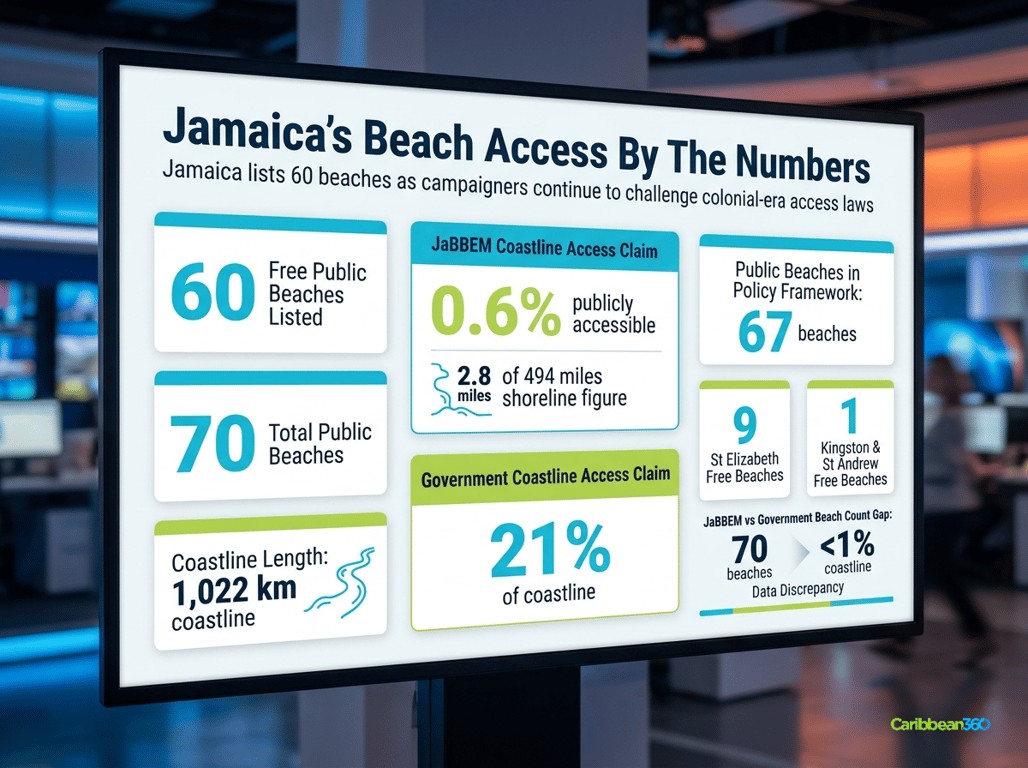
At the heart of the campaigners' frustration is a discrepancy in the official record. Jamaica's 2000 National Beach Policy recorded 87 public recreational beaches. The government now cites 70 public beaches in total — 60 of which have been upgraded in recent years, according to Minister Bartlett, with only ten commercially operated and just five requiring an entry fee.
That leaves an unreconciled gap of 17 beaches between the two official counts, with no published explanation to date. For JET and JaBBEM, this is not a bureaucratic quibble. It speaks to what they describe as a lack of transparency about how beach access is actually managed, and whether the state is keeping proper track of land that should belong to the people.
Minister Bartlett, speaking at the Artisan Village Food Festival in Falmouth, Trelawny, on August 6, 2026, offered a broader context for the challenge Jamaica faces. "Jamaica has approximately 2,200 kilometres of coastline, but only 29 per cent represents areas with any sand, and only 22 per cent of that is suitable for swimming and beach activities," he said. The implication is clear: the usable beach resource is finite, and managing it requires balancing public access with tourism development and environmental protection.
Yet JaBBEM estimates that only about 0.6 per cent of Jamaica's coastline is accessible to the general public. It must be noted that this is an advocacy figure, calculated using the group's own definition of what constitutes accessible coastline, and is not an independently audited national statistic. Still, the sheer gap between that estimate and the government's characterisation of a nation with ample free beaches underscores how far apart the two sides remain.
The 1956 law at the centre of the storm
JaBBEM's central demand is not for tweaks or amendments. The group is calling for the full repeal and replacement of the Beach Control Act of 1956, a law passed when Jamaica was still a British colony. The Act placed the island's foreshore and seabed under state control and allowed stretches of coast to be licensed for private use.
Dr Devon Taylor, President of JaBBEM, argues the law reproduces what he calls plantation-era spatial control, and he rejects the framing of the debate as a choice between tourism and community rights. "We should refuse the falsehood that we must choose between tourism or beach rights, investment or community, development or fishermen, jobs or environmental protection, and hotels or public access," Dr Taylor said via The Gleaner. "The real question is under whose rule development occurs, who benefits, and what rights are guaranteed to the people."
That language — of "plantation tourism" and colonial continuity — resonates across the Caribbean, where small island states have long wrestled with the tension between foreign investment in coastal tourism and the traditional rights of fishing communities and ordinary citizens. In Trinidad and Tobago, similar questions have arisen over the years about access to beaches and waterfronts, though the specific legal instruments differ. The broader regional pattern is familiar: development pressures, a tourism-dependent economy, and communities that feel their birthright is being negotiated away by interests far from their shores.
JET's measured but firm critique
The Jamaica Environment Trust has taken a somewhat different tack. JET reviewed the government's March 2026 Beach Access and Management Policy and concluded that while it is long overdue, it does not go far enough. The problem, as JET sees it, is one of framing: the policy treats access as something to be "provided" or "maintained" by the state, rather than establishing it as an enforceable public right.
JET is not calling for unrestricted access regardless of environmental or safety concerns. But the organisation insists that public access must be the legal starting point, not a discretionary privilege that can be withdrawn when land changes hands or when a licence expires. The group has specifically highlighted the vulnerability of traditional fishing beaches on privately owned land, and has warned that entry fees and licence conditions can become de facto barriers to access, even when the policy on paper appears open.
If JET's rights-based framework were to succeed, the default position would shift dramatically. Access would no longer be a matter of state grace or private permission, but a legal entitlement. That would particularly benefit fishing communities and low-income Jamaicans who lack the resources to challenge access disputes through the courts — a significant consideration in a country where the cost of litigation can be prohibitive.
Where the pressure points remain
The government's list of 60 beaches is heavily weighted toward the northern coastline, with more than half of the named locations stretching from Hanover in the west through St James, Trelawny, St Ann, St Mary and Portland. St Elizabeth stands out with nine free public beaches, including Great Bay, Font Hill, Calabash Bay and Billy's Bay. Kingston and St Andrew, the capital parish, has just one: Copacabana.
Yet some of the most contentious access disputes are not on the list at all. Communities in St Ann, Portland and St James remain in the most uncertain position, given documented disputes at sites including Mammee Bay, Blue Lagoon and Flankers/Providence Beach in St James. The Flankers case is particularly significant: JaBBEM has an ongoing court challenge over access to that beach, and the outcome could set a precedent for how the 1956 Act is interpreted going forward.
For the communities involved, this is not an abstract legal debate. It is about whether a grandmother in St James can take her grandchildren to the sea without walking through a hotel lobby or climbing over a fence. It is about whether fishermen in Portland can launch their boats from the same coves their families have used for generations. It is about whether the promise of "free, legal, unfettered, forever" access — the phrase campaigners have adopted — is a real possibility or an impossible dream.
Tourism's double-edged sword
Minister Bartlett's defence of the government's record is rooted in the economic realities of a country where tourism is a major employer and earner of foreign exchange. He has acknowledged that isolated access problems exist, but argues they should not define the national picture. The 60-beach list, he says, reflects genuine public access, and the government's continued investment in upgrading beach infrastructure is evidence of its commitment.
The ministry's own social media post announcing the list struck a welcoming tone: "Jamaica's public bathing beaches provide free access to our sandy coastline for Jamaicans to enjoy, with recognised locations across the island. From swimming and sunbathing to fishing, water sports or simply enjoying the coastline, these public bathing beaches are open to everyone with no entry fee required."
But campaigners counter that the very need to publish such a list is itself an admission that access cannot be taken for granted. In a country where the coastline is supposed to be a public resource, they argue, the government should not need to reassure citizens that they are allowed to swim at the beach. The fact that it does — and that online claims of denial have become common enough to worry the tourism minister — suggests a deeper unease.
What to watch in the months ahead
Several developments will determine whether this debate moves toward resolution or continues to simmer. The first is whether the government publishes a historical reconciliation of the beach-count discrepancy between the 87 beaches recorded in 2000 and the 70 cited today. The second is the outcome of JaBBEM's court case regarding access to Flankers/Providence Beach in St James. The third is whether the 2026 Beach Access and Management Policy is amended to establish a clear and enforceable public right of landward access — the point JET has identified as the policy's critical weakness.
For the wider Caribbean, Jamaica's struggle is a familiar one. From the Bahamas to Barbados, from St Lucia to Trinidad, the question of who can reach the shoreline is never far from the surface. Tourism development brings jobs and revenue, but it also brings fences, private security and the slow erosion of customary access. Small island states must constantly negotiate the line between welcoming the world and protecting the birthright of their own people.
Jamaica's government says it is on the right side of that line, pointing to 60 free beaches as proof. JaBBEM and JET say the line itself is drawn in the wrong place, and that until the law is changed, the beach will never truly belong to the people. The truth, as is so often the case, lies somewhere in between — but for the families in St James, Portland and St Ann who face locked gates and disputed boundaries, the distinction is not academic. It is the difference between a birthright and a privilege.
By Sharon Sahatoo, Staff Writer
This article was produced with AI-assisted research and editorial support. Sources: Caribbean360, Jamaica Observer, The Gleaner, The Guardian.
What's Your Reaction?
 Like
0
Like
0
 Dislike
0
Dislike
0
 Love
0
Love
0
 Funny
0
Funny
0
 Wow
0
Wow
0
 Sad
0
Sad
0
 Angry
0
Angry
0

Caribbean Correspondent at Global1.News. Based in Port of Spain, Trinidad, covering Caribbean politics, economy, energy, climate, and culture. Amplifying the voices and stories of the Caribbean region.












Comments (0)