
Gaza border communities surge 10% above pre-Oct. 7 population
Israel’s Gaza border region, known locally as the Tekuma or “Resurgence” area, is undergoing a demographic and economic transformation that far exceeds the pace of national recovery.
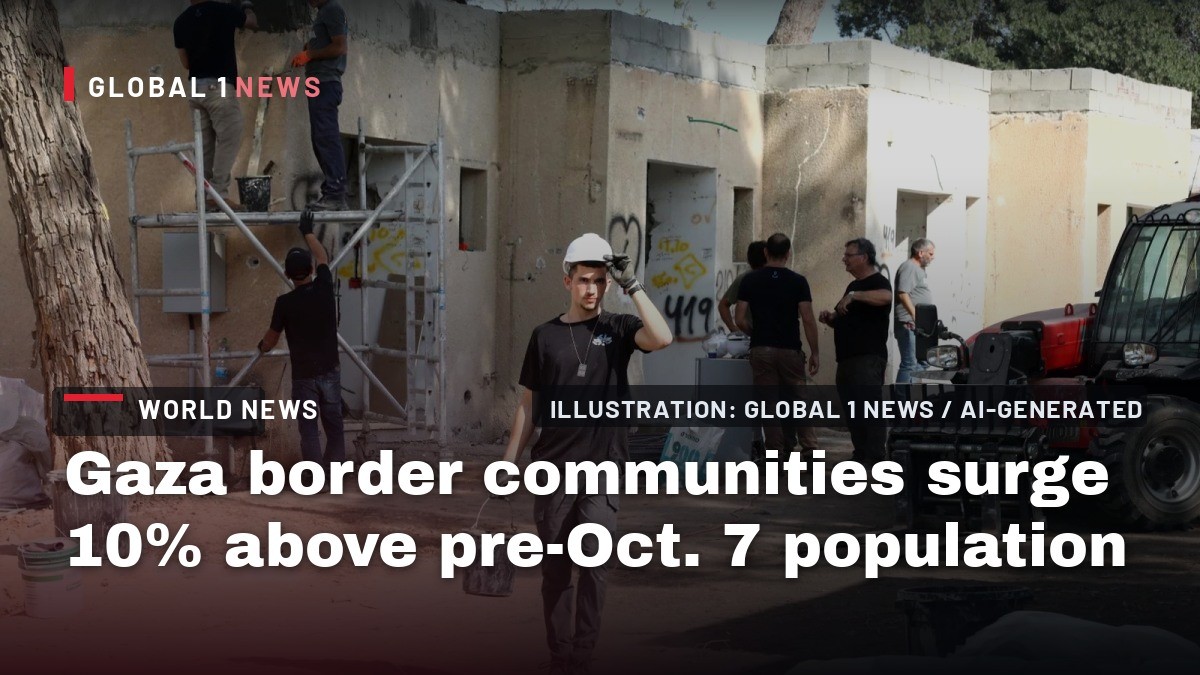
Israel’s Gaza border region, known locally as the Tekuma or “Resurgence” area, is undergoing a demographic and economic transformation that far exceeds the pace of national recovery. According to the Central Bureau of Statistics and the Tekuma Administration, the population of the 47‑community cluster has risen by roughly ten percent since the eve of the Oct. 7, 2023 attacks, reaching about 66,000 residents – an increase of some 5,000 people. This growth rate, at 2.5 times the national average, reflects both a strong return of evacuees and a wave of new families attracted by reconstruction incentives, security improvements and emerging employment opportunities.
Population rebound and community revitalisation
More than 90 % of the residents who fled the border towns during the war have now returned, with Sderot remaining the region’s urban hub. The city, home to roughly 40,000 people, accounts for over half of the Tekuma’s total population. Schools in the area report an influx of about 2,000 additional pupils, while another 1,000 young adults are enrolled in pre‑military academies, Nahal groups, national‑service programmes and hesder yeshivas. These figures illustrate a broader demographic shift: the return of long‑time residents is being complemented by thousands of new families drawn by housing subsidies and the promise of stable employment in the region’s expanding industrial sector.
Community recovery varies across the map. Kfar Aza achieved a 96 % return rate in 2026, signalling a near‑full repopulation of its homes and farms. Holit’s residents have begun a gradual return after prolonged rehabilitation restrictions, while Be’eri is slated to see its remaining evacuees back by the end of the year. Nir Oz, still under reconstruction, is expected to complete its rehabilitation by 2027. The Tekuma Administration’s long‑term vision is to double the current population to roughly 120,000 by 2033, a target that hinges on sustained investment and the creation of higher‑paying jobs.
Funding the reconstruction effort
The Israeli government has earmarked approximately 17.5 billion shekels in multi‑year funding for the Tekuma’s recovery, of which more than 11.5 billion shekels have already been committed to construction, infrastructure and community services. Physical reconstruction and temporary housing alone have consumed over 3 billion shekels. While hundreds of damaged buildings have been renovated or rebuilt, State Comptroller audits reveal a persistent gap between promised budgets and funds actually disbursed, causing delays in some multi‑year projects. The funding shortfall underscores the importance of efficient budget execution as the region moves from emergency relief to long‑term development.
Beyond direct construction, the state is channeling resources into the region’s strategic pillars – agriculture, advanced manufacturing and renewable energy – to ensure a diversified economic base that can sustain a larger population. These investments are designed to attract both seasoned professionals and a new generation of entrepreneurs, thereby reinforcing the Tekuma’s role in Israel’s broader food‑security and high‑tech ecosystems.
Agricultural renewal through technology
Agriculture remains a cornerstone of the Tekuma’s economy and of Israel’s national food security. The Oct. 7 conflict inflicted heavy losses on farms, wiping out workers, equipment and cultivated land. In response, the Agriculture Ministry and the Tekuma Administration launched a 72 million‑shekel capital programme in 2026 to upgrade water infrastructure, irrigation and advanced control systems. Veteran farmers can receive grants covering half of the investment costs needed to rebuild greenhouses, dairy barns, livestock facilities, poultry houses and orchards.
A separate “Next Generation” programme, budgeted at roughly 15 million shekels, seeks to draw younger farmers and agri‑entrepreneurs into the region. Labor shortages have accelerated the adoption of automation, with grants covering up to 40 % of costs – and as much as 10 million shekels per farm – for robotics and automated packing solutions. These measures aim to offset the demographic challenge of an aging farming workforce while positioning the Tekuma’s agricultural sector at the forefront of precision‑farming technology.
Industrial diversification and high‑tech incentives
The Tekuma’s industrial landscape is shifting from low‑margin, labour‑intensive activities toward advanced manufacturing and higher‑paying jobs. The Israel Innovation Authority’s investment arm offers grants of up to 30 % of investment costs for companies that establish, expand or relocate production facilities to the border region. Complementary subsidies cover up to 30 % of wage costs for new employees at regional factories, providing a financial buffer that encourages firms to hire locally.
One flagship project is a 15‑acre employment and industrial complex planned for Kibbutz Kfar Aza, with an estimated cost of 250 million shekels and a slated opening in 2027. In Sha’ar HaNegev, officials are promoting a high‑tech park, a regional research institute and an innovation centre in partnership with Sapir Academic College. An additional 300 million shekels has been allocated for renewable‑energy infrastructure and efficiency upgrades at regional factories, signalling a commitment to sustainability alongside productivity gains.
Case studies: divergent industrial recovery paths
Beeri Print, Israel’s leading printer of driver’s licences, credit cards and government documents, illustrates a rapid recovery trajectory. Despite the devastation of Kibbutz Be’eri, the company suffered no critical structural damage and resumed operations within a week of the Oct. 15, 2023 attack, under heavy security. Its profitability has provided a financial cushion for the kibbutz’s broader rehabilitation, estimated at 465 million shekels. Beeri Print remains the kibbutz’s economic engine and continues to compete for exclusive government contracts involving sensitive identification documents.
In contrast, Nirlat’s paint factory in Kibbutz Nir Oz faced near‑total destruction. The 12.6‑acre facility was burned during the attack, forcing the parent company Inrom to rebuild from scratch. The Tax Authority advanced roughly 201 million shekels to accelerate recovery, enabling limited production to resume by December 2023 at an undamaged solvent plant and through temporary relocation to Beersheva and Netanya. In 2026, Inrom approved a 400 million‑shekel plan for a fully automated paint factory in Nir Oz, slated for completion in about three years. The new plant is positioned to become one of the world’s most advanced facilities of its kind, and Nirlat has secured a renewed 25‑year lease with the kibbutz.
Remaining challenges and the road ahead
Despite the influx of capital and the return of most residents, significant reconstruction challenges persist. Approximately 1,952 acres of open and agricultural land were directly damaged by combat and military vehicle movements, with losses estimated in the tens of millions of shekels. Rehabilitation of the land and surrounding environment remains an ongoing task, requiring both financial resources and technical expertise.
Nevertheless, the Tekuma is transitioning from emergency recovery to a phase of long‑term growth. Communities are repopulating, schools are expanding, agriculture is embracing high‑tech solutions, and major industrial projects are breaking ground. The government’s ambition extends beyond merely restoring pre‑war conditions; it aims to forge a larger, more resilient, and technologically advanced border region by 2033. If the current trajectory holds, the Tekuma could become a model for post‑conflict reconstruction that blends demographic renewal with innovation‑driven economic development.
This article was produced with AI-assisted research and editorial support. Reporting is based on the source material cited below. Sources: JNS (Jewish News Syndicate); jns.org; Global1.News (09 October 2026).
By Hannah Berg, Staff Writer
What's Your Reaction?
 Like
0
Like
0
 Dislike
0
Dislike
0
 Love
0
Love
0
 Funny
0
Funny
0
 Wow
0
Wow
0
 Sad
0
Sad
0
 Angry
0
Angry
0

Israel Correspondent at Global1.News. Based in Tel Aviv, covering Israeli politics, security, technology, and society. Provides balanced, deeply-sourced reporting on one of the most closely-watched regions in the world.













Comments (0)