
Israeli Donations Shift From Wartime Needs to Mental Health and Rehabilitation, Fundraising Data Shows
Israelis kept giving through a third year of war, prolonged reserve duty and cost-of-living pressure, but the destination of their money has changed markedly. New data from the fundraising platforms Charidy and Jgive show that donations for mental health and post-trauma campaigns surged almost fivefold compared with 2023, while giving to campaigns for soldiers and reservists fell by 52% from its peak.
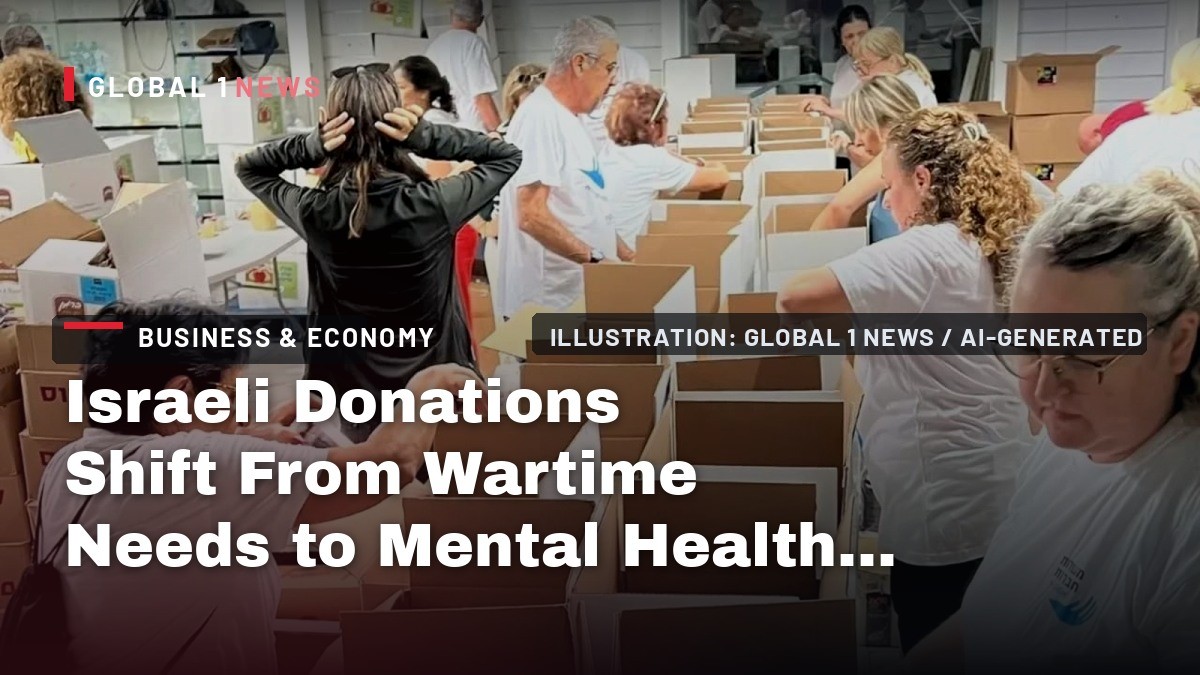
Israelis kept giving through a third year of war, prolonged reserve duty and cost-of-living pressure, but the destination of their money has changed markedly. New data from the fundraising platforms Charidy and Jgive show that donations for mental health and post-trauma campaigns surged almost fivefold compared with 2023, while giving to campaigns for soldiers and reservists fell by 52% from its peak.
The figures, released ahead of the Tishrei holiday season, offer one of the clearest pictures yet of how Israeli civil society is recalibrating nearly three years into a war whose immediate emergency phase has given way to a longer, quieter set of needs — psychological care, rehabilitation, welfare, commemoration and food assistance.
Giving Keeps Growing Despite the War's Economic Toll
According to Charidy, more than NIS 2 billion was raised through its campaigns worldwide in the Jewish year 5786 — the Hebrew year now drawing to a close — an increase of more than 5% compared with 5785. A total of approximately 1.82 million donors participated in campaigns worldwide. In Israel, about NIS 340 million was raised through the platform from 509,793 donors. The number of Israeli donors rose by nearly 10% compared with the previous year, when it stood at about 467,000.
Jgive recorded a similar expansion. During the Tishrei holiday period, the volume of donations grew over four years from about NIS 44.7 million to about NIS 68.5 million, a 53% surge. At the same time, the number of donations rose by 57%, from 63,110 to 99,066.
That growth is notable in a country where households have absorbed higher prices, extended unpaid reserve duty and the broader slowdown that has accompanied nearly three years of conflict. The donation data suggest that mutual responsibility has not eroded — but that the public is now directing it differently.
From the Front Line to the Therapist's Couch
The most striking shift is in mental health. Between January and July 2026, 1,165 donations were recorded on Jgive for campaigns related to mental health and post-trauma, compared with only 250 in the corresponding period in 2023 — a 4.7-fold increase.
Conversely, the number of donations to campaigns identified with soldiers and reservists stood at about 7,400, approximately 52% lower than the peak recorded in 2024. At the start of the war, the public mobilized on a large scale for soldiers, reservists and immediate emergency needs. That impulse has not disappeared, but it has been overtaken by a wave of giving aimed at the war's long-term consequences.
Economic distress is also visible on the donation map. Between January and July of this year, 3,551 donations were recorded for food basket and food package campaigns, compared with 2,069 in the corresponding period in 2023, an increase of more than 70%. The rise in food aid suggests that a growing number of households have slipped below the poverty line as the war's economic tail drags on.
Tishrei Giving: Welfare and Emergency Aid Lead
During the Tishrei period, the two leading fields by number of donations were welfare and national emergency assistance. The welfare sector, which includes financial aid, food, and support for the needy and the elderly, drew between 16,000 and 20,000 donations totaling approximately NIS 12.7 million. National emergency assistance drew between 18,000 and 18,700 donations, totaling approximately NIS 5.8 million.
Commemoration is also taking up a larger place in the giving map. The number of donations in the field of commemoration and memory rose from 4,058 in 5782 to 12,694 in 5786, more than tripling. The sector, which was in fourth place by number of donations, moved up to third place, with a monetary volume of about NIS 3.5 million.
That trajectory is a quiet measure of loss. As the war's fallen are memorialized through community projects and memorial funds, Israeli donors are increasingly funding the institutions of remembrance themselves — a role that has traditionally been shared between the state and established national bodies.

How Israelis Give Is Changing Too
The change is not only in who receives donations, but also in who donates and how. According to Jgive data, the proportion of recurring donations rose from 14% to 17.5%, and the median donation grew from NIS 120 to NIS 150. Recurring giving, common in the nonprofit worlds of North America and Europe, has historically been less developed in Israel, where giving has tended to be spontaneous and campaign-driven. Its rise suggests a maturing donor base that is planning its charitable commitments rather than responding only to emergencies.
At the same time, a significant portion of the money still comes from a relatively small number of large donations. Donations of more than NIS 5,000 account for only 1.27% of all donations, but are responsible for 59% of the total amount donated.
That concentration carries real implications for smaller nonprofits. Organizations without access to major donors or the professional fundraising staff needed to cultivate them may find themselves increasingly dependent on many small gifts, even as the overall pie grows. The data suggest a sector splitting between a handful of large, well-marketed campaigns and a long tail of smaller groups competing for modest sums.
Local Donors Take Over From Foreign Currency
A sharp decline was recorded in the share of foreign-currency donations, falling from about 53.7% of the total money to only about 16%. This comes while the total number of donors grew by 45% and the monetary volume rose by 53% — a figure that may indicate a strengthening in the weight of local donors.
For years, Israeli charities relied heavily on donors abroad, particularly Jewish communities in North America, whose contributions were often denominated in dollars and shielded from shekel volatility. The new data suggest that the backbone of Israeli giving is now domestic. That is a sign of civic resilience, but it also means Israeli nonprofits are more exposed to the same economic pressures — inflation, mortgage costs, reserve-duty wage losses — that their donors are facing at home.
Holiday Weeks: More Donors, Smaller Gifts
The holiday weeks illustrate the pattern. In the week preceding Rosh Hashanah, approximately NIS 14.1 million was donated in 16,421 donations, an average of about NIS 860 per donation. In the week preceding Yom Kippur, 24,152 donations were recorded, totaling about NIS 13.4 million — an average of about NIS 554 per donation. More people donated, but in smaller amounts.
Looking at a four-year period, the volume of donations during the Ten Days of Repentance surged by 112%, and in the period between Sukkot and Simchat Torah, an increase of 284% was recorded. The Tishrei season, long a peak period for Jewish giving, has become even more central to the Israeli fundraising calendar.
Big Campaigns Still Dominate the Top End
At the other end of the scale are the large campaigns. According to Charidy, the campaign that raised the highest amount in 5786 was by the Vizhnitz Hasidic center, with more than NIS 32 million. The campaign with the highest number of participating donors was "Meitar Rose Wants to Live," with 42,822 donors. The campaign enabled eight-year-old Meitar to receive the first treatment in Israel for Duchenne disease, using a medication considered one of the most expensive in the world.
The single largest donation recorded on Charidy stood at NIS 375,000 and was given to the Shalom Rav Yeshiva. In Israel, the single largest donation stood at NIS 108,000 and was designated for the Tzedakah Center.
The Meitar campaign is a reminder of how quickly a single family's medical crisis can become a national fundraising event — and of the gaps that private giving is asked to fill when a treatment exists but is not yet covered by the public health basket.
What the Donation Map Says About the State's Role
Ori Ben Shlomo, founder and CEO of Jgive, framed the shift as a form of early warning. "One of the interesting things we see is that the public is mobilized and responds quickly to needs that arise from the ground, especially in times of emergency," he said. "During the war, the money flowed quickly to soldiers and immediate needs, and today it is already shifting to mental health, rehabilitation, and welfare. In this sense, the donation map is an early indicator of the needs the public identifies, and sometimes also of the places where it feels the existing infrastructural response is not yet sufficient."
That last point is delicate. The surge in mental health giving comes as Israel's public mental health system has faced sustained pressure since the war began, with long waiting lists and a shortage of therapists a recurring concern in Israeli media coverage. When private donors step in, they can move faster than government ministries — but they also risk creating a two-tier system in which care depends on a family's ability to tell its story compellingly enough to attract a campaign.
Rabbi Shay Chervinsky, CEO of Charidy, added that "the data for the year 5786 are an impressive testament to the power of mutual responsibility. Even in a year of war, uncertainty, and economic challenges, the public did not withdraw into itself, but continued to open its heart and give. More than half a million donors in Israel and millions of donors around the world chose to take part and assist, and the numbers show that the desire to give and help others is strong even during the most complex periods."
A Civil Society Carrying What the State Cannot
Taken together, the numbers describe an Israeli public that has not retreated from collective responsibility, but has redirected it toward the slower, less visible wounds of the war: trauma, rehabilitation, poverty, remembrance. The emergency reflex of October 2023 and 2024 has matured into something more sustained — and, in some ways, more demanding of the organizations receiving the money.
Whether that shift holds through another year of uncertainty will depend on the same factors that shape everything else in Israel today: the trajectory of the war, the health of the economy, and the willingness of hundreds of thousands of ordinary donors to keep giving, in smaller amounts, to needs that no longer make headlines.
This article was produced with AI-assisted research and editorial support. Sources: The Jerusalem Post; Charidy; Jgive.
By Hannah Berg, Staff Writer
What's Your Reaction?
 Like
0
Like
0
 Dislike
0
Dislike
0
 Love
0
Love
0
 Funny
0
Funny
0
 Wow
0
Wow
0
 Sad
0
Sad
0
 Angry
0
Angry
0

Israel Correspondent at Global1.News. Based in Tel Aviv, covering Israeli politics, security, technology, and society. Provides balanced, deeply-sourced reporting on one of the most closely-watched regions in the world.















Comments (0)