
Green Hydrogen: India’s Big Ambitions, Costly Realities
India’s ambition to become a global hub for green hydrogen (GH) is now confronting a series of cost and infrastructure challenges that could shape the trajectory of its clean‑energy transition.
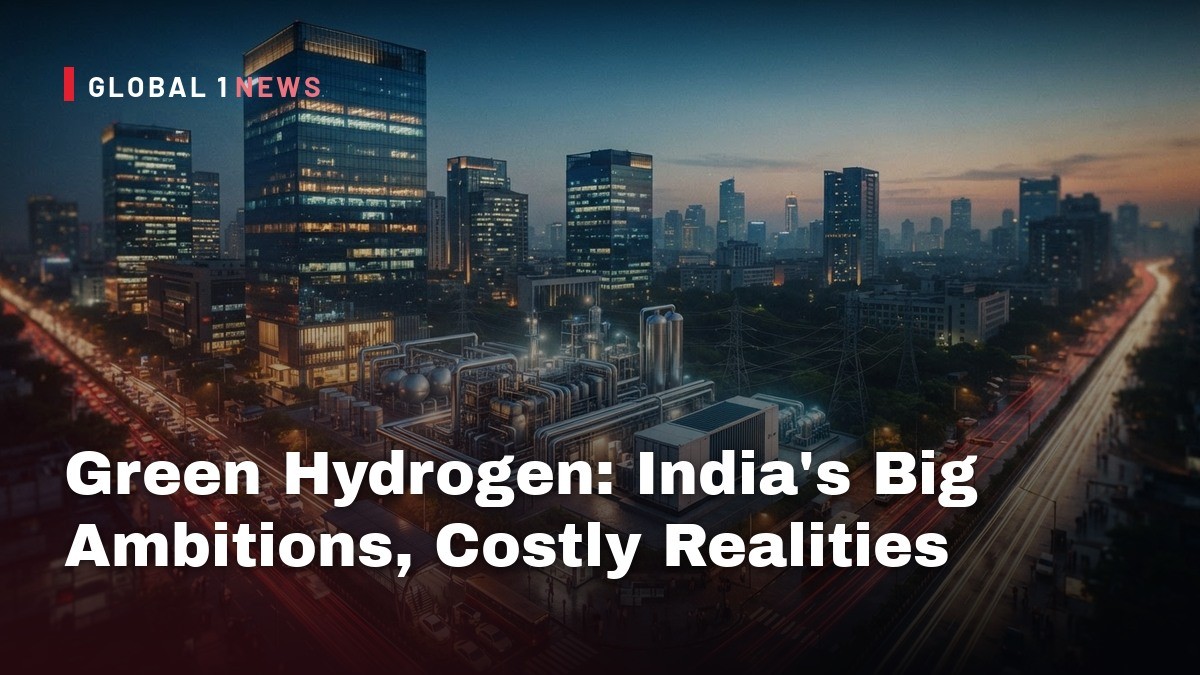
India’s ambition to become a global hub for green hydrogen (GH) is now confronting a series of cost and infrastructure challenges that could shape the trajectory of its clean‑energy transition. Launched in early 2023, the National Green Hydrogen Mission (NGHM) set a target of at least five million tonnes of annual GH production by 2030. By the end of 2025 the government had awarded incentives for roughly 0.86 million tonnes per annum (MTPA) of capacity – about 17 percent of the stated goal – and for 3 GW of electrolyzer manufacturing. The gap between the current award base and the 2030 target highlights the scale of the task ahead.
Policy framework and short‑term subsidies
The NGHM combines direct financial support with strategic planning. A dedicated budget of 174.9 billion rupees has been earmarked for the Strategic Interventions for Green Hydrogen Transition (SIGHT) programme, which funds short‑term production subsidies, green ammonia incentives and electrolyzer manufacturing support. Production subsidies have been reduced from 50 rupees to 30 rupees per kilogram of GH, while green‑ammonia subsidies fell from 8.8 rupees to 5.3 rupees per kilogram. Both subsidies are limited to a three‑year window and together cover only 10‑15 percent of the cost gap between green and grey hydrogen.
Electrolyzer incentives are spread over five years, declining from 4,440 rupees to 1,480 rupees per kilowatt. This tiered approach is intended to spur domestic electrolyzer production and lower equipment costs, but the reliance on a declining subsidy schedule underscores the need for a longer‑term cost‑reduction strategy beyond direct cash support.
Cost structure and the renewable energy link
Renewable electricity remains the dominant cost driver for GH, accounting for roughly half to two‑thirds of total production expenses. The NGHM therefore seeks to lower these costs by waiving Inter‑State Transmission System (ISTS) charges for eligible projects, a measure designed to make round‑the‑clock renewable supply more affordable. Nonetheless, the high capital cost of electrolyzers and the need for reliable, continuous power remain significant hurdles.
Geographical mismatches between renewable‑rich regions and designated GH hub ports exacerbate the cost issue. For example, Gujarat and Rajasthan host abundant solar and wind resources, yet the nearest hub, Kandla, is relatively close, whereas Paradip – a hub linked to a major ACME Group facility – sits farther from these generation clusters. Transporting electricity over long distances via ISTS, or moving compressed or liquefied hydrogen, adds layers of expense that could erode the competitiveness of Indian GH on the global market.
Domestic demand constraints
While GH can theoretically replace grey hydrogen in fertilizers, refineries, steelmaking and heavy transport, actual domestic demand remains uncertain. The International Energy Agency has warned that slow infrastructure development and unclear market signals make GH unlikely to undercut grey alternatives in the near term. Consequently, the NGHM proposes a Green Hydrogen Production Obligation to create guaranteed off‑take for hydrogen‑using industries, but the policy is still in its infancy.
Decentralised use of GH – such as blending into natural‑gas pipelines for nearby refineries and fertilizer plants – could mitigate the need for costly long‑distance transport. By prioritising local consumption and exporting only surplus output as derivatives like green ammonia, producers may achieve economies of scale while keeping domestic prices competitive.
Export potential and market requirements
Exports are a cornerstone of India’s GH strategy. Projections suggest that the European Union and East Asia together could import between 3.4 and 6 million tonnes of GH annually by 2030, although these estimates do not differentiate between electricity sources or include derivative trades.
Recent commercial agreements illustrate growing export momentum. In July 2026 ACME Group secured long‑term supply contracts with Japanese firms: 0.41 MTPA of green ammonia for IHI and 1.0 MTPA of green methanol for Mitsubishi Gas Chemical, both sourced from the Paradip hub. Similar cooperation with Germany and other European partners is underway, but meeting EU certification standards – specifically the Renewable Fuels of Non‑Biological Origin (RFNBO) framework – will require robust traceability and proof of renewable electricity sourcing from the outset.
Infrastructure bottlenecks and supply‑chain risks
Beyond electricity transmission, the physical handling of GH and its derivatives poses logistical challenges. Compressing hydrogen to 200‑700 bar or liquefying it at –253 °C entails high capital and operating costs, especially when facilities are far from renewable generation sites. Converting GH into ammonia or methanol at the production site offers a more economical transport route, leveraging existing petrochemical infrastructure.
India’s reliance on imported electrolyzer components also introduces supply‑chain vulnerabilities. Concentrated manufacturing hubs abroad and the need for critical minerals mean that disruptions elsewhere could affect domestic GH projects. Strengthening domestic electrolyzer production, supported by the NGHM’s performance‑linked incentives, is therefore a strategic priority to reduce exposure to external shocks.
Environmental and resource considerations
Large‑scale GH production will draw heavily on land and water resources. Water‑intensive electrolyzers require reliable supplies, and locations facing water stress will need desalination or other treatment solutions. The environmental footprint of such measures must be balanced against the climate benefits of replacing fossil‑based hydrogen.
Moreover, the siting of GH hubs near ports raises questions about coastal ecosystem impacts. While the NGHM has identified three ports – Deendayal, V.O. Chidambaranar and Paradip – as coordination points for production, storage and export, comprehensive environmental assessments will be essential to ensure that expansion does not compromise marine habitats.
Path forward: balancing subsidies, market creation and export focus
India’s GH roadmap hinges on three interlinked pillars: cost reduction, demand creation, and export market development. Short‑term subsidies have narrowed the green‑grey cost gap but cover only a fraction of the total differential. Long‑term competitiveness will depend on cheaper renewable electricity, domestically manufactured electrolyzers and performance‑linked incentives that reward cost‑efficient production.
Domestic demand can be stimulated by mandating GH use in sectors where hydrogen already plays a role, such as fertilizer production and refining, and by encouraging blended‑gas pipelines that reduce the need for pure‑hydrogen transport. Simultaneously, an export‑oriented strategy – leveraging green ammonia, methanol and other derivatives – can generate the scale needed to lower unit costs, while also delivering foreign‑exchange earnings and reducing fossil‑fuel import bills.
Ultimately, the NGHM’s success will be measured by its ability to translate ambitious tonne‑level targets into a resilient, cost‑effective value chain that aligns with both India’s energy security goals and the stringent certification regimes of overseas buyers. The coming years will reveal whether policy incentives, infrastructure investments and market‑building measures can bridge the current gap between the 0.86 MTPA awarded capacity and the five‑million‑tonne vision for 2030.
This article was produced with AI-assisted research and editorial support. Reporting is based on the source material cited below. Sources: The Diplomat; thediplomat.com; Global1.News (09 November 2026).
By Kenji Tanaka, Staff Writer
What's Your Reaction?
 Like
0
 Dislike
0
 Love
0
 Funny
0
 Wow
0
 Sad
0
 Angry
0

Japan Correspondent at Global1.News. Tokyo-based voice covering Japanese politics, technology, economy, and culture. Tracks the intersection of tradition and innovation in one of the world's most dynamic societies.













Comments (0)