
Israel's Imaginings of Forced Displacement, and UN Culpability
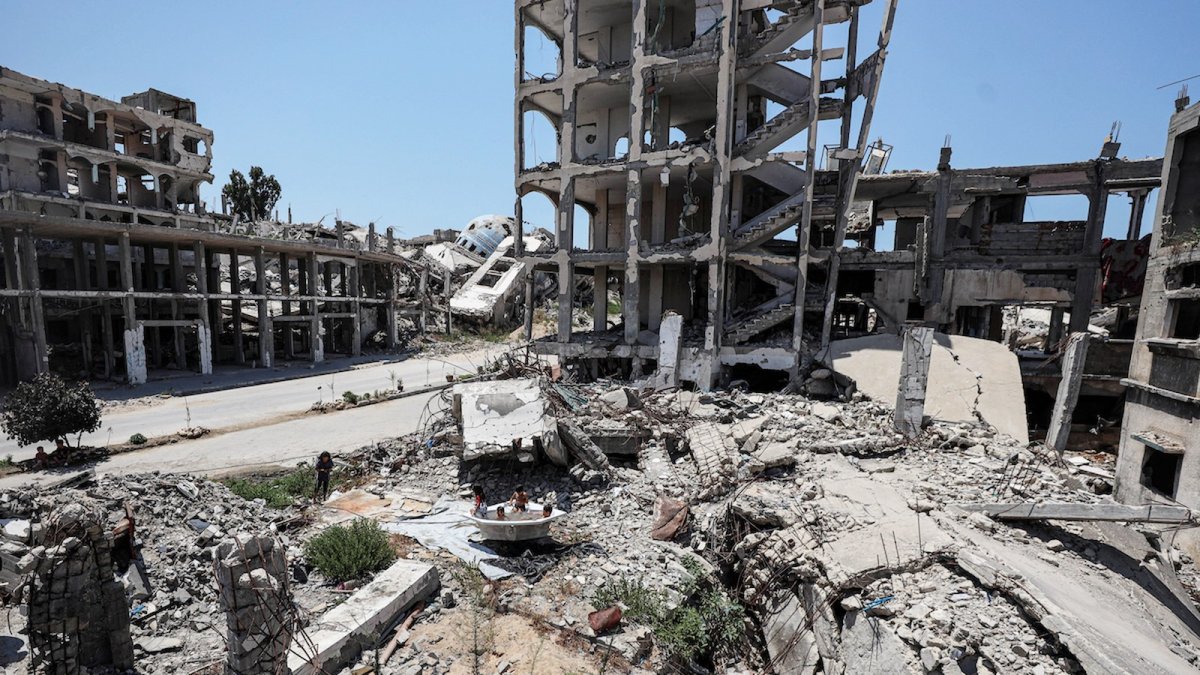
Gaza’s Future as a Military Buffer: Israel’s Blueprint for Permanent Displacement In the rubble-strewn neighborhoods of Beit Lahia, where children now cool off in bathtubs salvaged from destroyed homes, a new and chilling consensus is hardening among Israel’s political and military establishment.
Gaza’s Future as a Military Buffer: Israel’s Blueprint for Permanent Displacement
In the rubble-strewn neighborhoods of Beit Lahia, where children now cool off in bathtubs salvaged from destroyed homes, a new and chilling consensus is hardening among Israel’s political and military establishment. The debate over Gaza’s future is no longer about whether Palestinians will return, but about how to formalize their permanent absence. Former Israeli National Security Council head and retired General Giora Eiland has added his voice to this discourse, recommending that Gaza remain destroyed for generations and that Israel maintain its hold on the so-called Yellow Line, the buffer zone carved into the enclave’s perimeter. His proposal is not an outlier; it is the logical endpoint of a policy trajectory that has moved from military operations to explicit colonial planning.
Eiland’s recommendation, reported by Middle East Monitor, strips away any remaining pretense of a temporary security operation. He argues that Israel does not need to build settlements in Gaza, but rather can use the territory as a permanent military buffer zone. This framing is significant: it suggests that the destruction itself is the desired end state, not a byproduct of combat. For the families displaced from northern Gaza, from Beit Hanoun to Jabalia, this means their homes are not merely damaged—they are designated as a permanent exclusion zone. The distinction between a settlement and a military buffer is academic to a displaced family; both mean they cannot return.
Netanyahu’s Red Lines: No Withdrawal, No Negotiation
Prime Minister Benjamin Netanyahu has been unambiguous in his position. In recent statements, he has declared that there will be no military withdrawal from Gaza, effectively annexing the territory by military fiat without the formal trappings of sovereignty. This position has been met with a notable absence of international condemnation. The veneer of diplomatic opposition has eroded to the point where Netanyahu can articulate colonial intent openly, without fear of political consequence. The international community, which debated the genocide for nearly two years before acknowledging it less than a month before a ceasefire was declared, has effectively granted Israel a blank check.
Netanyahu’s calculus appears to be that military control over Gaza serves multiple purposes simultaneously. It satisfies his domestic political base, which has grown accustomed to the rhetoric of total victory. It provides a strategic buffer against any future Palestinian armed resistance. And, critically, it makes the forced displacement of Palestinians a permanent condition rather than a temporary wartime measure. The Prime Minister’s insistence on military control is not about security in the abstract; it is about ensuring that the demographic reality on the ground shifts irrevocably in Israel’s favor.
Smotrich’s Settlements: The Colonial Impulse Resurfaces
While Eiland and Netanyahu speak of military buffers and security zones, Finance Minister Bezalel Smotrich has renewed his calls for establishing full civilian settlements in Gaza. Smotrich, who has long advocated for the annexation of the West Bank, now sees Gaza as the next frontier for the settler movement. His vision is not merely about security; it is about demographic transformation. Settlements would bring Israeli civilians into the heart of the enclave, creating facts on the ground that would make any future Palestinian return politically impossible.
The tension between Eiland’s buffer-zone model and Smotrich’s settlement model is more apparent than real. Both approaches share a common foundation: the permanent exclusion of the Palestinian population. Whether Gaza is kept as a destroyed military zone or rebuilt as a civilian settlement, the outcome for the approximately 1.9 million displaced Palestinians is the same. They will not go home. The debate among Israeli officials is not about whether displacement should continue, but about what form the colonial project should take. This is a conversation that Palestinians have been excluded from entirely.
The Pilot Projects: Reconstruction as a Mirage
The international community’s response to Gaza’s destruction has been reduced to what officials euphemistically call “pilot projects.” These small-scale, limited initiatives are presented as first steps toward reconstruction, but they function as a political fig leaf. The United Nations initially publicized grand reconstruction plans, and the Board of Peace, authorized by the UN Security Council, proposed a comprehensive framework. These efforts, however, are relics of a past paradigm that failed Palestinians long before the genocide began. The shift to pilot projects signals that the international community has abandoned any serious commitment to rebuilding Gaza as a habitable place for its indigenous population.
The pilot project approach validates Netanyahu’s assertion that there will be no military withdrawal. If the international community accepts that reconstruction will be piecemeal, conditional, and subject to Israeli security vetoes, then it has effectively accepted that Gaza will remain under Israeli control indefinitely. The pilot projects are not a path to recovery; they are a mechanism for managing the optics of humanitarian concern while the underlying policy of displacement continues unabated. For the families living in tents amid the rubble, a pilot project in one neighborhood does nothing to address the systematic denial of their right to return.
The UN’s Complicity: From Genocide to Colonial Expansion
The United Nations’ role in this unfolding catastrophe cannot be separated from the broader failure to prevent the genocide itself. The international body debated the nature of the violence in Gaza for nearly two years, hesitating to use the term “genocide” until the death toll had reached catastrophic proportions. This delay was not a bureaucratic oversight; it was a political choice that granted Israel impunity. When the UN finally acknowledged the genocide, it was less than a month before a ceasefire was declared, a timing that suggested the acknowledgment was designed to avoid accountability rather than to enable intervention.
In the aftermath, the UN has refused to acknowledge the link between Gaza and the forcibly displaced Palestinians. Instead, it has shifted responsibility for Gaza to the United States, which in turn has granted full concessions to Israel. This delegation of authority is a dereliction of the UN’s foundational mandate. By outsourcing Gaza to Washington, the UN has absolved itself of any obligation to protect Palestinian rights. The result is that colonial expansion proceeds without even the pretense of international oversight. The UN’s penchant for failed paradigms—from the Oslo Accords to the two-state solution—has created the foundations for all that transpired in the Gaza genocide.
Historical Precedent: Rebuilding Over Destruction
History offers a grim lesson about what happens to destroyed Palestinian communities. After the 1948 Nakba, hundreds of villages were razed and never rebuilt. The ruins of those villages remain scattered across Israel, serving as silent monuments to a displacement that has never been reversed. The pattern repeated in 1967, and again in successive wars. Each time, the international community expressed regret, called for peace, and then moved on. The destruction of Gaza follows this same trajectory, but with a more explicit articulation of intent.
It is unlikely that Israel destroyed Gaza merely to leave it as a memory of the genocide it inflicted. The scale of the destruction—entire neighborhoods reduced to dust, agricultural land bulldozed, infrastructure obliterated—suggests a deliberate effort to make the territory uninhabitable. But leaving it in its current form is also politically risky for Israel. A permanently destroyed Gaza would be a visible indictment of Israeli policy, a tangible reminder of the genocide that the international community failed to stop. Rebuilding over the destruction, whether through settlements or through a controlled reconstruction process, is a more plausible scenario. It allows Israel to claim that it is bringing civilization to a barren land, erasing the evidence of what came before.
The Nakba Continues: Displacement as a Permanent Condition
For Palestinians, the current moment is not a new crisis but a continuation of the Nakba. The forcible displacement of 1948, which created the refugee population that still exists today, was the foundational trauma. Every subsequent war, every occupation, every siege has been an attempt to complete that original project. The current situation in Gaza is the most extreme manifestation of this ongoing Nakba. The international community’s failure to stop the genocide, and its current failure to address the displacement, are not aberrations; they are the logical outcomes of a paradigm that has never truly recognized Palestinian rights.
Hidden in plain sight, as always since 1948, are the forcibly displaced Palestinians. They are not a statistic or a footnote; they are people with names, histories, and a profound attachment to their land. The Israeli officials who speak of military buffers and settlement blocs are not discussing abstract geography. They are discussing the fate of families who have already been displaced multiple times, who have lost everything, and who are now being told that their return is not on the table. The international community’s silence in the face of this is not neutrality; it is complicity.
What Comes Next: The International Community’s Choice
The international community faces a stark choice. It can continue to enable Israel’s colonial expansion, accepting the pilot projects as a substitute for genuine reconstruction and the military buffer as a permanent reality. Or it can finally confront the paradigm that has failed Palestinians for nearly eight decades. The latter would require the UN to unravel its own complicity in the genocide, a process that would be painful and politically costly. Turning a blind eye to colonial expansion is much easier, and it is the path that the international community appears to be taking.
But the consequences of this choice are not abstract. Every day that passes without a genuine commitment to Palestinian return is a day that the displacement becomes more entrenched. The longer Gaza remains a military buffer zone, the harder it will be to reverse. The longer the international community accepts pilot projects as a substitute for reconstruction, the more it legitimizes the destruction. The choice is not between engagement and disengagement; it is between justice and complicity. For the families in Beit Lahia, for the children bathing in salvaged tubs, for the millions of refugees who have waited since 1948, the time for choosing has long passed. The question is whether the international community will finally choose to see them.
By Fatima Al-Rashid, Staff Writer
This article was produced with AI-assisted research and editorial support. Sources: Middle East Monitor.
What's Your Reaction?
 Like
0
Like
0
 Dislike
0
Dislike
0
 Love
0
Love
0
 Funny
0
Funny
0
 Wow
0
Wow
0
 Sad
0
Sad
0
 Angry
0
Angry
0

Gulf/MENA Correspondent at Global1.News. Based in Doha, covering Gulf politics, energy markets, diplomacy, and development across the Middle East and North Africa. Tracks the economic transformation of the Gulf states.












Comments (0)