
Iran and Oman Agree on Temporary Strait of Hormuz Transit Corridor as Full Reopening Remains Tied to US Commitments
Iran and Oman agreed on a temporary 7-mile Strait of Hormuz transit corridor, but Iran says the strait remains closed until the US meets lapsed June deal commitments. New US sanctions and security risks persist.
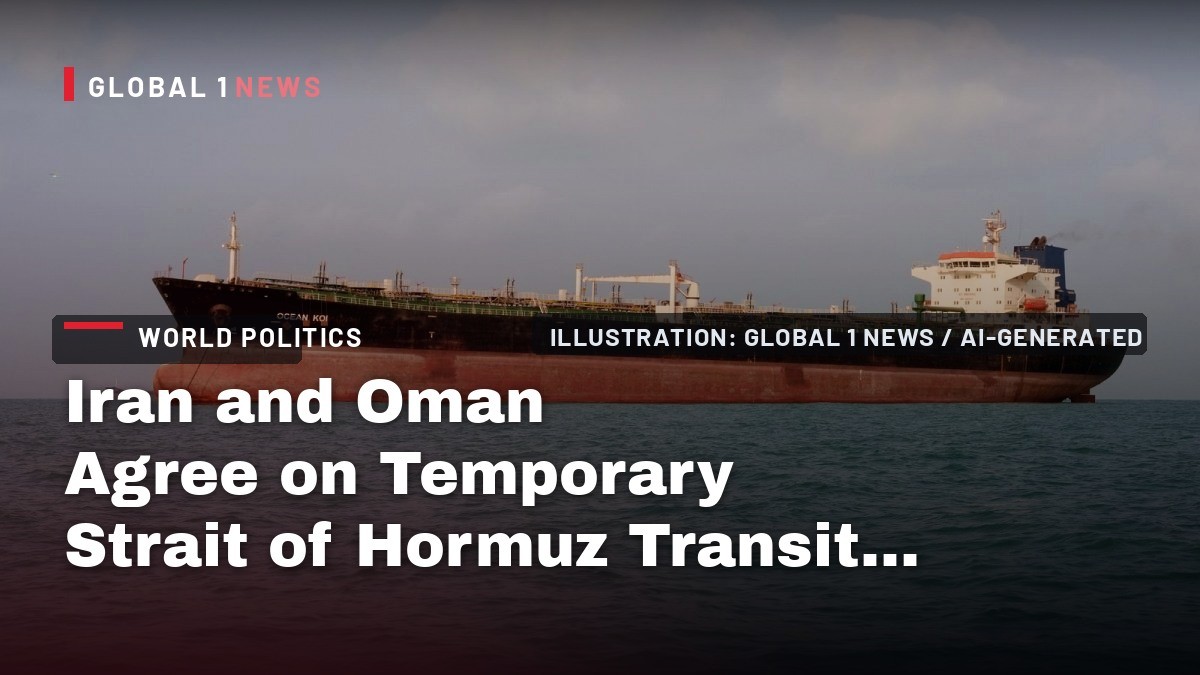
Iran and Oman have reached an agreement on a temporary maritime corridor through the Strait of Hormuz, a senior Iranian diplomat announced Tuesday, marking the first structured attempt to restore some shipping traffic through the waterway since it was effectively closed by conflict earlier this year. The deal, however, falls well short of a full reopening, and Iranian officials were emphatic that the strait remains closed to general traffic until the United States fulfills commitments under a lapsed interim peace agreement.
Deputy Foreign Minister Kazem Gharibabadi said on state television that the transit corridor will be 7 miles (11.3 km) wide, with entry beginning in Iranian territorial waters. "Part of the exit route would also be through our territorial waters," he said, according to reports from Al Jazeera and Reuters. The announcement follows months of near-total closure of the strait, through which more than 20 percent of global oil and LNG shipments from Gulf producers passed in peacetime, with roughly 130 ships crossing daily.
The agreement comes amid escalating US pressure on Iran, including new sanctions announced Monday against 60 entities accused of facilitating Iranian oil sales, and follows threats from President Donald Trump to make the Strait of Hormuz a US territory. Iranian officials have refused direct talks with Washington since US bombing of parts of Iran in July, saying they will speak directly only to Oman about the future of the waterway, which passes through the territorial waters of both countries.
A Temporary Route, Not a Reopening
Gharibabadi was explicit that the new corridor does not constitute an opening of the strait. "The agreed-upon transit route with Oman is a temporary route," he said, emphasizing that the waterway will not fully reopen until the United States fulfills its commitments under an interim peace deal signed in June. Those commitments include sanctions relief and the release of frozen Iranian assets — conditions that have not been met, and the memorandum of understanding has since lapsed.
The June 17 memorandum, sometimes referred to as the Islamabad memorandum of understanding, established a ceasefire of up to 60 days and included an Iranian commitment to keep the strait open for all traffic, free of charge, for that period. However, vague wording led to disagreements over routes, and the waterway fractured into two disputed courses — a southern route approved by Oman and backed by the US, used by commercial carriers under US naval protection, and a northern route approved by Iran. The MoU lapsed without a permanent resolution.
Iran's army spokesperson Mohammad Akraminia added a further layer of control, stating that vessels will be subject to Iranian surveillance before entering the strait and will only be allowed to pass if Iran grants permission. This condition underscores Tehran's insistence on maintaining authority over the waterway, a position that runs directly counter to Washington's core demand that Iran relinquish control of the strait as a condition for ending the war.
Oman's Mediating Role and the Joint Statement
Earlier Tuesday, Iran's Foreign Minister Abbas Araghchi met his Omani counterpart, Badr Albusaidi, in Tehran to discuss the temporary navigation corridor and a project to clear mines, according to a joint statement. Albusaidi said on X that he hoped the countries would "soon announce" the corridor, adding that "future management of the strait and a permanent solution will follow in due course." Technical talks are planned on a long-term arrangement, including information sharing and navigational and security services.
Oman has long positioned itself as a neutral mediator between Iran and the US, a country it considers an ally. The US and Oman have been partners for nearly 200 years, and Oman has not publicly stated it intends to join Iran in controlling the strait. The joint statement suggests a coordinated approach, but analysts caution that an exclusive Iran-Oman understanding could lend Iran's position greater legitimacy on the international stage.
Laleh Khalili, professor of Gulf studies at the University of Exeter, told Al Jazeera that a solution mediated without US intervention "would show how impotent the United States is and has been." Khalili noted that the strait lies entirely within the territorial waters of Iran and Oman, a legal reality that complicates US claims of control and could reshape the diplomatic landscape around the waterway.
Iran's Conditions and the Lapsed June Agreement
The June memorandum was signed amid a ceasefire that facilitated peace negotiations, but its collapse has left the strait in a state of high risk. Iran agreed to keep the strait open for all traffic, free of charge, for 60 days, but disputes over routes quickly emerged. The US accused Iran of planting mines in the strait — an accusation Iran has not confirmed but has addressed by saying that following its designated route would minimize the risk of encountering them.
President Trump has asserted that US forces destroyed "all" 28 Iranian mine-laying boats in the strait's international waters. Gharibabadi dismissed that claim Tuesday as "only aimed at calming the markets," and warned that US mine-detection vessels would become "very good targets" if they entered the area. The exchange highlights the continued volatility of the situation, even as a temporary corridor is announced.
The lapsed agreement has left the waterway fractured, with passage remaining high risk for commercial carriers. The US enforced a naval blockade of Iranian ports in and around the strait to restrict Iran's fuel exports, a measure that has compounded the economic pressure on Tehran. Iran's insistence on linking any full reopening to US sanctions relief and asset release suggests that a permanent resolution remains distant.
US Pressure and Sanctions Escalation
President Trump announced last week what he called the "most crushing economic operation ever" against Iran, threatening sanctions against any country doing business with it. On Monday, US Treasury Secretary Scott Bessent laid out a wave of new sanctions against 60 entities around the world that the US accuses of facilitating Iranian oil sales. The measures are designed to choke off Iran's revenue streams and force concessions on the strait.
Earlier in August, Trump claimed Washington has "total control" of the strait — a claim Iran dismissed. He also threatened to make the Strait of Hormuz a US territory on August 16, and on August 17 told Fox News, "If Oman gets in the way, we'll bomb the s*** out of them." This was not the first such threat; he made a similar statement in May. Trump has also claimed his administration opened a direct backchannel for talks with the IRGC — a claim Iranian officials have denied.
Gharibabadi urged countries to resist US pressure, saying, "We are urging countries not to succumb to American pressure regarding the sanctions that Washington wants to impose on us." He added that Washington was "mistaken about its ability to enforce its sanctions against our neighbours." The statement reflects Iran's strategy of seeking regional allies, particularly Oman, to counterbalance US economic warfare.
Market Impact and Energy Shortages
The announcement of the temporary corridor comes as Asia, heavily dependent on Gulf shipments, faces energy shortages from the closure. When Trump signaled in early August that a deal to reopen the strait was close, oil prices fell and stocks rose, indicating how sensitive markets remain to any development in the waterway. The new agreement, while limited, may provide some relief to shipping companies and insurers assessing risk in the region.
Just before the war, Brent crude — the global benchmark — was about $66 a barrel. Over the course of the conflict, prices surged past $100 on several occasions, most recently on July 23. In March, the highest Brent price reached almost $120 a barrel. The volatility reflects the strait's critical role in global energy supply, with more than 20 percent of global oil and LNG shipments passing through it in peacetime.
The temporary corridor, at 7 miles wide, is significantly narrower than the strait's full navigable width, and the requirement for Iranian surveillance and permission adds a layer of uncertainty for commercial operators. Under international law, tolls for passing through natural waterways such as Hormuz are forbidden, but fees for services such as insurance, environmental protection, and docking can be charged. The revenue-sharing arrangement between Iran and Oman, mentioned by an IRGC spokesperson, may fall into this category.
Security Risks and the Mine Threat
On Tuesday, an oil tanker was disabled by an unidentified projectile close to Oman's Ash Shishah, near the strait's entrance, according to the United Kingdom's Maritime Trade Operations (UKMTO). The incident underscores the continued security risks in the area, even as diplomatic efforts advance. The UKMTO report did not attribute the attack, but it highlights the fragile security environment surrounding the waterway.
Iran has not confirmed the US accusation that it planted mines in the strait, but the IRGC has issued route maps to "friendly" ships since April, routing traffic much closer to the Iranian coast and designating a large section of Omani territorial waters as "restricted." The new temporary corridor appears to formalize some of these arrangements, though the mine threat remains a significant concern for any vessel transiting the area.
An IRGC spokesperson said Wednesday, per Bloomberg and The Jerusalem Post, that "we entered into negotiations with Oman about a month ago and have reached results that have been accepted by both sides. Agreements have been reached on the share of each country in the waters of the strait and the share of Iran and Oman in its revenues." This statement suggests a deeper bilateral arrangement than the temporary corridor alone, with revenue-sharing implications that could shape future negotiations.
What Comes Next for the Strait
The temporary corridor is a stopgap measure, not a solution. Iran's demand that the US fulfill its commitments under the lapsed June agreement — including sanctions relief and asset release — remains the central obstacle to a full reopening. The US, for its part, continues to insist that Iran relinquish control of the strait, a position that Tehran has repeatedly rejected. The diplomatic impasse shows no signs of breaking.
Oman's role as mediator could prove pivotal. The joint statement from Araghchi and Albusaidi indicates a willingness to pursue technical talks on a long-term arrangement, including information sharing and navigational and security services. But Oman's neutrality and its alliance with the US create tensions that may limit how far it can go in supporting Iran's position. Analysts note that any exclusive Iran-Oman understanding would run contrary to Washington's demands and could deepen the rift between the US and its Gulf partners.
For now, the strait remains effectively closed to general traffic, with only the temporary corridor available to ships that receive Iranian permission. The 7-mile-wide route, subject to Iranian surveillance and approval, offers a narrow path through a waterway that once carried a fifth of the world's oil. Whether this arrangement holds, and whether it leads to a permanent solution, depends on factors far beyond the control of Tehran and Muscat — including the actions of a US administration that has shown it is willing to use both sanctions and military threats to achieve its objectives.
By Jessica Ali, Staff Writer
This article was produced with AI-assisted research and editorial support. Sources: Al Jazeera (aljazeera.com), Bloomberg, Reuters, The Jerusalem Post, France 24, NY Post.
What's Your Reaction?
 Like
0
Like
0
 Dislike
0
Dislike
0
 Love
0
Love
0
 Funny
0
Funny
0
 Wow
0
Wow
0
 Sad
0
Sad
0
 Angry
0
Angry
0

Editor-in-Chief at Global1.News. Atlanta-based journalist who cuts through the BS and tells it like it is. Lead anchor, host, and the voice you hear when the spin stops and the truth starts.











Comments (0)