
Gandalf Protesters Target Peter Thiel's Buenos Aires Mansion Over Oil and Influence
In a recent DW News report, protesters marched outside tech billionaire Peter Thiel's mansion in Buenos Aires, channeling the spirit of J.R.R. Tolkien's Gandalf to deliver a pointed message about foreign influence in Argentina. The demonstration, which took place this weekend, marks a growing discontent among Argentines over the PayPal co-founder's deepening financial and political footprint in their country.
Gandalfs at the Gate: A Protest Born from Fantasy
The first protest saw roughly a dozen individuals dressed as Gandalf the Grey — complete with grey tunics, pointed hats, and long white beards — gathered outside Thiel's mansion in Palermo Chico, one of Buenos Aires' wealthiest neighborhoods. The group chanted football-style songs at the gate, holding a banner that read "You shall not pass," a direct reference to the iconic scene in The Lord of the Rings where the wizard blocks the Balrog on the Bridge of Khazad-dûm.
One football-style song translated roughly to: "You've got palantirs to see the future / look in the mirror, you'll see an idiot." The reference to palantirs — the seeing stones from Tolkien's legendarium, associated with surveillance and corruption — was no accident. Thiel's AI and data-analytics firm, Palantir Technologies, is named after those very stones and holds government contracts spanning predictive policing, border control, and military intelligence across multiple countries.
The group, loosely identified in Argentine media as "Lxs Gandalfs del Sur" or "Ciudadan@s Gandalf," has no formal structure, no published manifesto, and no named leaders. Their demands exist entirely in their chants. According to Infobae, protesters called Thiel "a super villain living in our city." The theatrical nature of the protest — part lucha libre spectacle, part political theater — resonated deeply in a country where street protest is a time-honored tradition.
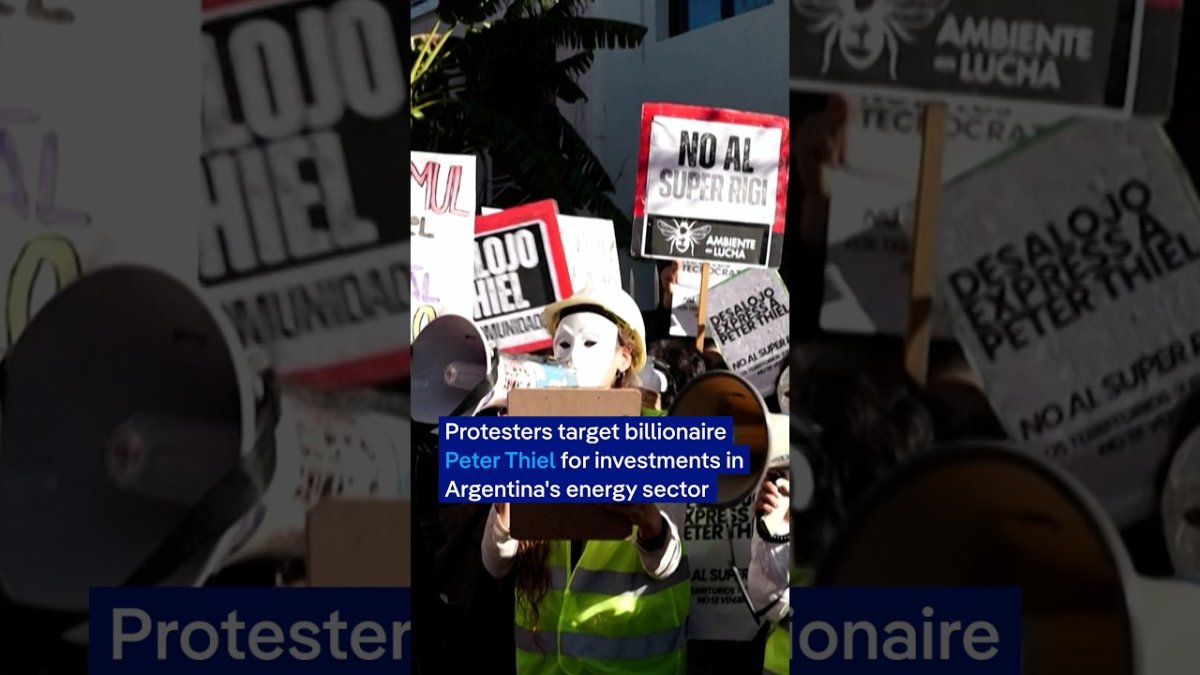
On Saturday, August 29, 2026, a new group of masked people with banners went to Barrio Parque, adjacent to Palermo Chico, to question Thiel's actions in Argentina. Argentine outlet Página/12 described it as "Desalojo express a Peter Thiel" — an express eviction of Peter Thiel. This second mobilization followed the earlier Gandalf protest, and footage circulated on X, reaching global media within hours. No arrests were reported, and no response came from Thiel or Palantir.
The Mansion and the Oil: Thiel's Argentine Portfolio
Thiel's presence in Argentina is not merely symbolic. He purchased a reported US$12 million mansion in Palermo Chico in 2026, with some reports citing US$13.5 million. But the real estate acquisition was just the beginning. After buying the mansion, Thiel moved into Argentina's energy sector with a significant financial stake.
Thiel's hedge fund, Thiel Macro LLC, disclosed in a SEC Form 13F filed August 14, 2026, a stake of about 1.2 million American depositary shares in Vista Energy SAB — Argentina's biggest oil exporter — valued at about US$76 million at the end of the second quarter of 2026. It was Thiel's first investment in the oil sector. Vista Energy is the shale powerhouse driving Argentina's Vaca Muerta boom in Patagonia, one of the world's largest reserves of unconventional oil and gas.
The market responded immediately. Vista Energy's American depositary receipts jumped 4.9% to $71.67, the highest level in two months, the Monday after the stake was disclosed in mid-August. For many Argentines, this was a stark illustration of how quickly foreign capital can move markets — and how little local communities have to say about it.
Milei and Thiel: A "Libertarian Laboratory"
Thiel's relationship with Argentine President Javier Milei is well-documented. The two first met in person in 2024 in a meeting brokered by Alec Oxenford, a former tech entrepreneur who is now Argentina's ambassador to the United States. Since then, Thiel has had multiple meetings with Milei, including at the Casa Rosada, the presidential palace.
The New York Times reported that Thiel's new roots in Argentina are partly motivated by concerns about the future of the United States and shared beliefs with Milei. Thiel has spoken about Argentina as a "libertarian laboratory," with plans floated for shale gas and lithium-powered AI data centers. For a man who has long expressed dystopian views about the United States' political trajectory, Argentina under Milei offers a blank canvas.
But what looks like an experiment to a billionaire looks like a threat to many citizens. Argentine concerns include data sovereignty, Palantir's influence in the region, and the "Super RIGI" investment incentive regime — a sweeping package of tax breaks, currency guarantees, and regulatory exemptions designed to attract large-scale foreign investment. Critics argue that Super RIGI hands over strategic national resources to foreign corporations with minimal oversight.
Palantir's Shadow: Surveillance and Data Sovereignty
Palantir Technologies is not a passive investor. The company's name itself is a warning, drawn from Tolkien's seeing stones that allowed their users to observe distant events — but also corrupted them over time. In the real world, Palantir's contracts with governments across the globe have raised alarms among civil liberties advocates.
In Argentina, the concern is acute. The country has a painful history of state surveillance during the military dictatorship (1976-1983), and the idea of a foreign tech billionaire with close ties to the president wielding data-analytics tools is deeply unsettling to many. The Gandalf protesters' chant about palantirs was not just a clever literary reference — it was a pointed critique of what they see as a surveillance state in the making.
This resonates far beyond Argentina. In Mexico, the debate over data sovereignty and foreign influence in technology has been equally charged. The Instituto Nacional de Transparencia, Acceso a la Información y Protección de Datos Personales (INAI) has repeatedly clashed with federal agencies over data protection. The mañanera briefings from Palacio Nacional have framed national resources — including data — as patrimony that must be defended from foreign extraction.
The Mexican context is instructive. When foreign tech companies have sought to expand in Mexico, from ride-hailing apps to data centers, the response has often been a mix of enthusiasm and suspicion. The same tension plays out in Argentina, but with a sharper edge given Thiel's explicit ideological alignment with Milei.

Vaca Muerta and the Resource Extraction Question
Vista Energy's operations in Vaca Muerta are central to Argentina's economic future. The shale formation in Patagonia has attracted billions in foreign investment, and the promise of energy independence is a powerful political narrative. But the human cost is often overlooked.
Communities in Neuquén province, where Vaca Muerta is located, have reported environmental concerns, water contamination, and housing shortages as workers flood into the region. The boom has created jobs, but it has also strained local infrastructure and deepened inequality. For many Argentines, Thiel's $76 million stake in Vista Energy is not a sign of confidence — it is a reminder that the profits from their natural resources are flowing to a man who lives in a mansion in Buenos Aires and holds a passport from a country that has historically intervened in Latin American affairs.
The "Super RIGI" regime exacerbates these fears. By offering foreign investors unprecedented protections and exemptions, the Milei administration has signaled that it prioritizes capital over community. The Gandalf protesters' message — "You shall not pass" — is as much about defending Argentine sovereignty as it is about stopping one billionaire.
A Regional Backlash Against Billionaire Power
The protests in Buenos Aires are not an isolated phenomenon. Across Latin America, there is a growing backlash against the concentration of wealth and power in the hands of a global tech elite. In Mexico, the debate over foreign investment has been framed by the current administration as a struggle between national sovereignty and neoliberal extraction. The mañanera briefings have repeatedly emphasized the importance of keeping strategic sectors — energy, lithium, telecommunications — under national control.
Thiel's arrival in Argentina, with his mansion, his oil shares, and his AI ambitions, has become a lightning rod for these anxieties. He represents everything that critics of the libertarian project fear: unaccountable wealth, ideological extremism, and a willingness to treat entire countries as experiments.
The masked protesters who went to Barrio Parque on Saturday were not just targeting one man. They were targeting a system that allows billionaires to buy influence, extract resources, and shape policy with little regard for the people who actually live there. The Página/12 headline — "Desalojo express a Peter Thiel" — captured the sentiment perfectly: this is about evicting an unwanted presence, not just protesting it.
What Comes Next for Argentina and Latin America
Thiel has not responded to the protests, and Palantir has remained silent. But the silence is unlikely to quell the discontent. The protests have already achieved something significant: they have put Thiel's Argentine ventures under a global spotlight. The footage circulating on X and picked up by international media has turned a local demonstration into a regional story.
For Argentina, the question is whether the Milei administration will heed the warnings or double down on its libertarian experiment. The Super RIGI regime is already in place, and Vista Energy's stock continues to climb. But the political cost may be rising as well. If the protests grow, they could become a rallying point for a broader opposition movement — one that connects the dots between foreign billionaires, surveillance technology, and resource extraction.
For Latin America as a whole, the Buenos Aires protests are a warning sign. The region has long been a battleground for foreign powers seeking resources and influence. The difference now is that the actors are not just governments and corporations — they are individuals with more wealth than many nations. Peter Thiel's bet on Argentina is a test case for whether the region will accept this new form of power or push back.
The Gandalfs of Buenos Aires have made their position clear. Whether the rest of Latin America follows remains to be seen. But one thing is certain: the image of a dozen wizards chanting "You shall not pass" at the gates of a billionaire's mansion is a powerful symbol of resistance — and it is not going away anytime soon.
By Rosa Martinez, Staff Writer
This article was produced with AI-assisted research and editorial support. Reporting is based on sources cited in the article.
What's Your Reaction?
 Like
0
Like
0
 Dislike
0
Dislike
0
 Love
0
Love
0
 Funny
0
Funny
0
 Wow
0
Wow
0
 Sad
0
Sad
0
 Angry
0
Angry
0
Latin America/Andes Correspondent at Global1.News. Based in Bogota, covering politics, environment, energy, and social movements across the Andean region. Passionate about environmental journalism and communities protecting their land.













Comments (0)