
Europe Is Tired of Renting America's AI Computers — So It Just Opened Bidding on Seven of Its Own
The EU opened bidding on July 30 for seven AI gigafactories — 10 billion euros of public money designed to unlock 20 billion more. Europe is trying to stop renting American compute, and the buildout changes the hosting market.
Europe Is Tired of Renting America's AI Computers — So It Just Opened Bidding on Seven of Its Own
Let me tell you something that's been sitting wrong with me all week. The European Union opened bidding on July 30 for seven AI gigafactories — the biggest sovereign compute bet the continent has ever made. Ten billion euros of public money, designed to unlock at least twenty billion more in private capital, to build seven facilities that each pack a hundred thousand cutting-edge AI chips.
And I know what you're thinking, because I thought it too: finally. A continent looked at the AI buildout, looked at who owns the compute, and decided it's done being a tenant. Euronews has the story — the video is worth your time. But this isn't a funding story. It's a dependency story wearing a funding costume.
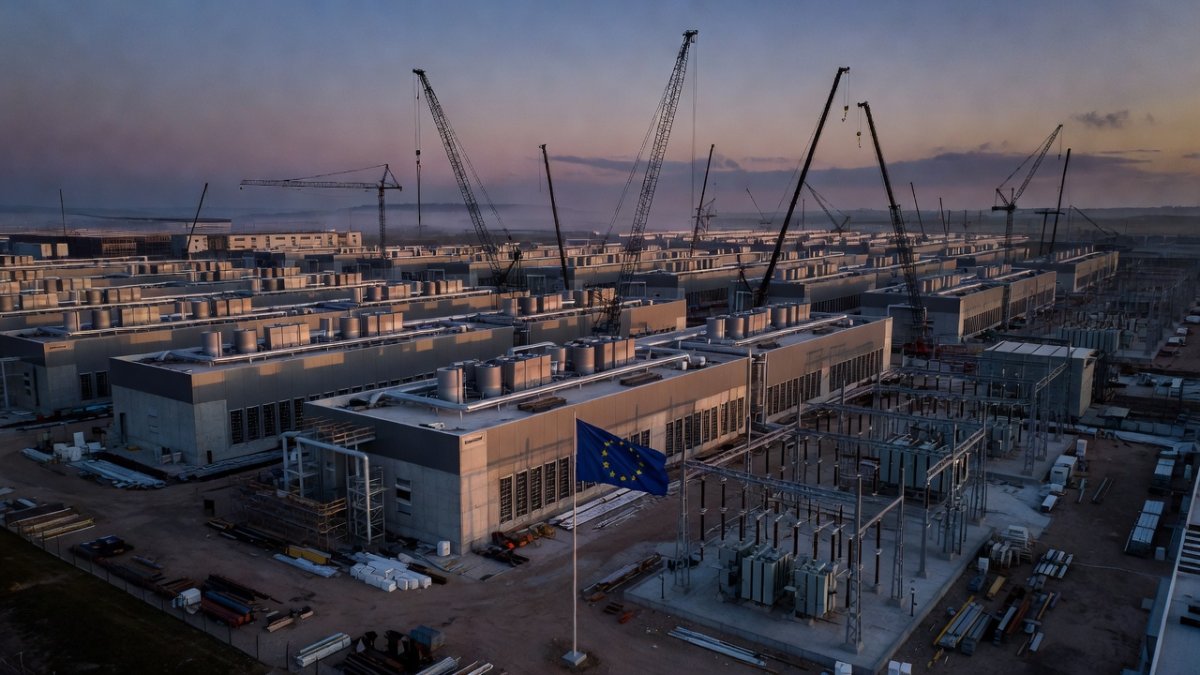
The Announcement — What Brussels Actually Did
The mechanics first. The European Commission and the EuroHPC Joint Undertaking opened a formal call for tenders to select consortia that will build and operate the gigafactories — up to seven of them, across one or several member states, including cross-border distributed facilities. Proposals are due November 12. Selection happens early 2027. The winners have eighteen months to get operational — call it mid-2028 for the first machines humming.
Each gigafactory has to field at least 100,000 of the most advanced AI processors available — roughly four times the power of the biggest AI data center Europe is running today. The numbers back the sales pitch: the continent's entire current AI compute network, nineteen AI Factories stretching from Finland to Spain, will more than double when these seven come online.
The public money — ten billion euros from the Union and member states combined — is designed as an anchor customer, not a handout. The procurement model is built to de-risk the private capital that's supposed to follow: at least twenty billion euros in private investment, taking the total past thirty billion. The European Investment Bank is in. The Commission has reportedly signed letters of intent with AMD, Nvidia, and Qualcomm to smooth hardware access. Even the energy angle is handled — the call demands energy-efficient data centers, which in Europe is less a slogan than a survival requirement.
The Dependency Problem — Five American Clouds and a Continent That Rents Them All
Now here's the part that should make every founder in Europe sit up straight. The Commission's own report, presented to the European Parliament back in June, spelled it out in language that's unusually honest for a bureaucracy: Europe's top five cloud providers are all American. All five.
Stanford's AI Index puts Europe at about six percent of significant AI models, against more than fifty percent for the United States. Other analyses say Europe holds roughly five percent of global AI compute. Five percent. A continent of 450 million people running on five percent of the world's AI brains — and renting most of that five percent from companies headquartered three thousand miles away.
The Commission report said it better than I can: "European businesses and public authorities will continue to rely on US AI providers to the detriment of European service providers struggling to work at the frontier." And then the kicker: dependence on hyperscale cloud providers "will continue to expose data to third-country access and carry risks to service continuity, endangering operational autonomy."
Read that again. That's the European Commission — the most regulation-happy institution on the planet — admitting that its own continent's data lives in buildings it doesn't control, on terms it can't dictate. Henna Virkkunen, the Commission's tech sovereignty chief, called access to raw computing power "a strategic necessity." She's right. It's also a strategic hole.
The Mistral Sub-Plot — One Company Already Got the Memo
You want proof the dependency is real? Look at what France's Mistral just did. The company spent 830 million dollars building its own data center campus in Paris — one of the largest AI facilities in the EU so far. Until now, Mistral ran its models on Microsoft Azure, Google Cloud, and CoreWeave. The standard startup playbook: rent compute, ship fast, worry about margins later.
Then someone did the math on what renting actually costs when you're a strategic competitor. Mistral isn't waiting for the gigafactories. It's building its own floor. That's the private sector's vote of no-confidence in rented compute — the most important signal in this whole story. When a company that's been renting from the hyperscalers for years decides owning beats renting, the "rent forever" thesis has a hole in it.
The Counter-Argument — Thirty Billion Euros Is a Rounding Error
Now let me be the guy who argues with himself, because this is where the skeptics have a point. American hyperscalers are on track to spend more than a trillion dollars on AI infrastructure. The EU's thirty billion — ten public, twenty private — is a rounding error next to that. One good quarter from one hyperscaler capex plan and the gigafactory budget is dust.
Electricity in the EU can cost two to three times what it costs in the United States or China, according to the Commission's own numbers. Europe doesn't manufacture most of the components that go into a data center. And the question the analysts keep asking: if Europe builds the gigafactories, will an AI industry actually come? A building full of chips isn't a business. It's a building full of chips.
And the sharpest critique I've seen from the European tech community is that this isn't a funding problem at all — it's a deployment problem. Europe has announced flagship AI compute projects for years. The gap between announcement and operation is where European tech goes to die. Eighteen months to operational is optimistic. I'd call it aggressive.
What This Actually Means for Independent Hosting Providers
Here's where I stop editorializing and start telling you what to do with this.
First, if you serve European customers, data residency just became a growth market. Every one of those Commission warnings about "third-country access" is going to convert into procurement requirements. European companies are going to be asked — by lawyers, by regulators, by nervous procurement officers — where their data physically lives. Independent hosting in the EU just got a sales pitch it didn't have six months ago.
Second, do not try to compete with a hundred-thousand-chip gigafactory on raw frontier compute. You will lose. You don't have the balance sheet, the power contract, or the patience. Compete on what a gigafactory structurally cannot do: hand-holding, compliance, custom setups, a human who answers the phone. The hyperscalers and the gigafactories fight over the frontier; you own the messy middle.
Third, watch the 2028 capacity curve. Seven gigafactories, plus Europe's announced push to triple data center capacity in five to seven years, means a lot of EU compute coming online at once. When that hits, colo pricing in Europe gets interesting — for buyers, not sellers. If you're a European provider, don't sign long-term capacity leases you can't exit. If you're a US provider with EU ambitions, wait for the glut and buy the pieces.
Fourth, study the anchor-customer model. The EU isn't building these gigafactories itself — it's underwriting private consortia with guaranteed public procurement. That's the single most bankable infrastructure model in the world right now: a sovereign anchor tenant de-risking a private build. If you ever wondered how to fund a serious data center without a hyperscaler checkbook, this is the template.
The Structural Reality — Sovereignty Takes a Decade, Not a Tender
Let me leave you with the part nobody in Brussels wants to hear. A tender doesn't build a semiconductor industry. Seven gigafactories, even at a hundred thousand chips each, don't close a dependency that took thirty years to open. Europe will still buy its GPUs from America, its HBM from Korea, its power at double the US price. The gigafactories make the dependency less acute. They do not end it.
But here's the thing — they were never supposed to end it overnight. This is a decade-long project wearing a two-year timeline. The announcement matters because it's the first time the continent has treated compute as infrastructure, the way it treats roads and grids. That's the real story. Not the thirty billion. The shift in thinking.
The Bottom Line
I've been running infrastructure long enough to know one thing for certain: renting compute is fine — right up until the landlord decides you're a competitor. Europe just spent thirty billion euros making sure it's never in that position again. The gigafactories may or may not deliver on schedule. The dependency may take a decade to unwind. But the direction of travel is set.
If you're a hosting provider, the lesson is the same whether you're in Frankfurt or Phoenix: don't build your business on infrastructure you don't control. Europe figured it out. The question is whether you have.
— Allan Ali, Founder
This article was produced with AI-assisted research and editorial support. Reporting is based on sources cited in the article.
What's Your Reaction?
 Like
0
Like
0
 Dislike
0
Dislike
0
 Love
0
Love
0
 Funny
0
Funny
0
 Wow
0
Wow
0
 Sad
0
Sad
0
 Angry
0
Angry
0

Publisher of Global1.News. Automation architect, systems builder, and the guy making sure the truth gets published.















Comments (0)