
Drunk Driver Kills Three in Nonthaburi After World Cup Final
The Early Morning Collision in Tambon Sano Loi The crash occurred at 4.30am on the main street inside a housing estate in tambon Sano Loi, Bang Bua Thong district, Nonthaburi province. Two women passengers aged 77 and 82 were leaving home to sell desserts at Bang Bua Thong Market when the collision took place. Emergency responders found the severely damaged tuk-tuk lying on its side with three bodies beside it, including the 37-year-old female driver Prathum.
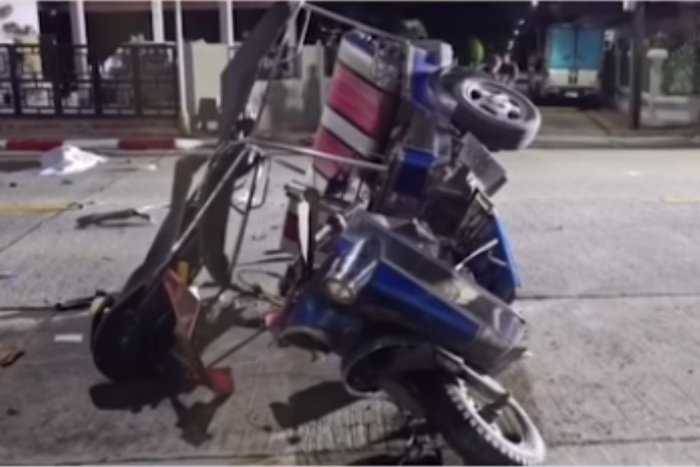
In the quiet hours before dawn in a Nonthaburi housing estate, a single moment of impaired judgment shattered the lives of three women whose daily routines sustained their families and neighbors. A 32-year-old driver, returning from World Cup celebrations, collided with a tuk-tuk carrying two elderly market vendors and their trusted driver, leaving a community in mourning. This tragedy, unfolding in tambon Sano Loi, Bang Bua Thong district, underscores the fragile balance between joy and loss that often follows Thailand's most cherished gatherings.
Drunk Driver Kills Three in Nonthaburi Housing Estate After World Cup Final
Bangkok, Thailand — Article continues...
The Early Morning Collision in Tambon Sano Loi
The crash occurred at 4.30am on the main street inside a housing estate in tambon Sano Loi, Bang Bua Thong district, Nonthaburi province.
Two women passengers aged 77 and 82 were leaving home to sell desserts at Bang Bua Thong Market when the collision took place.
Emergency responders found the severely damaged tuk-tuk lying on its side with three bodies beside it, including the 37-year-old female driver Prathum.
A black BMW with a damaged front end remained jammed against a streetside tree after the impact.
Victims Identified as Local Market Vendors and Tuk-Tuk Driver
The two elderly passengers, known locally as Aunty Pat and Aunty Lamai, regularly traveled with Prathum to sell desserts at the market.
Prathum, a mother of two children in Grades 7 and 3, had picked up the vendors every day for many years according to her husband Rungsak.
Rungsak, aged 49, learned of the deaths from a motorcycle taxi driver and confirmed the loss at the scene in tambon Sano Loi.
The families in Bang Bua Thong district now face immediate financial and emotional hardship following the loss of three breadwinners.
Bang Bua Thong Police Record Driver Statement and Blood Alcohol Level
The 32-year-old BMW driver, identified as Yossathorn, told Namploy he lived in the same housing estate and was returning from a restaurant on Ratchaphruek Road.
Yossathorn had watched the World Cup final at the restaurant before driving home through Nonthaburi.
Bang Bua Thong police measured his blood alcohol level at 152 milligrammes per 100 millilitres, three times the legal limit of 50mg per 100ml.
Security camera recordings showed the BMW traveling at speed before striking the tuk-tuk and then hitting the tree.
Niece Namploy Describes Hearing the Crash and Initial Response
Namploy, the 38-year-old niece of the two elderly victims, was awake at home in the housing estate when she heard the collision.
She rushed outside and found Aunty Pat and Aunty Lamai had been killed instantly beside the overturned tuk-tuk.
Yossathorn remained at the scene until Bang Bua Thong police arrived and stated he would take responsibility for his actions.
Local residents in tambon Sano Loi gathered quickly to support the families in the hours after the incident.
Impact on Rungsak and the Children Left Behind in Nonthaburi
Rungsak and Prathum had been together for more than 20 years before the crash ended their partnership.
The couple's two children now face life without their mother in their Bang Bua Thong home.
Rungsak expressed devastation at having to raise the children alone following a tragedy that could have been prevented.
Community members in tambon Sano Loi have begun offering support to the family during the initial mourning period.
Thailand's Ongoing Road Safety Crisis and Drunk Driving Enforcement
The Royal Thai Police continue to record high numbers of fatalities from alcohol-related crashes across Nonthaburi and greater Bangkok each year.
Thailand maintains one of the highest road death rates in Southeast Asia, with many incidents occurring in the early morning hours after social events.
The legal blood alcohol limit of 50mg per 100ml exists to protect vulnerable road users such as tuk-tuk passengers and market vendors.
Bang Bua Thong police have confirmed that Yossathorn will face prosecution under existing traffic laws for the deaths in tambon Sano Loi.
Thailand continues to rank among the world's most dangerous places for road travel according to World Health Organization data, with an estimated 20,000 to 25,000 fatalities annually that place the country near the top of global lists for road deaths per capita. This grim standing reflects deep-rooted issues including lax enforcement, widespread alcohol consumption, and inadequate infrastructure in both urban and rural areas. During festive periods the numbers spike dramatically, turning what should be celebrations into periods of national mourning as families lose loved ones to preventable crashes. The cultural acceptance of drinking as part of social gatherings only compounds the problem, leaving authorities struggling to change long-standing behaviors despite repeated public awareness campaigns.
In the lead-up to Songkran 2026, police recorded more than 1,300 drink-driving cases nationwide, with Nonthaburi alone accounting for 110 incidents that highlighted how suburban areas are increasingly affected. Drivers face severe legal consequences including up to one year in prison, fines ranging from 5,000 to 20,000 baht, and immediate license suspension, yet many still take the risk during holidays. The upcoming FIFA World Cup final, hosted across the United States, Canada, and Mexico with Spain emerging victorious, historically triggers similar spikes in impaired driving throughout Southeast Asia as fans gather to celebrate or commiserate late into the night. Bangkok police have responded with intensified nightclub crackdowns, setting up checkpoints near popular entertainment districts to catch intoxicated drivers before they reach the roads.
These enforcement efforts reveal both progress and persistent gaps in Thailand's approach to road safety. Officers often work long shifts during high-risk periods, balancing cultural respect for celebrations with the urgent need to protect lives. Community leaders in areas like Nonthaburi have begun partnering with police to promote designated driver programs, drawing on traditional Thai values of collective responsibility. Still, the combination of major sporting events and national holidays creates perfect conditions for tragedy, underscoring the need for sustained, year-round strategies rather than seasonal crackdowns alone.
The World Cup Connection: Post-Match Celebrations and Impaired Driving
Major sporting events like the 2026 FIFA World Cup, hosted jointly by the United States, Canada, and Mexico with Spain claiming victory in the final, have long been linked to rises in impaired driving incidents worldwide. Post-match celebrations often spill into the streets with alcohol flowing freely, creating dangerous conditions for drivers who underestimate their level of intoxication. In Southeast Asia these global moments amplify existing cultural tendencies toward social drinking, turning what begins as joyful gatherings into sources of heartbreak when participants later climb behind the wheel. Thai authorities have observed similar patterns during previous tournaments, prompting temporary alcohol sales restrictions around match times in an effort to reduce risks.
During earlier World Cup periods, Thailand implemented targeted measures such as limiting bar operating hours and increasing roadside checkpoints, yet enforcement remained inconsistent across provinces. These restrictions acknowledged the powerful draw of international football while attempting to safeguard communities, though many fans still found ways to continue celebrations privately. The global concern over road tragedies following major matches has led neighboring countries to experiment with public transport incentives and designated driver campaigns tied directly to game schedules. Thailand could build on these lessons by expanding similar programs ahead of future events.
Looking ahead, Thai authorities might consider more proactive steps such as widespread public messaging in both Thai and English, partnerships with football fan clubs to promote safe transport options, and extended sobriety checkpoints in entertainment districts during key matches. Integrating these efforts with existing Songkran-style enforcement could create a more consistent culture of responsibility around high-profile sporting occasions. By learning from past patterns and neighboring successes, Thailand has an opportunity to turn global sporting moments into safer shared experiences rather than sources of preventable loss.
Why This Tragedy Resonates Across Thai Communities and the Region
Daily routines like traveling to Bang Bua Thong Market form the backbone of local economies in Nonthaburi province.
The sudden loss of three women who supported families through market work highlights the ripple effects of impaired driving on entire neighborhoods.
Buddhist teachings on impermanence find direct expression in such sudden events that alter multiple households in a single moment.
Readers across Southeast Asia see similar patterns of post-event driving risks after major sporting occasions, underscoring the need for stronger local enforcement.
Tuk-tuks remain far more than colorful tourist attractions in Thailand; they serve as vital daily transport for local workers, market vendors, and families navigating narrow sois and congested streets where larger vehicles cannot easily pass. In neighborhoods across Nonthaburi and greater Bangkok, these three-wheeled vehicles carry fresh produce to morning markets, ferry children to school, and help elderly residents reach temples or clinics. When a crash claims the lives of tuk-tuk drivers, entire communities feel the absence because these operators often know their regular passengers by name and provide a human touch that ride-hailing apps cannot replicate. Their loss disrupts the quiet rhythms of neighborhood life that many Thais depend upon.
The economic ripple effects extend well beyond the immediate families when three income earners are lost in a single incident. Local markets lose reliable suppliers and customers, while small businesses that relied on these drivers for deliveries or transport face sudden shortfalls. In tight-knit suburban communities, such tragedies can reduce household spending power, affecting everything from food stalls to temple donation drives. The interconnected nature of Thai local economies means one crash can quietly diminish opportunities for dozens of neighboring households who depend on the same daily flows of people and goods.
Buddhist perspectives on making merit through honest daily work add another layer of sorrow, as sudden death interrupts the cycle of positive actions these drivers performed through their labor. Communities respond with extended mourning rituals, merit-making ceremonies, and collective support for surviving relatives, reflecting deep cultural values of compassion and continuity. Nonthaburi's rapid suburban growth has brought more daily commuters onto already busy roads, increasing both the volume of traffic and the emotional weight when tragedy strikes close to home.
By Ann Srisawat, Staff Writer
This article was produced with AI-assisted research and editorial support. Reporting is based on sources cited in the article.
What's Your Reaction?
 Like
0
Like
0
 Dislike
0
Dislike
0
 Love
0
Love
0
 Funny
0
Funny
0
 Wow
0
Wow
0
 Sad
0
Sad
0
 Angry
0
Angry
0

Southeast Asia Correspondent at Global1.News. Based in Bangkok, covering Thai and Southeast Asian politics, economy, technology, and culture. Deep regional perspective on one of the world's most dynamic regions.














Comments (0)