
Danielle Smith rejects energy export tariffs, urges diplomacy as Canada-U.S. trade war escalates
Alberta Premier Danielle Smith is urging Canada to “double down” on diplomatic engagement with American officials and resist calls to weaponize the province’s energy exports, warning that any move to tax or cut off oil shipments to the United States would trigger a devastating retaliatory response t
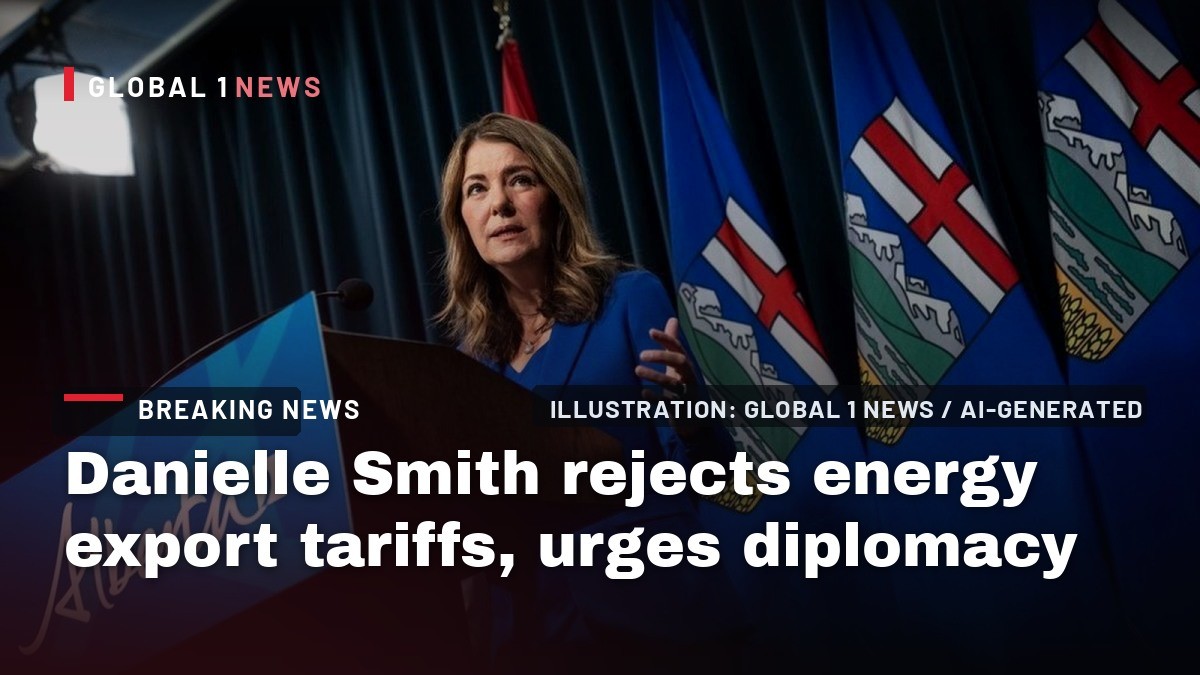
Danielle Smith rejects energy export tariffs, urges diplomacy as Canada-U.S. trade war escalates
Alberta Premier Danielle Smith is urging Canada to “double down” on diplomatic engagement with American officials and resist calls to weaponize the province’s energy exports, warning that any move to tax or cut off oil shipments to the United States would trigger a devastating retaliatory response that could cost half a million Canadian jobs.
Speaking at a news conference on Wednesday, Smith rejected demands from the Opposition NDP, as well as former premier Jason Kenney, to use Alberta’s energy sector as a high-stakes bargaining chip in the ongoing trade dispute with the administration of U.S. President Donald Trump.
“Although I understand the need to respond strongly to these tariffs, I cannot think of a more disastrous policy decision than cutting off or taxing Alberta’s oil to the United States,” Smith said. “When you take an action, you have to expect an equal and opposite — and probably even more forceful — reaction.”
The premier cautioned that the U.S. possesses the capacity to cripple Canada’s energy infrastructure and economy in response to any aggressive move from Ottawa or the provinces.
“It would not only extinguish the livelihoods of hundreds of thousands of Albertans, it would economically hobble our friends and neighbours in other provinces to the east,” she said.
A dire prediction of retaliation
Smith outlined a grim scenario if Canada were to enact a 50 per cent tariff on the four million barrels of oil exported southward each day. She predicted the U.S. would respond with retaliatory tariffs ranging from 50 to 100 per cent on all oil and gas products, including refined fuels such as aviation gasoline and diesel that are shipped from American refineries to Eastern Canada.
“This would result in the loss of about half a million jobs at a minimum, mostly in Alberta, but also hundreds of thousands of jobs in Ontario and Quebec,” she said.
The premier argued that cutting off exports entirely would produce an even worse outcome, particularly as Canada heads into the colder months.
“The United States would, of course, respond and cut off all gasoline and diesel from their refineries to Ontario and Quebec, right as we turn into fall and winter,” Smith said.
She also warned that American refineries currently processing Alberta’s heavy crude would pivot to alternative suppliers, likely turning to Venezuelan oil to fill the gap.
“As a result, we would lose the United States as a customer entirely and likely forever,” she said.
So far, Alberta’s oil and gas exports to the U.S. have avoided the tariffs imposed by the Trump administration. Provincial statistics peg the value of Alberta’s oil exports to the U.S. in 2025 at close to $111 billion — representing much of the province’s nearly $177 billion worth of all global exports.
Patience over confrontation
Smith said she does not believe Canada can win the dispute through force or economic coercion, arguing instead that the country’s advantage lies in its reputation as a reliable and amicable partner.
“We need to be wise, patient, careful and deliberate to overcome the economic attacks our country is facing. So rather than making threats and promises we know we cannot keep, Canada should focus on what we can control and do,” she said.
The premier pointed to the upcoming U.S. midterm elections on Nov. 3, when all 435 seats in the House of Representatives and 35 of the 100 Senate seats will be contested. If Democrats regain control of either chamber, they would be positioned to block Trump’s legislative agenda and launch investigations into his administration for the final two years of his term.
Smith said Canada needs to seize that political moment.
“We must give our people and our businesses the resources they need to survive, and give the American people and their leaders the time they need to reverse these terrible policies after the November midterms,” she said.
The Alberta premier said that means de-escalating threats and ramping up diplomacy with U.S. Congress members and state governors from both parties, with the goal of communicating how destructive the tariffs are for American consumers and businesses.
“Canada will not win this battle through brute force. We will win it through being smarter, more strategic, more agile, and using our relationship with the American people to have these tariffs reversed,” Smith said.
NDP accuses premier of inaction
Opposition NDP Leader Naheed Nenshi sharply criticized Smith’s approach, accusing her of offering little more than hope in the face of an escalating economic conflict.
“She thinks being nice to the Americans and hoping they come around is a strategy,” Nenshi said after Smith’s news conference. “It isn’t. Hope is not a strategy and relying on Trump is certainly not a strategy.”
The NDP called for tougher measures, including banning American liquor from provincial shelves and cancelling the upcoming referendum on Alberta’s future within Canada to focus entirely on the trade war.
“For more than a year now we’ve been talking about the need to strengthen Canadian markets, forming a more strategic relationship with the United States, diversifying our global trade relations, attracting global talent, and, most of all, protecting Alberta’s workers,” Nenshi said.
“Every other premier is on board with Team Canada except Danielle Smith. Let’s get back to work and save Canada.”
Referendum debate intensifies
Those advocating for Alberta to remain in Canada also weighed in on Wednesday. Thomas Lukaszuk, organizer of the Forever Canada campaign, said the Oct. 19 referendum on the province’s political future must be deferred given the gravity of the trade dispute.
“In light of the recent unprovoked trade war launched by U.S. President Donald J. Trump, we submit that this is not the time for unnecessary domestic conflict; this is the time for Albertans to stand together with our fellow Canadians and collectively rally against this unprecedented economic threat,” Lukaszuk said in an open letter to the premier.
Smith dismissed the suggestion that the referendum should be postponed, framing it as a separate matter from the trade dispute. She argued that the current circumstances actually underscore the value of Canadian unity.
“I think this is an important time for us to be looking at the benefits that come from being a part of Canada. That’s what I’ve been advocating. That’s why I’m voting to remain,” she said.
Counter-tariffs and provincial co-operation
During her afternoon news conference, Smith said she opposes tariffs on principle but acknowledged that Prime Minister Mark Carney’s list of proposed counter-tariffs is a proportionate response to the U.S. measures that took effect Saturday.
The U.S. has levied import fees on $28 billion worth of Canadian goods, with Canada announcing counter-tariffs that are to kick in Sept. 8 on an array of items, ranging from American steel and aluminum products to video game consoles and fishing rods.
Smith called on her fellow premiers and the federal government to do more to protect Canadian businesses through the fray, including implementing tax reform measures and reducing interprovincial trade barriers around alcohol.
“No more protectionism — stop talking about it and just do it,” she said.
The premier also called for an accelerated approval timeline for the West Coast pipeline that her government is pitching, arguing that expanding export capacity to markets beyond the U.S. is essential for long-term economic security.
Smith said she has formed two new committees in response to the breakdown in trade talks, as well as an online portal for businesses to share how they are being impacted by tariffs.
One committee, made up of her cabinet members, is scheduled to discuss on Thursday whether to follow Saskatchewan’s lead by imposing a 50 per cent tax on U.S. alcohol brought into the province. Smith said she prefers Premier Scott Moe’s approach to an outright ban on American alcohol in Alberta, noting that Canadian products are not blocked from going south of the border.
“Maybe this is an opportunity for all provinces to look at if we’re going to match equal for equal,” she said.
Tags: Danielle Smith, Alberta, trade war, tariffs, U.S.-Canada relations, energy exports, oil sands, Naheed Nenshi, Jason Kenney, Mark Carney, Thomas Lukaszuk, Scott Moe, midterm elections, interprovincial trade, West Coast pipeline, referendum
By Alex Thompson, Staff Writer
This article was produced with AI-assisted research and editorial support. Sources: Global News (globalnews.ca).
What's Your Reaction?
 Like
0
Like
0
 Dislike
0
Dislike
0
 Love
0
Love
0
 Funny
0
Funny
0
 Wow
0
Wow
0
 Sad
0
Sad
0
 Angry
0
Angry
0

Canada Correspondent at Global1.News. Based in Toronto, covering Canadian politics, energy, trade, and US-Canada relations. Provides the Canadian perspective on North American and global affairs.














Comments (0)