
Google's TPUs to catch some rays in orbit next week
Google’s latest moonshot – lofting its Tensor Processing Units (TPUs) into orbit – reads like a sci‑fi stunt, but the reality behind Project Suncatcher is a hard‑nosed engineering test.
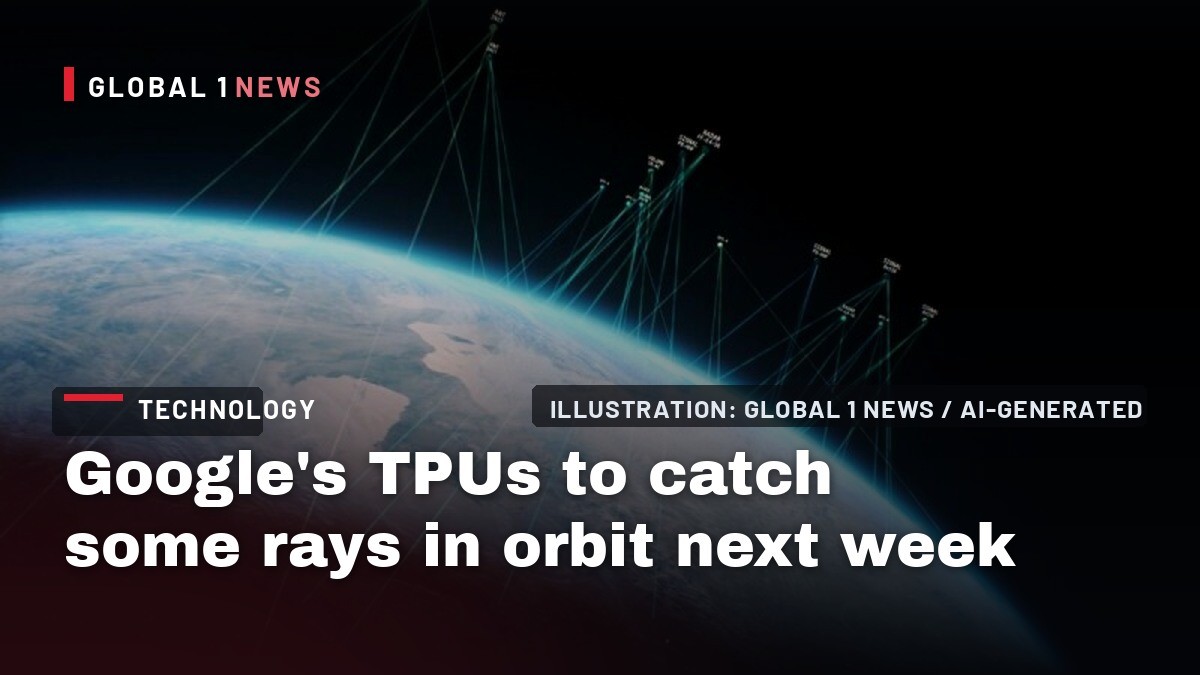
Google’s latest moonshot – lofting its Tensor Processing Units (TPUs) into orbit – reads like a sci‑fi stunt, but the reality behind Project Suncatcher is a hard‑nosed engineering test. As a founder who has spent a decade wrestling with real‑world servers, I’m not here to cheerlead the hype; I’m here to strip away the glitter and lay out what this means for anyone running a data centre on Earth, especially independent hosting outfits that can’t afford to chase space‑age fantasies.
Why Google is tossing TPUs into the void
Google’s public line is simple: space‑based datacenter clusters powered by endless solar energy could be the answer to a more sustainable AI future. The company is betting that the vacuum of orbit, free from terrestrial power constraints, will let it run massive AI workloads without the carbon‑heavy electricity bills that keep most hosting providers up at night.
That vision is still very much a proof‑of‑concept. The launch slated for October 1 on SpaceX’s Transporter‑18 rideshare mission is the first step in testing whether a lightly modified TPU – the same silicon Google has been using in its data centres – can survive the brutal launch environment and the relentless radiation of space. Until this test flies, the “limitless solar power” promise remains just that – a promise.
The launch shock: 50‑100 g’s of raw force
Google admits the first hurdle is surviving the ride up. Its own blog post notes that the chips will experience between 50 and 100 times Earth’s gravity during launch. That’s not a gentle bump; it’s enough to literally shake hardware apart if the mounting and packaging aren’t engineered to absorb the load.
Google’s team has run vibration‑table tests to simulate this, but as any hardware veteran knows, a lab table can’t perfectly replicate the chaotic, multi‑axis forces of a Falcon 9 ascent. For a hosting provider, the takeaway is clear: even on the ground, you need robust mechanical design. If you can’t trust your chassis to hold a server rack steady under a modest shock, you won’t survive the real thing.
Radiation: the silent killer
Once the satellite clears the atmosphere, the next enemy is radiation. Google’s engineers have bombarded TPUs with proton beams at UC Davis’ Crocker Nuclear Laboratory to gauge susceptibility to single‑event upsets (bit flips) and cumulative ionizing damage. The tests give a baseline confidence, but they can’t capture the full stochastic nature of solar flares and cosmic rays over a satellite’s operational life.
For us on the ground, radiation isn’t a daily concern, but it illustrates a broader point: any “new” compute platform must be hardened against the environment it will actually run in. If you’re considering exotic hardware (say, ARM‑based servers) for edge locations, you need to validate reliability under local temperature swings, humidity, and power quality – not just assume a lab spec will hold in the field.
Cooling in a vacuum: a radiator nightmare
Google’s own numbers are stark: roughly 1.3 square metres of radiator area are needed to dump the heat from a single TPU. Multiply that by the “dozens” of TPUs they hope to pack onto a satellite, and you’re looking at a sizeable panel to radiate waste heat. In space, convection is dead; you must rely on radiation, which is far less efficient.
The company is experimenting with heat pipes and pumped coolant loops to ferry heat from the chips to the radiators. This mirrors the challenges we face on the ground when trying to cram high‑density compute into a small rack – the need for reliable thermal pathways, redundancy, and the ability to manage hot spots. If Google can’t get a decent thermal solution in a vacuum, imagine the headaches of trying to retrofit a legacy server farm with aggressive cooling upgrades.
Inter‑satellite links: bandwidth at a premium
Even if Google nails the hardware, the architecture still hinges on high‑speed inter‑satellite communication. The plan calls for laser‑based links to stitch together a constellation of AI‑focused satellites. Existing inter‑satellite systems favour low‑bandwidth, wide‑area coverage – the opposite of what an orbital AI cluster needs, which is ultra‑high bandwidth over relatively short distances.
From a business‑risk perspective, this is a massive unknown. Laser links are still maturing, and any latency or reliability hiccup could cripple a distributed AI workload. For independent providers, the lesson is to be wary of any “high‑performance” claim that depends on an unproven networking layer. If the network fails, your compute is just a heat‑generating brick floating in space.
Cost to orbit: the $7,000‑per‑kg myth
Google’s venture also leans on a dramatic cost reduction in launch pricing. SpaceX and other launch providers currently charge around $7,000 per kilogram to get payloads into orbit. The dream is to drive that down to $10 per kilogram – a figure that, according to a conversation with the startup Orbital, is still speculative and widely doubted.
Even if launch costs fell dramatically, the economics of a space‑based AI cluster remain shaky. You’d still need to build, launch, and maintain dozens of satellites, each with its own thermal, power, and communication subsystems. For a hosting company, the capital outlay and risk profile of such a venture dwarf the incremental cost of buying a few extra servers on the ground. The bottom line: until launch economics truly collapse, space‑based AI remains a capital‑intensive gamble.
What independent hosting providers should take away
Google’s orbiting TPU test is an entertaining glimpse into what the big hyperscalers might chase when terrestrial power costs climb. But for the rest of us, the practical takeaway is to focus on the fundamentals that keep our data centres humming: robust hardware design, proven cooling solutions, and reliable networking – all of which can be validated on Earth without a rocket launch.
My advice to fellow founders: keep an eye on the space experiments, but don’t let them divert resources from the core business. Invest in solid server hardware, automate your thermal monitoring, and negotiate bandwidth contracts that don’t hinge on untested laser links. If you can squeeze more performance out of a well‑tuned rack, you’ll stay competitive without betting on a moonshot that may never leave the launch pad.
— Allan Ali, Founder
This article was produced with AI-assisted research and editorial support. Reporting is based on the source material cited below. Sources: The Register; theregister.com; Global1.News (27 September 2026).
By Allan Ali, Global1.News
What's Your Reaction?
 Like
0
Like
0
 Dislike
0
Dislike
0
 Love
0
Love
0
 Funny
0
Funny
0
 Wow
0
Wow
0
 Sad
0
Sad
0
 Angry
0
Angry
0

Publisher of Global1.News. Automation architect, systems builder, and the guy making sure the truth gets published.










Comments (0)