
China Probes Formaldehyde-Tainted Cabbages as Food Safety Crackdown Intensifies
Chinese authorities have launched a formal investigation into the illegal use of formaldehyde to preserve cabbages destined for human consumption, a case that has reignited public concern over food safety and prompted a rapid regulatory response across the country.
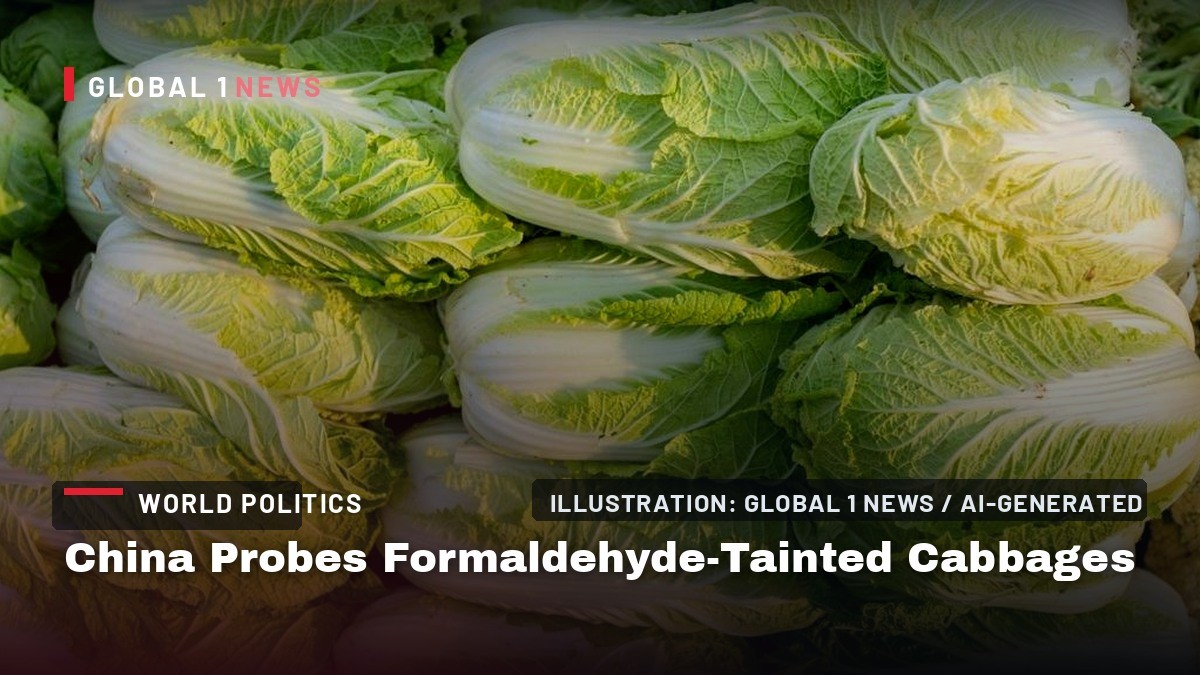
Chinese authorities have launched a formal investigation into the illegal use of formaldehyde to preserve cabbages destined for human consumption, a case that has reignited public concern over food safety and prompted a rapid regulatory response across the country. Officials in Hebei province, a major agricultural hub in the country's north-east, confirmed on Monday that they had verified footage showing individuals dipping cabbages into a chemical solution before loading the vegetables onto trucks for transportation.
The footage, first released by an environmental blogger last week, shows the produce being treated in what appears to be a wholesale operation. Formaldehyde, a colourless chemical commonly used to preserve biological specimens and known to be carcinogenic, is strictly prohibited for use in food preservation under Chinese law. Police have already taken legal action against the individuals involved, according to state media reports, though specific charges and the number of detainees have not yet been disclosed.
Hebei Authorities Confirm Footage and Launch Market-Wide Spot Checks
The confirmation from Hebei officials marks a significant escalation in what began as a social media exposé. Investigators are now working to determine the geographic scope of the practice and to trace affected vegetables that may have already entered the supply chain. State media reports indicate that spot checks are being carried out on markets across the country, with a particular focus on wholesale hubs that distribute produce to major urban centres.
Local authorities in Kangbao county, where the incident is believed to have originated, issued a statement on Saturday that sought to project both urgency and control. "Any illegal or non-compliant practices discovered will be dealt with strictly in accordance with the law to ensure the safety of the vegetable supply," the statement read. The county, located in the northern part of Hebei, is a significant producer of leafy vegetables and supplies markets throughout the Beijing-Tianjin-Hebei economic corridor.
Xinfadi Market Moves to Reassure Consumers in the Capital
In Beijing, the Xinfadi market — one of the capital's largest sources of fresh produce — moved quickly to distance itself from the contaminated supply chain. In a public statement, market management said it had investigated the source of its cabbages and confirmed that none of the affected vegetables had entered its facilities. The market, which handles thousands of tonnes of produce daily, is a critical node in Beijing's food distribution network, and its response reflects the sensitivity of the issue among urban consumers.
The swift response from Xinfadi underscores the broader anxiety that such incidents generate in China's food system. While the market's statement was designed to reassure the public, it also highlights the difficulty of tracing produce through a fragmented supply chain that involves numerous intermediaries between farm and table. The investigation will now focus on how widespread the practice has become and whether it is isolated to a single county or extends across multiple production regions.
People's Daily Editorial Condemns Wholesalers' 'Moral Bottom Line'
The incident has generated widespread media attention in China, with state media framing the case as a test of the country's regulatory resolve. An editorial in the People's Daily, the official newspaper of the Communist Party of China, delivered a sharp rebuke to those involved. "The wholesalers focused solely on their immediate economic interests while completely disregarding the lives and health of consumers," the editorial read. "[They] crossed a legal red line and breached the moral bottom line."
The editorial's language is notable for its severity, reflecting the political sensitivity of food safety issues in China. Since the 2008 melamine scandal, in which contaminated infant formula led to the deaths of at least six children and sickened hundreds of thousands more, food safety has been a recurring theme in domestic governance. The government has since enacted a series of regulatory reforms, including the establishment of a unified food safety law and the creation of the State Administration for Market Regulation (SAMR) in 2018 to consolidate oversight functions.
China's Cabbage Industry: A Global Giant Under Scrutiny
The scale of China's cabbage industry makes this case particularly significant. China produces well over 30 million tonnes of cabbages each year, accounting for nearly half of the world's annual total. The vegetable is a staple of the Chinese diet, consumed in everything from pickled preparations to stir-fries, and its affordability and availability are considered matters of basic food security. Vietnam, South Korea and Russia are among the largest export destinations for Chinese cabbages, meaning that the implications of this incident extend beyond domestic borders.
For export markets in Asia, the case raises questions about the reliability of Chinese agricultural supply chains. South Korea, which imports significant quantities of Chinese cabbages for its own kimchi production, has historically been sensitive to quality issues in Chinese produce. The current investigation will be closely watched by importers and regulators in these countries, who may demand additional certification or testing protocols in the wake of the scandal.
Formaldehyde Health Risks and the Regulatory Framework
The health implications of formaldehyde exposure are well documented, though the risks vary by dose and duration. Exposure to relatively high quantities of formaldehyde in some workplaces has been linked to certain types of cancer in humans, according to the American Cancer Society. However, the effect of exposure to small amounts — such as those that might be ingested through contaminated food — is less clear. This ambiguity complicates the public health messaging around the incident, as officials seek to prevent panic without downplaying the seriousness of the violation.
China's regulatory framework explicitly prohibits the use of industrial chemicals in food processing, and the penalties for violations can include criminal prosecution. The case has now been referred to police, indicating that authorities are treating it as a criminal matter rather than a mere administrative infraction. The investigation will also examine whether the practice is isolated or part of a broader pattern of using chemical preservatives to extend the shelf life of perishable goods.
Broader Implications for China's Food Safety Governance
This incident arrives at a time when China's food safety governance is undergoing significant transformation. The 2008 melamine scandal served as a watershed moment, prompting a comprehensive overhaul of the regulatory system and a shift toward more proactive enforcement. In the years since, authorities have invested heavily in testing infrastructure, traceability systems and public reporting mechanisms. The current case, however, demonstrates that gaps remain, particularly in the wholesale and distribution segments of the supply chain where oversight is less robust than in large-scale processing facilities.
The government's response — combining swift police action, market spot checks and public statements from state media — reflects a playbook that has been refined over nearly two decades of food safety crises. The emphasis on restoring consumer confidence is deliberate; in China, food safety incidents have historically led to sharp declines in consumer spending on affected products and broader distrust of the food system. The cabbage case, while smaller in scale than the melamine scandal, carries similar symbolic weight because it involves a staple food consumed by millions of households daily.
Strategic Significance for Beijing's Governance Objectives
For Beijing, the handling of this case is about more than just cabbages. It is a test of the government's ability to manage risk in a complex, decentralised supply chain while maintaining public trust in state institutions. The incident also intersects with the broader "Dual Circulation" strategy, which emphasises the resilience and self-sufficiency of domestic supply chains. If Chinese consumers lose confidence in the safety of domestically produced food, it could undermine efforts to reduce reliance on imported agricultural products.
The investigation is also likely to have implications for rural governance and the regulation of small-scale agricultural producers. Many of the wholesalers involved in such practices operate in a grey zone between formal regulation and informal commerce, making enforcement challenging. The case may prompt calls for stricter licensing requirements, more frequent inspections and greater use of digital traceability tools to close these gaps. As the investigation unfolds, the key question will be whether the response is limited to punishing the individuals involved or extends to systemic reforms that address the root causes of such violations.
By Prof. Marcus Chen, Staff Writer
This article was produced with AI-assisted research and editorial support. Sources: BBC News.
What's Your Reaction?
 Like
0
Like
0
 Dislike
0
Dislike
0
 Love
0
Love
0
 Funny
0
Funny
0
 Wow
0
Wow
0
 Sad
0
Sad
0
 Angry
0
Angry
0

World Politics Analyst at Global1.News. Based in Beijing, covering US-China relations, global trade, and geopolitical strategy. Brings deep analytical perspective to the power dynamics shaping international affairs.















Comments (0)