
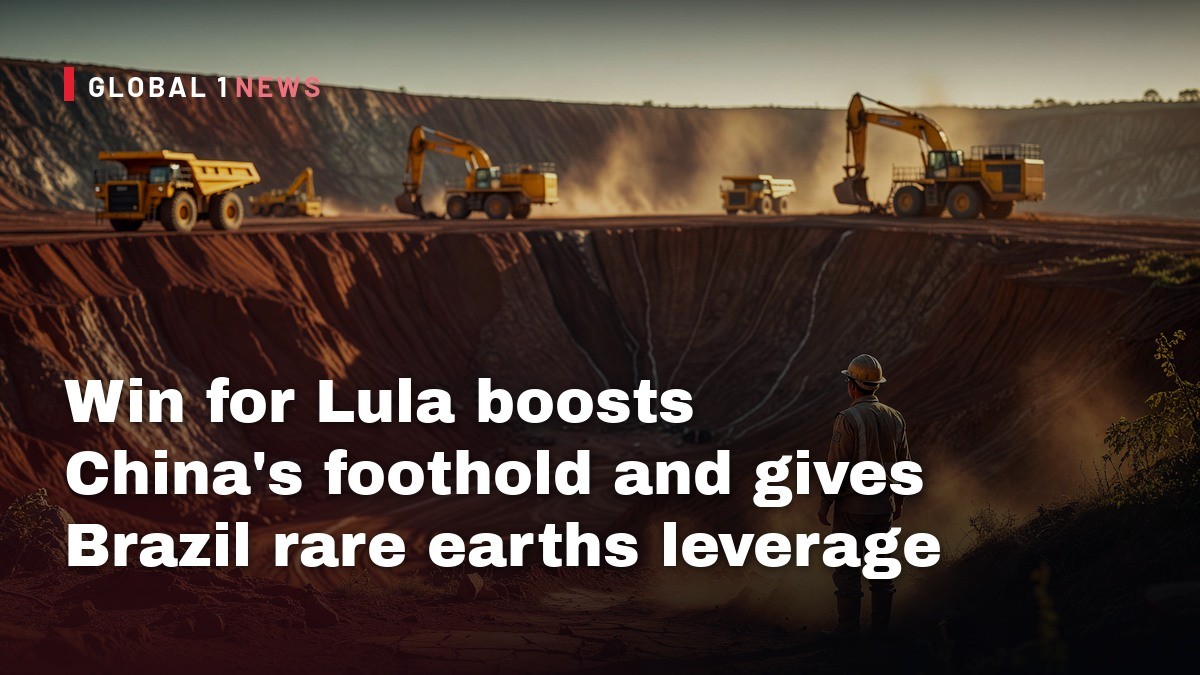
Win for Lula boosts China’s foothold and gives Brazil rare earths leverage
Brazil’s presidential election concluded with Luiz Inácio Lula da Silva securing an unprecedented fourth term, a result that reverberates far beyond South America’s borders.
Brazil’s presidential election concluded with Luiz Inácio Lula da Silva securing an unprecedented fourth term, a result that reverberates far beyond South America’s borders. The 80‑year‑old leader captured 51.8 percent of the runoff vote, defeating the right‑wing challenger Flávio Bolsonaro, whose campaign was closely aligned with former U.S. President Donald Trump. While the Bolsonaro camp has yet to concede, the swift congratulations from Beijing underscore the strategic weight Brazil carries in the evolving U.S.–China rivalry, particularly in the domain of critical minerals. This article situates Lula’s victory within the broader geopolitical contest, traces the historical contours of China‑Brazil relations, and assesses the strategic options now open to Brasilia as it navigates an increasingly polarized global order.
Electoral Outcome and Immediate Diplomatic Signals
The runoff held on 26 October 2026 delivered a decisive, though narrow, mandate to Lula, who secured 51.8 percent of the vote. The result confirms his ability to mobilise a coalition that spans labor unions, agrarian interests and urban middle‑class voters, despite his advanced age. The defeat of Flávio Bolsonaro, a figure closely tied to the former U.S. president’s political network, signals a rejection of the more overtly anti‑China, pro‑U.S. posture that characterized the Bolsonaro‑Trump alignment.
Within hours of the official announcement, China’s Ministry of Foreign Affairs issued a statement through spokesman Guo Jiakun, congratulating Lula and affirming Beijing’s readiness to “continue advancing the building of a China‑Brazil community with a shared future.” The phrasing mirrors language used in prior high‑level exchanges, indicating that Beijing views the election outcome as a reinforcement of its long‑term partnership with Brazil, rather than a disruption.
Historical Trajectory of China‑Brazil Relations
Since the early 2000s, China has steadily deepened its engagement with Brazil, initially through commodity trade and later through strategic cooperation frameworks. The “China‑Brazil community with a shared future” slogan first appeared during Lula’s earlier administrations, reflecting a mutual interest in diversifying trade away from traditional Western partners. Over the past two decades, China has become Brazil’s largest trading partner, a status cemented by large‑scale imports of soybeans, iron ore and oil, alongside growing Chinese investment in Brazilian infrastructure and technology sectors.
The continuity of this relationship across successive Brazilian administrations—both left‑leaning and centrist—demonstrates its resilience. Lula’s return to power, therefore, does not represent a rupture but rather a reaffirmation of a partnership that has withstood political oscillations. The diplomatic overture from Beijing after the 2026 election underscores that China perceives Brazil as a stable pillar in its Latin American strategy.
Rare Earths: Brazil’s Emerging Leverage
Beyond agricultural and mineral exports, Brazil possesses significant deposits of rare earth elements (REEs), a group of critical minerals essential for advanced electronics, renewable energy technologies and defence applications. While the United States and China dominate global REE supply chains, Brazil’s reserves provide a potential third‑party source that can be leveraged in the broader strategic competition. Lula’s administration, aware of this strategic asset, can now negotiate from a position of relative strength, offering rare earths to both sides while maintaining a policy of non‑alignment.
The election outcome, therefore, enhances Brazil’s diplomatic toolkit. By preserving a constructive relationship with Beijing, Lula secures continued Chinese investment and technology transfer, while simultaneously preserving the latitude to engage with Washington on issues of mutual interest, such as climate cooperation and trade diversification. The rare earths sector, in particular, becomes a bargaining chip that can be used to extract concessions or secure favorable terms from either superpower.
Implications for the U.S.–China Rivalry in Latin America
The United States has long viewed Latin America as its traditional sphere of influence, yet in recent years Beijing has made concerted inroads through infrastructure financing, trade agreements and soft‑power initiatives. Brazil, as the continent’s largest economy, sits at the centre of this contest. Lula’s victory, coupled with the explicit Chinese congratulatory message, signals to Washington that Brazil will continue to pursue a balanced foreign policy, resisting overt alignment with either bloc.
For the United States, the election presents a diplomatic challenge: how to engage a Brazil that is simultaneously courting Chinese investment and preserving strategic autonomy. The refusal of Flávio Bolsonaro’s camp to concede may create short‑term political friction, but the broader trend suggests that Brazil will not be coerced into a binary choice. Instead, it is likely to adopt a pragmatic approach, extracting benefits from both sides while safeguarding national interests.
Domestic Political Landscape and Lula’s Strategic Options
Domestically, Lula inherits a fragmented Congress and a populace divided over economic performance and social policies. His advanced age and the narrow margin of victory underscore the need for careful coalition management. By positioning Brazil as a neutral conduit for critical minerals, Lula can appeal to nationalist sentiments while also delivering tangible economic benefits through foreign investment.
Strategically, Lula can deepen cooperation with China in sectors such as renewable energy, leveraging Chinese capital to advance Brazil’s climate commitments. Simultaneously, he can maintain dialogue with Washington on trade diversification, intellectual property protection and technology transfer. This dual‑track approach aligns with Brazil’s historical foreign‑policy principle of “strategic autonomy,” allowing it to navigate great‑power competition without sacrificing sovereignty.
Future Trajectories for China‑Brazil Cooperation
Looking ahead, the partnership is likely to expand beyond commodity trade into higher‑value domains. China’s interest in securing stable supplies of rare earths dovetails with Brazil’s ambition to develop a domestic high‑tech manufacturing base. Joint ventures in battery production, electric‑vehicle components and advanced electronics could emerge, supported by Chinese financing and Brazilian raw material endowments.
Moreover, the political endorsement from Beijing may translate into increased Chinese participation in Brazil’s infrastructure projects, such as ports, railways and energy grids. These projects, if executed transparently, could bolster Brazil’s logistical capacity and enhance its export competitiveness, further entrenching the bilateral relationship.
Strategic Implications for Global Geopolitics
Lula’s re‑election, set against the backdrop of an intensifying U.S.–China rivalry, underscores the growing importance of middle powers in shaping the architecture of the twenty‑first‑century order. Brazil’s ability to leverage its rare‑earth resources and its established partnership with China provides it with a diplomatic lever that can influence global supply‑chain dynamics and, by extension, the strategic calculations of both superpowers.
For policymakers in Washington and Beijing, Brazil’s stance serves as a reminder that coercive alignment strategies may be less effective than nuanced engagement that respects the agency of emerging economies. As Lula’s fourth term unfolds, the world will watch how Brazil balances its economic imperatives with its geopolitical aspirations, potentially setting a template for other resource‑rich nations seeking to navigate great‑power competition without being subsumed by it.
This article was produced with AI-assisted research and editorial support. Reporting is based on the source material cited below. Sources: South China Morning Post; scmp.com; Global1.News (27 October 2026).
By Prof. Marcus Chen, Staff Writer
What's Your Reaction?
 Like
0
 Dislike
0
 Love
0
 Funny
0
 Wow
0
 Sad
0
 Angry
0

World Politics Analyst at Global1.News. Based in Beijing, covering US-China relations, global trade, and geopolitical strategy. Brings deep analytical perspective to the power dynamics shaping international affairs.











Comments (0)