
Israel's Count Overturns the Exit Polls as the Arab Parties Reach a Record 18 Seats
Partial results from Israel's 28 October count put Benjamin Netanyahu's bloc ahead but well short of 61 seats, while the Arab-led parties reached a record 18 seats and Gadi Eisenkot claimed the first right to form a government.
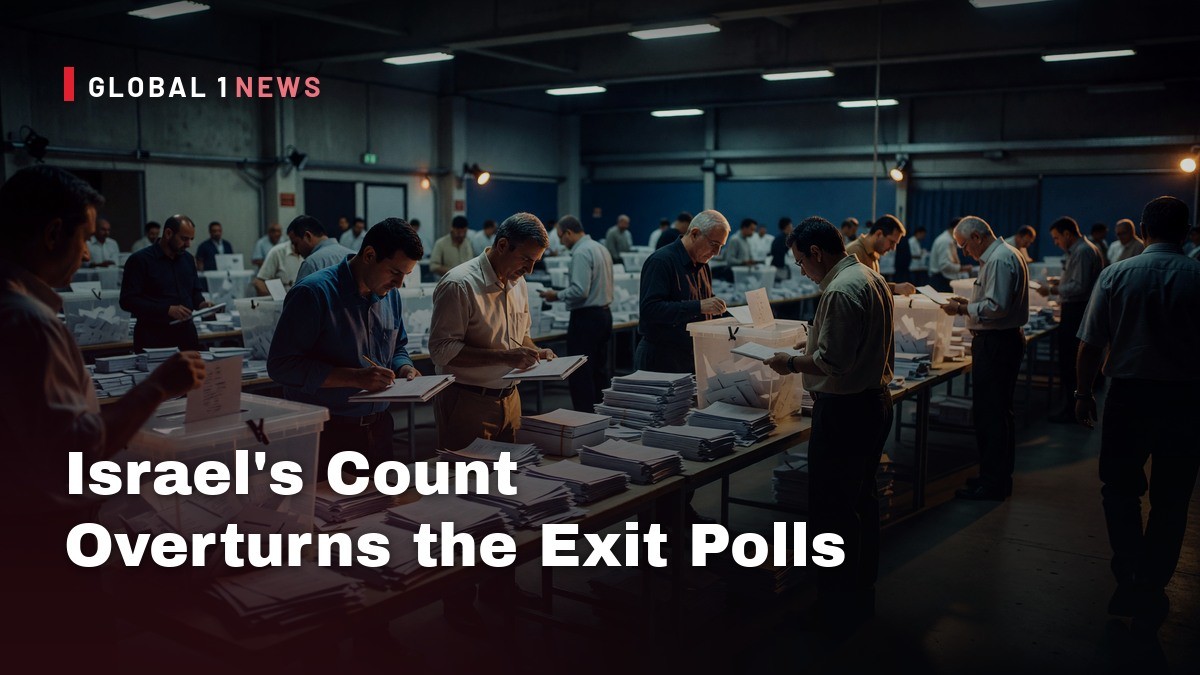
The first exit polls put the blocs level. By morning, the count said otherwise. The Arab parties were the story nobody scripted, and the shekel felt it before the speeches did.
Israel's Count Overturns the Exit Polls as the Arab Parties Reach a Record 18 Seats
Jerusalem, Israel — The ballots kept moving after the studios went dark, and every stage of the count redrew the map the exit polls had drawn.
The Count That Turned
The Central Elections Committee published snapshots through the night, and each one broke the exit-poll picture a little further. At 57.3% of ballot boxes counted, partial committee results carried by the Times of India gave the Netanyahu bloc 55 seats, the anti-Netanyahu bloc 49 and the Arab parties 16. By 9:16 a.m. local, at 65% counted, the Guardian reported the Netanyahu bloc at 56, the Eisenkot bloc at 48 and the Palestinian Israeli parties at 16. At 10:03 a.m., with 72.4% of boxes counted, the Times of Israel reported the pro-Netanyahu bloc at 54, the Eisenkot-led bloc at 48 and the Arab parties at 18 after Ra'am gained two. The committee's own caveat travels with every one of those numbers: the results are partial and will change as counting continues, and votes cast in double envelopes, including soldiers' ballots, are counted later. The market read the uncertainty fast. The shekel depreciated 0.7 percent to NIS 3.0765 per dollar in morning trading in Tel Aviv, after hitting a three-week high on Tuesday when investors bet on a definitive outcome, the Times of Israel reported.
A Night of Two Headlines
Two headlines competed, and both survived the night. Likud remained the largest single party in every partial count, and no bloc came near the 61 seats a governing majority requires. That is the arithmetic of a 120-seat Knesset elected by proportional representation, where a list must clear 3.25% of the vote to win any seats at all. CNN reported that polls had suggested 11 to 13 parties would clear that bar; the partial count put eleven lists in the chamber, from a field that began with dozens. The exit polls published on 27 October set the terms of the argument: Kan 11 and Channel 13 put both blocs at 51 seats each, Channel 12 gave the opposition 52, and only Channel 14, the pro-Netanyahu outlet, put his bloc at 60. The Guardian noted that Israeli exit polls are often revised after publication and are notoriously imprecise, with the final count often swinging by several seats. The count swung. The structure held: a fragmented chamber, a threshold that punishes the small, and two camps short of the line.
Netanyahu: 'A Strong, Right-Wing, Nationalist Government'
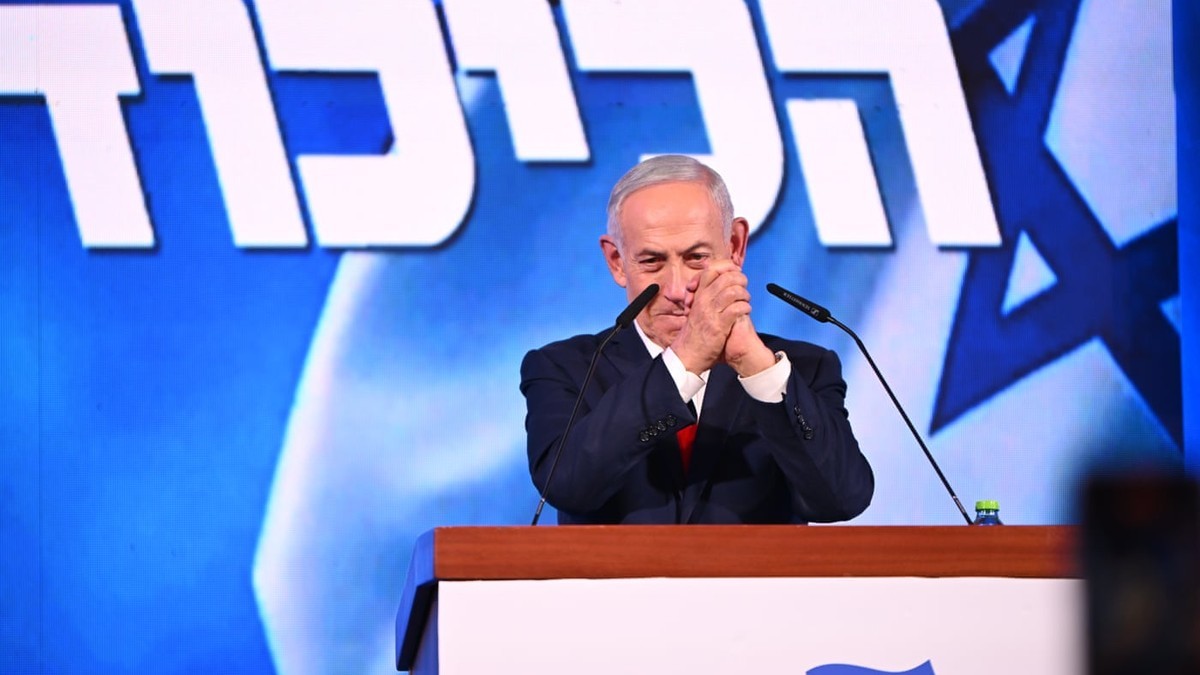
At Likud headquarters in Binyanei HaUma in Jerusalem, early on 28 October, Benjamin Netanyahu was defiant. He praised Israel's military achievements of the past three years and positioned himself to remain the country's longest-serving prime minister, the Associated Press reported. Then came the lines that framed the night. "We must establish a strong, right-wing, nationalist government," he said. And: "We must not endanger Israel and establish a government that relies on anti-Zionist Arab parties." The AP reported that he dismissed the idea of a partnership with Arab parties, whose constituents make up 20% of Israel's population, as treasonous. The Times of India reported that Netanyahu claimed his bloc had a "significant, decisive majority" among Jewish voters and those supporting a Jewish state. Foreign Minister Gideon Saar, on social media, offered the night's driest post: "Likud is the largest party in Israel. It is always good to learn something from the past."
Eisenkot Claims the First Right
Gadi Eisenkot declared victory and said the preliminary results should give him the first right to try to form a government, CNBC reported. The former military chief of staff, whose new centrist party Yashar has made him Netanyahu's principal challenger, spoke at his headquarters in Tel Aviv. "The initial exit poll results indicate a complete lack of confidence in Netanyahu and his October 7 government among the Zionist majority and the majority of Israeli citizens," he said, according to the Jerusalem Post. "If these are the final results, they represent a victory for Israel's national-minded, Zionist majority." He added: "I will act immediately to implement the people's decision, replace the Netanyahu government, and establish a Zionist government committed to military conscription as soon as possible." Then a warning to the security establishment: "The prime minister is now a caretaker prime minister. Stand firm against any attempt to challenge you. You have my clear backing." And: "Netanyahu, do not dare use security for political purposes."
The Arab Parties' Record Night
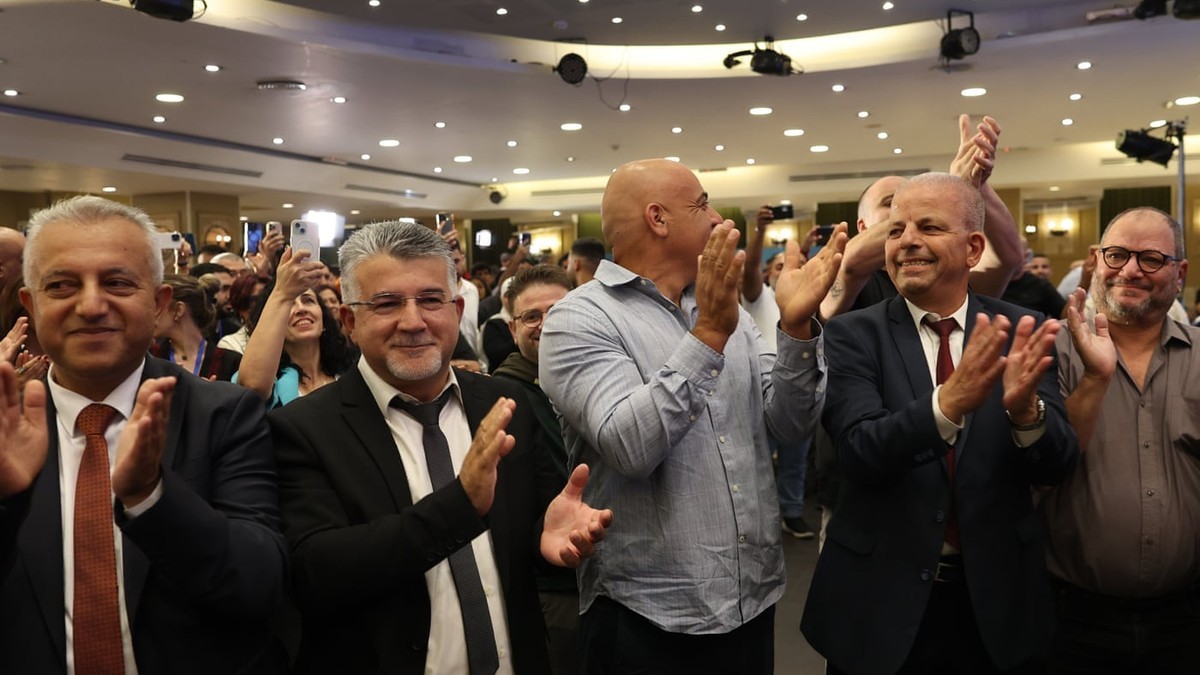
The Arab-led parties posted their strongest showing ever. The Times of Israel seat chart from that morning gave the Joint List 12 seats and Ra'am 6, and CNN noted the exit polls had projected the two at 17 to 18 seats, surpassing the previous high of 15 in 2015. Ra'am is led by Mansour Abbas, who in 2021 made it the first Arab-led party to join an Israeli governing coalition. The Joint List is an alliance of Hadash, Ta'al and Balad, chaired by Yousef Jabareen. Palestinian citizens make up about 21 percent of Israel's population. The path to this night ran through a courtroom: in September 2026 the Central Elections Committee barred both Arab lists from the vote, and on 2 October the Supreme Court unanimously overturned the bans, Al Jazeera reported. Abbas stated his priority plainly on Tuesday, according to the Guardian: to "bring down [Benjamin Netanyahu], Smotrich, and Ben Gvir in this election."
'I Know How to Count to 120'
Yair Golan, chairman of The Democrats, took to X with the night's sharpest arithmetic. "Netanyahu lost. I know how to count to 120. 65 is more than 55. That's how Israeli democracy works. Period." He pressed the argument further: "The reality must teach us one resounding lesson: We have no future here if we don't stop being afraid. And if we don't stop with the racism. We must no longer accept Netanyahu's racist division between Jewish votes and Arab votes." He turned the Zionist-majority claim back on the Netanyahu bloc: "If Netanyahu insists on counting only a Zionist majority, let him first subtract from his own bloc the 16 Knesset members from the non-Zionist Haredi parties. They won't preach to us about Zionism." His conclusion: "The change bloc has an Israeli majority: 65 against 55." He posted while the count still had the Netanyahu bloc ahead. His arithmetic counts the Arab parties inside his own majority. It is his characterisation, not a certified figure.
The Refusal at the Heart of It
Here is the contradiction the count cannot resolve. Both Netanyahu and Eisenkot have ruled out partnering with the Arab-led parties, citing a lack of shared values, Al Jazeera reported. Eisenkot has left the door open under certain conditions, the AP reported, including recognition of Israel as a Jewish state and of Hamas as an extremist group, but some likely partners have ruled that out. The Joint List has said it could act as a "safety net" for an anti-Netanyahu coalition, agreeing not to vote against it in a confidence vote even without joining the government, according to Al Jazeera. Analysts see the refusal as the hinge. Asaf Ronel said there are serious questions whether other leaders can overcome their "racism and refusal" to collaborate with the Arab-led groups, and warned that otherwise the most likely scenario is another round of elections in the next few months. Dov Waxman of UCLA said he could not see a path for Netanyahu to assemble a governing coalition.
Turnout, the Threshold and the Small Right
Turnout at the close of polls was 77.7%, up from 70.6% in 2022, the Central Elections Committee reported, with 5,695,682 voters. CNN called it the highest since at least 1999. The threshold is doing work the campaign could not. The Times of Israel reported three lists sitting below the 3.25% bar: Reservists at 2.7%, People of Israel at 1.7%, and Charedi Public at 0.2%. Those lost votes never reach the allocation of seats. The Jerusalem Post named the first two lists as Ofer Winter's People of Israel and Yoaz Hendel's Reservists-Economic party, and reported that both falling short could further complicate Netanyahu's bloc's effort to secure a majority. Turnout among soldiers was 79.9% after polls closed, up 6.2 percent on 2022, the Israeli military reported, and those double-envelope ballots, cast by soldiers and others away from their home polling stations, are the last tranche counted. That is one reason the bloc numbers have kept moving through the morning rather than settling.
Trump Takes Credit
Donald Trump weighed in from outside the count. On Truth Social he quoted Irving C. Schwartz: "When President Trump endorsed Bibi Netanyahu, the whole tide turned, and now, rather than a decisive defeat for a Great Prime Minister, it looks like a big come-from-behind stalemate, or even a WIN for Netanyahu." On the tarmac near Air Force One after a rally in Texas, he said: "I heard the poll numbers were wrong... the exit polls; I heard he [Netanyahu] did very well. It was pretty close, but very well. When the endorsement went out, it helped him a lot." He had urged Israelis to back Netanyahu on Sunday: "Vote for Bibi Netanyahu for Prime Minister, we have to finish the job that we started!" No outlet reports any evidence connecting the endorsement to a shift in voter behaviour. The claim is Trump's own assertion. President Isaac Herzog has said the endorsement "won't affect who he tasks as PM" and that nobody can "intervene in my discretion," the Times of Israel reported.
November 4, and Then 42 Days
The calendar now does the work. The final tally is expected by Friday, 30 October; official results are formally published on 4 November. The new Knesset is set to convene on 10 November. Once the tally is in, Herzog will ask party leaders whom they want as prime minister, then tap the candidate he believes has the best chance of governing. That need not be the leader of the largest party. The first designated candidate gets 28 days, extendable by 14, up to 42. If that fails, the president may task a second Knesset member, who gets 28 days and no extension. Failing that, at least 61 MKs can ask the president to designate a third candidate, who gets 14 days. A government needs only a simple majority in a confidence vote, which can be fewer than 61 if parties abstain, leaving a minority government open. If the Knesset deadlocks, it is dissolved and another election follows within 90 days. The precedent is close: three elections between April 2019 and March 2020, a power-sharing deal with Benny Gantz, and a government that collapsed a year later over a budget.
By Jessica Ali, Staff Writer
This article was produced with AI-assisted research and editorial support. Sources: The Associated Press, The Guardian, Al Jazeera, The Times of Israel, The Jerusalem Post, CNBC, CNN, The Times of India, The Straits Times, Ynet and JNS. Photographs: Ariel Schalit/AP; Jamal Awad/EPA; Alexi J Rosenfeld/Getty Images.
What's Your Reaction?
 Like
0
 Dislike
0
 Love
0
 Funny
0
 Wow
0
 Sad
0
 Angry
0

Editor-in-Chief at Global1.News. Atlanta-based journalist who cuts through the BS and tells it like it is. Lead anchor, host, and the voice you hear when the spin stops and the truth starts.















Comments (0)