
Apple unleashes a swarm of Mac Minions to share GPU resources for large AI tasks
Apple’s latest internal hack, dubbed “Minions,” is a blunt‑force answer to a problem that many of us in the hosting world have been wrestling with for years: idle GPU capacity sitting on desks while engineers wait hours for a slot on a centralized cluster.
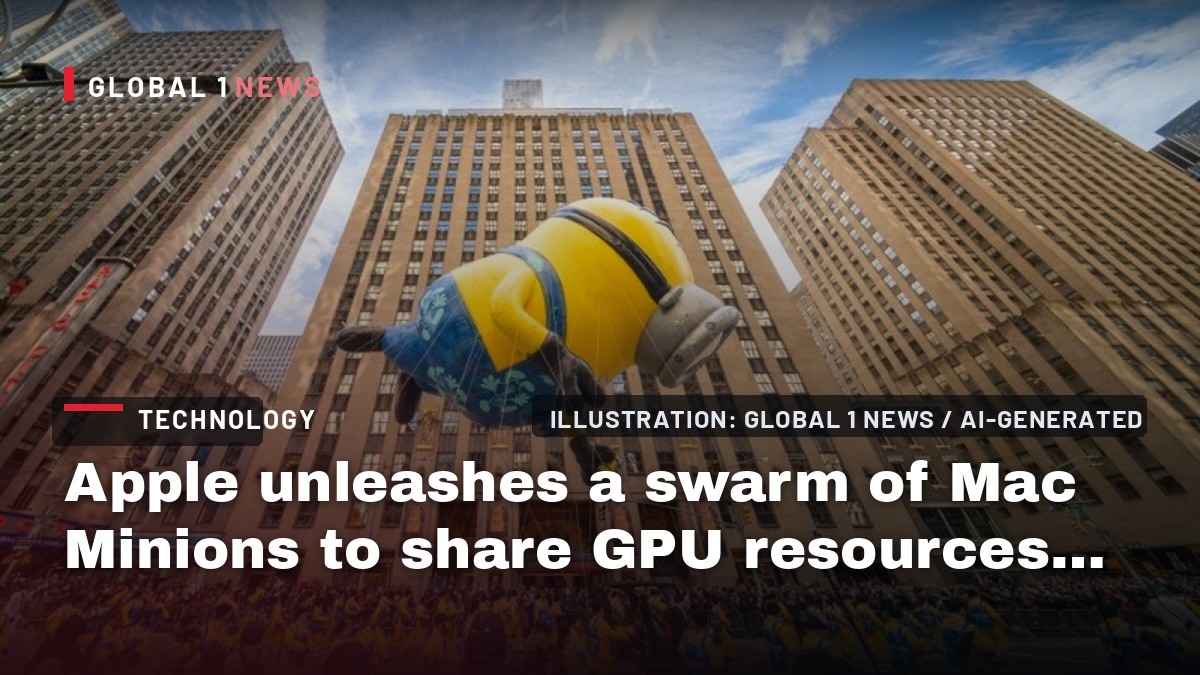
Apple’s latest internal hack, dubbed “Minions,” is a blunt‑force answer to a problem that many of us in the hosting world have been wrestling with for years: idle GPU capacity sitting on desks while engineers wait hours for a slot on a centralized cluster. The Register’s rundown makes it clear that Apple has taken a very pragmatic, hardware‑first approach – aggregating idle Apple Silicon GPUs across macOS devices into a virtual GPU cloud for inference workloads. From a founder’s perspective, the idea is simple and seductive: squeeze more compute out of existing hardware without buying a single‑purpose Nvidia rig. But the devil is in the details, and the way Apple has wired this together raises a host of questions for anyone running their own infrastructure.
Why Apple Went the Minion Route
Apple’s internal paper notes that before Minions, some inference jobs were stuck in queues longer than ten hours because the company’s centralized GPU pool was simply too small. By turning idle Macs into a distributed pool, they claim tasks now start in minutes. The motivation is pure utilization – turn every idle GPU on a Mac mini or Mac Studio into a revenue‑neutral compute node. For a company that already fields thousands of Macs, the hardware cost is essentially sunk, and the only real expense is the orchestration layer.
This mirrors a trend we’ve seen in the hyperscaler world: use every spare cycle to shave latency and cost. But Apple’s twist is the reliance on RDMA over Thunderbolt 5 for clustering, a feature that only the newest Mac mini and Mac Studio support. That hardware specificity means the solution is tightly coupled to Apple’s own silicon roadmap – a classic case of a vendor building a lock‑in around its own ecosystem.
The Architecture in Plain English
Minions is built around four components: a Minion Server that coordinates tasks, a PostgreSQL metadata store, a Minion Executor that runs inference on a Mac’s GPU and pushes results to S3, and a Minion Watchdog that watches for node failures and re‑assigns work. The coordination layer slices a user request into subtasks, hands them off to any idle Mac, and tracks progress via PostgreSQL. All the while, Grafana dashboards give engineers real‑time visibility into the pool’s health.
This is a textbook micro‑service design, but with a twist: the compute nodes are ordinary workstations, not purpose‑built GPU servers. The Watchdog component is crucial – in a distributed environment where a Mac might be turned off, rebooted, or lose network connectivity, you need automatic failover. Apple’s engineers have baked that in, but the approach also means you’re relying on the reliability of a heterogeneous fleet of desktops, which is a far cry from the hardened, rack‑mounted servers we run in data centres.
Performance Trade‑offs vs. Traditional GPU Clusters
Apple explicitly says Minions is not meant to compete with an Nvidia cluster that optimises for throughput, latency, and efficient utilisation of large models. The focus is on hardware availability – getting a job started quickly by tapping any idle GPU. That’s a different optimisation problem. In practice, you’ll see higher variance in latency because each subtask may land on a Mac with different GPU specs, thermal headroom, or background load.
For large models that exceed a single device’s memory, Apple’s RDMA over Thunderbolt 5 lets you stitch together compute and memory across machines. It’s clever, but the bandwidth and latency of Thunderbolt, while impressive, still lag behind the high‑speed interconnects (NVLink, InfiniBand) that power true multi‑GPU scaling. So expect a performance ceiling that’s acceptable for inference but not for training or real‑time serving at massive scale.
Implications for Independent Hosting Providers
What does this mean for us running our own hosting businesses? First, the Minions model underscores a fundamental truth: you can extract value from underutilised edge devices if you can orchestrate them reliably. However, the complexity of building a fault‑tolerant scheduler, a metadata store, and a watchdog that can handle node churn is non‑trivial. Apple can afford a team of researchers to fine‑tune this; a boutique provider would need to weigh the engineering effort against the marginal gain.
Second, the reliance on Apple‑specific hardware (Mac mini, Mac Studio) limits portability. If you’re already entrenched in x86 or ARM servers, retrofitting a Minion‑style layer would require a heterogeneous fleet, adding operational overhead. The lesson here is to design your own orchestration with hardware agnostic principles – use open standards like gRPC and containerised workloads so you can swap in any GPU‑enabled node, not just Macs.
Cost‑Benefit Realities
Apple’s internal paper highlights a dramatic reduction in queue times – from hours to minutes – by leveraging idle GPUs. For a large organisation, that translates to faster iteration cycles and potentially higher productivity. But the cost side is hidden: you need a robust networking fabric (Thunderbolt 5), a reliable S3‑compatible storage backend, and the software stack to manage the pool. Those aren’t free, even if the compute hardware is “already there.”
For a hosting provider, the economics are different. You charge customers for compute, storage, and bandwidth. Turning idle capacity into billable resources can improve utilisation, but you must also consider the added latency and potential SLA breach if a node disappears mid‑job. The Watchdog helps, but it can’t fully mask the unreliability of a desktop‑class node. In short, the upside is modest unless you can guarantee a stable, homogeneous pool.
Security and Data Governance Concerns
Apple’s Minions pushes inference results to S3 and logs metadata in PostgreSQL, with Grafana dashboards for visibility. That architecture surfaces a classic risk: data in motion across a loosely controlled network of workstations. If you’re handling sensitive models or proprietary data, you need to enforce encryption, authentication, and strict access controls on every node. Apple’s internal environment likely benefits from a tightly managed corporate network; replicating that in a multi‑tenant hosting scenario would be a nightmare.
Moreover, the Watchdog’s ability to re‑assign tasks means data could land on any machine in the pool. In a regulated industry, you’d need to audit each node’s compliance posture. This is a non‑starter for many providers unless you isolate the pool to a trusted zone, which defeats the purpose of a truly distributed, opportunistic compute fabric.
Actionable Takeaways for Founders
First, look at your own idle GPU inventory. If you have a fleet of workstations that sit idle for most of the day, a Minion‑style orchestrator could squeeze out extra value. But build it with open‑source tools – Kubernetes with GPU device plugins, a simple task queue like Celery, and Prometheus for metrics – rather than trying to replicate Apple’s proprietary stack.
Second, design for failure from day one. Apple’s Watchdog is a reminder that any node can drop out; your scheduler must be able to detect and re‑dispatch tasks without manual intervention. Implement health checks, heartbeat signals, and automatic retries.
Third, keep security front‑and‑center. Encrypt data at rest and in transit, enforce strict IAM policies, and isolate the compute pool from other workloads. If you can’t guarantee that, the risk outweighs the utilisation gains.
Finally, be realistic about performance. Expect higher latency variance and lower throughput compared to a purpose‑built Nvidia cluster. Use Minion‑type pools for batch inference or non‑latency‑critical workloads, not for real‑time serving of large models.
Apple’s Minions is a clever hack that showcases how a massive organisation can wring extra compute out of existing hardware. For the rest of us, it’s a case study in both the promise and the pitfalls of distributed GPU orchestration. Take the idea, strip away the Apple‑only dependencies, and build a solution that fits your own hardware, security, and performance constraints.
— Allan Ali, Founder
This article was produced with AI-assisted research and editorial support. Reporting is based on the source material cited below. Sources: The Register; theregister.com; Global1.News (15 October 2026).
By Allan Ali, Global1.News
What's Your Reaction?
 Like
0
Like
0
 Dislike
0
Dislike
0
 Love
0
Love
0
 Funny
0
Funny
0
 Wow
0
Wow
0
 Sad
0
Sad
0
 Angry
0
Angry
0

Publisher of Global1.News. Automation architect, systems builder, and the guy making sure the truth gets published.










Comments (0)