
Researchers use AI to design proteins that cut up other proteins
Researchers at the University of Washington have taken a bold step into the frontier of synthetic biology, using artificial‑intelligence design tools to build proteases that can be programmed to slice specific target proteins.
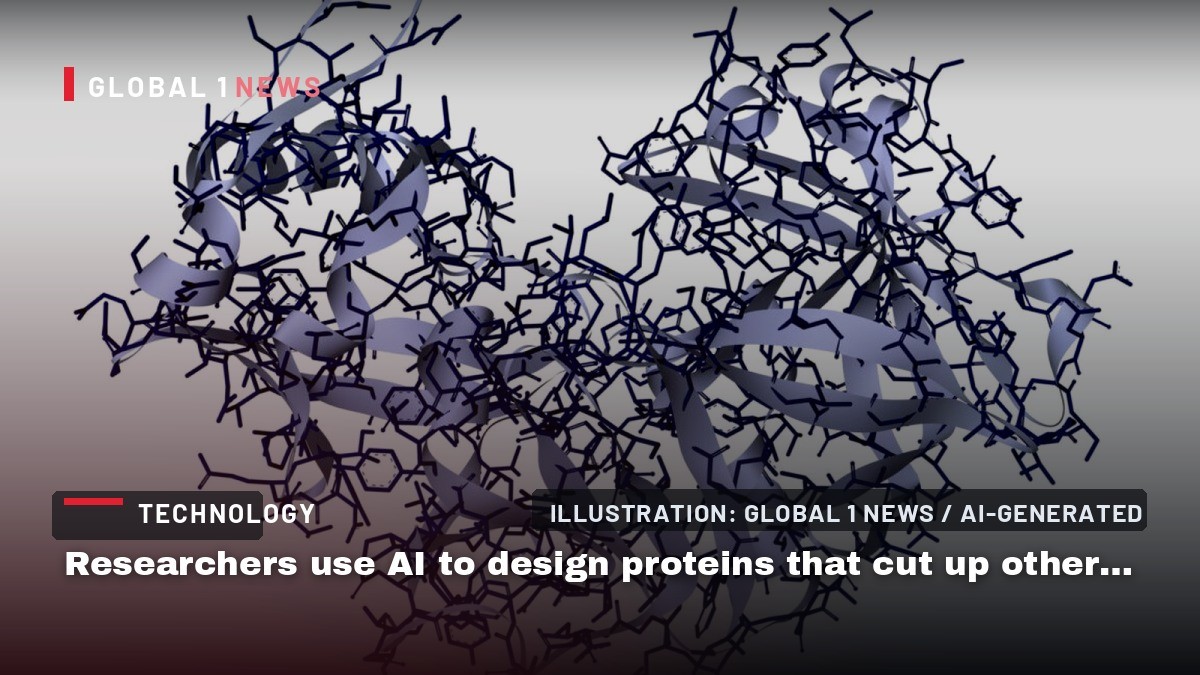
Researchers at the University of Washington have taken a bold step into the frontier of synthetic biology, using artificial‑intelligence design tools to build proteases that can be programmed to slice specific target proteins. The work, led by Nobel‑winner David Baker’s lab, demonstrates that AI can not only predict protein structures but also engineer entirely new enzymes from scratch—a development that could reshape drug discovery, biotechnology and our understanding of how life manipulates the chemistry of peptide bonds.
Why proteins need a catalyst
Proteins are long chains of amino acids linked by peptide bonds, and those bonds are remarkably stable. In pure water they are estimated to have a half‑life of several hundred years, meaning they would persist essentially unchanged without assistance. In nature, however, organisms have evolved a myriad of proteases—enzymes that accelerate the breakage of peptide bonds by many orders of magnitude. Without such catalysts, the biochemical reactions that power metabolism, immune defense and cellular turnover would be far too slow to sustain life.
The catalytic power of proteases comes from a precisely arranged set of amino acids in a tiny active site. Those residues position a water molecule, polarize bonds, and provide a nucleophile that attacks the peptide linkage. The new study shows that AI can recreate that delicate choreography, even when the surrounding protein scaffold is entirely novel.
Two classic protease mechanisms, re‑engineered
The Baker team focused on two well‑characterized mechanisms: a zinc‑dependent protease and a cysteine‑based protease. In the zinc system, a positively charged zinc ion coordinates the peptide bond and a water molecule, pulling a proton off the water to generate a reactive hydroxide that attacks the bond. In the cysteine system, a cysteine side chain acts as a nucleophile, forming a transient covalent intermediate that is later resolved by water. Both mechanisms rely on a handful of catalytic residues placed in close proximity, while the rest of the protein helps orient the target substrate.
By isolating just those catalytic cores, the researchers set out to replace the surrounding protein body with AI‑designed backbones, essentially giving the enzyme a new chassis while preserving its functional heart. This “short‑circuit” of natural diversification bypasses the slow, evolutionary route that normally yields the billions of protease variants seen in nature.
The AI design pipeline
The design workflow began with RFdiffusion2, a diffusion‑based model that generates protein backbones under user‑defined constraints. The team instructed the model to produce backbones that would bring the essential catalytic residues together and also accommodate a pre‑selected target peptide sequence near the active site. Once a plausible backbone emerged, the process moved to ProteinMPNN, which populates the backbone with specific amino acids while respecting folding stability, catalytic geometry and target binding requirements.
To verify that the generated sequences were truly novel, the researchers ran AlphaFold3 predictions on each design and compared the resulting structures against existing databases. The lack of close matches confirmed that the AI was not merely retrieving known proteins but was indeed forging new structural solutions.
From virtual models to functional enzymes
After dozens of design cycles, the team synthesized the most promising candidates. For the cysteine protease, they produced 12 distinct backbones and filled each with 69 different amino‑acid sets, yielding a broad library of variants. Thirteen of those designs—about a 19 percent success rate—demonstrated measurable catalytic activity in a fluorescent‑protein cleavage assay, albeit at lower levels than the native yeast enzyme that served as the template.
The zinc‑based effort involved an even larger set, with 135 designs generated and 89 tested experimentally. Only 14 showed any catalytic activity, and that activity was weak, reflecting the added challenge of engineering a water‑mediated reaction without the natural protein context. Nonetheless, the fact that any activity emerged at all validates the AI‑driven approach.
Proof of concept: cutting disease‑related proteins
To illustrate practical relevance, the researchers programmed the engineered proteases to target proteins implicated in neurological disorders. By embedding the desired cleavage site within a fluorescent reporter, they could monitor whether the enzyme successfully split the target in living cells. The successful designs cleaved the reporter, confirming that the AI‑crafted enzymes could be tuned to recognize and cut specific disease‑associated sequences.
This ability to “cut proteins in half” on demand opens a pathway toward therapeutic proteases that could selectively degrade pathogenic proteins, a strategy long pursued in drug development but hampered by the difficulty of creating highly specific enzymes.
Implications for biotech and biosecurity
The study demonstrates that AI can generate functional enzymes from scratch, a capability that could accelerate the creation of bespoke biocatalysts for industrial processes, waste remediation and precision medicine. By bypassing the slow march of natural evolution, companies could design proteases tailored to degrade stubborn polymers or to process complex biologics more efficiently.
At the same time, the technology raises biosecurity concerns. The same tools that enable rapid enzyme engineering could, in theory, be misused to design proteases that target human proteins or disrupt essential biological pathways. The researchers’ use of AlphaFold3 to confirm novelty underscores the need for robust oversight and transparent reporting as the field matures.
Looking ahead: the next frontier of AI‑crafted biology
While the current designs still lag behind their natural counterparts in speed and specificity, the proof‑of‑concept establishes a foundation for iterative improvement. Future cycles will likely incorporate larger training datasets, more sophisticated constraint handling and higher‑throughput screening to boost success rates.
In the words of the Baker lab, the challenge was to coax AI tools into arranging a handful of catalytic residues with atomic precision—a feat that, until now, seemed out of reach. The results prove that with the right computational scaffolding, we can rewrite the rules of enzyme design, ushering in an era where bespoke proteins are engineered on demand rather than discovered by chance. The ripple effects for medicine, industry and our broader understanding of life’s chemistry could be profound, provided we steer the technology responsibly.
This article was produced with AI-assisted research and editorial support. Reporting is based on the source material cited below. Sources: Ars Technica; arstechnica.com; Global1.News (15 October 2026).
By Jessica Ali, Staff Writer
What's Your Reaction?
 Like
0
Like
0
 Dislike
0
Dislike
0
 Love
0
Love
0
 Funny
0
Funny
0
 Wow
0
Wow
0
 Sad
0
Sad
0
 Angry
0
Angry
0

Editor-in-Chief at Global1.News. Atlanta-based journalist who cuts through the BS and tells it like it is. Lead anchor, host, and the voice you hear when the spin stops and the truth starts.













Comments (0)