
Meet Grok Voice 3.0: SpaceXAI Voice Agent Model Ranks #1 on Artificial Analysis
SpaceXAI just dropped Grok Voice 3.0, its newest realtime speech‑to‑speech agent, and the numbers are already making a ruckus in the hyperscaler‑dominated voice‑AI market.
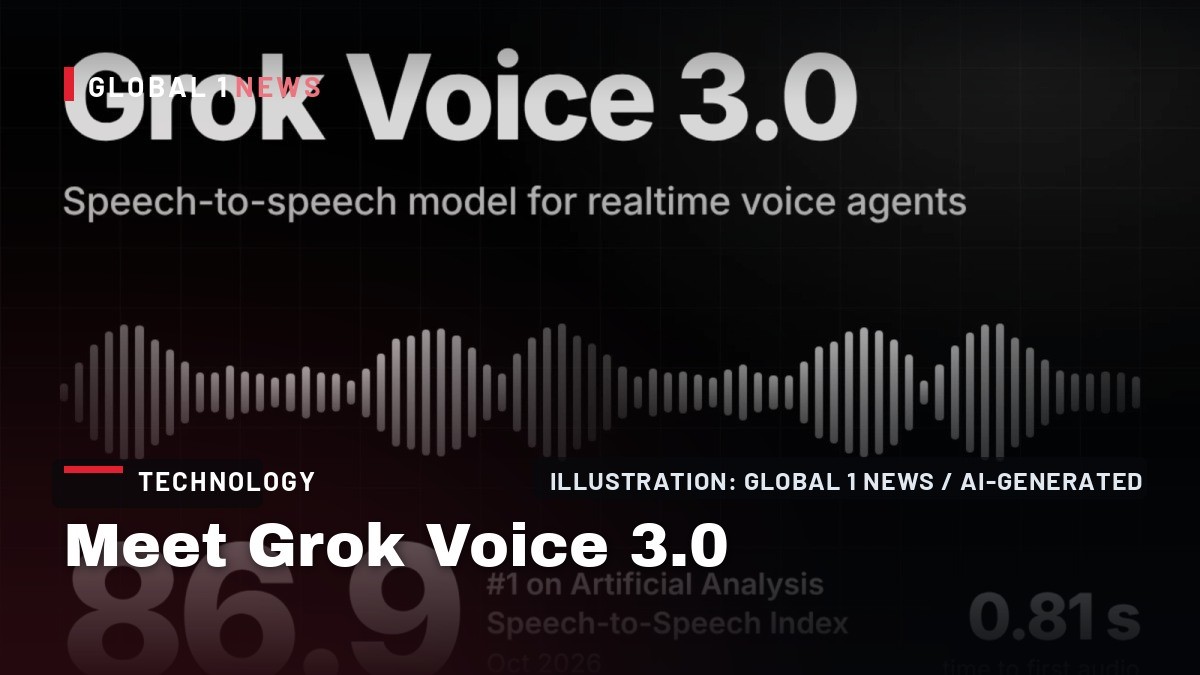
SpaceXAI just dropped Grok Voice 3.0, its newest realtime speech‑to‑speech agent, and the numbers are already making a ruckus in the hyperscaler‑dominated voice‑AI market. The model sits on SpaceXAI’s hosted Voice Agent API, costs the same $0.08 per minute as the previous version, and now claims the top spot on Artificial Analysis’s Speech‑to‑Speech Index with an 86.9 composite score. As a founder who’s been wiring up production voice stacks for a decade, I’m looking past the hype to see what this actually means for independent hosting providers, contact‑center operators, and anyone who’s ever had a tool‑chain break in the middle of a call.
What Grok Voice 3.0 actually is – and isn’t
First off, Grok Voice 3.0 is an API‑only offering. SpaceXAI does not ship any model weights, nor does it disclose parameter counts or architecture specifics. The service lives behind the wss://api.x.ai/v1/realtime?model=grok-voice-3.0 WebSocket endpoint, with the grok-voice-latest alias automatically pointing to the new version. That means any existing integration that was already calling the alias will flip over without a code change – a convenience for developers but a red flag for anyone who expects version control.
If you need a self‑hosted fallback, you’re out of luck. The model runs exclusively on SpaceXAI’s infrastructure, so you’re locked into their pricing and uptime guarantees. For a small hosting outfit that prides itself on keeping a copy of the model in‑house for redundancy, that’s a hard pill to swallow.
Performance: the numbers that matter
Artificial Analysis breaks the index down into four equal‑weighted components: Big Bench Audio reasoning, τ‑Voice agentic performance, Speech Agent Arena preference, and task success rate. Grok Voice 3.0 scores 86.9 overall, beating GPT‑Live‑1 (Astra, medium) at 83.2 and Gemini 3.8 Live at 82.6. The jump from Grok 2.0’s 81.3 is respectable, but the breakdown shows where the gains are thin.
In Big Bench Audio reasoning, Grok 3.0 posts a 98.5 % success rate, landing fourth overall – StepAudio 3 Realtime leads at 99.7 %. Full‑duplex handling (pauses, interruptions, back‑channels) is 97.0 %, also fourth. The biggest win is in the τ‑Voice agentic benchmark, where Grok 3.0 climbs to 71.6 % from 56.5 % in version 2.0, yet still trails GPT‑Live‑1’s 74.5 %. Task success – the share of conversations that end with the correct tool call – nudges up to 94.8 % from 94.6 %.
Latency is where Grok 3.0 shines for a production environment. Artificial Analysis measures time‑to‑first‑audio at 0.81 seconds, roughly 40 % faster than GPT‑Live‑1’s 1.34 seconds. However, Grok 2.0 was quicker at 0.70 seconds, so you’re paying a small latency penalty for the newer feature set. In a contact‑center where every millisecond counts, that trade‑off is worth a hard look.
Cost: the price tag behind the API
SpaceXAI keeps the per‑minute price flat at $0.08, identical to Grok 2.0. The fine‑print shows a per‑task cost of $0.025 for Grok 3.0, compared with $0.030 for GPT‑Live‑1 and $0.055 for the higher‑tier GPT‑Realtime‑2.1. When you translate that into a typical call volume – say 10 minutes per session – the marginal difference is a few cents per call, but it adds up across millions of minutes.
Gemini 3.8 Live undercuts the per‑hour audio cost at $3.50 versus Grok’s $4.80, but that figure includes a different pricing model (audio plus token usage). GPT‑Live‑1 charges $0.05 per minute plus separate backend usage fees, making direct comparison messy. The takeaway for an independent provider is simple: if you’re already on a $0.08/min plan, the switch to Grok 3.0 won’t blow your budget, but you won’t see a cost‑saving either.
Tool integration and extensibility
Grok 3.0 ships with five built‑in tool types: collections search, web search, X search, remote MCP servers, and custom functions. Reasoning is enabled by default (reasoning.effort set to “high”), but you can dial it down to “none” for faster turn‑taking. Server‑side voice activity detection handles barge‑in, which is a nice touch for live agent hand‑offs.
The API mirrors the OpenAI Realtime spec, so migration is essentially a URL swap and a new API key. That compatibility eases integration for teams already using OpenAI’s realtime stack, but it also means you’re inheriting the same “single point of failure” risk. If the WebSocket drops, your call falls back to silence unless you’ve built a robust reconnection strategy – a lesson learned the hard way when a hyperscaler outage took down a major call‑center in 2023.
Security, compliance, and data handling
SpaceXAI claims SOC 2 Type II compliance, HIPAA eligibility with a BAA, and GDPR alignment. They also state that audio is not stored or used for training, which eases some privacy concerns. However, the lack of on‑premise deployment means you still rely on their security posture. For regulated industries, the BAA is a necessary but not sufficient safeguard; you’ll need to audit their audit reports and ensure your own logging and retention policies line up.
The model supports 28 built‑in voices and custom voice cloning from a 120‑second reference clip. Language detection covers 20 locales, automatically switching as needed. Those features are attractive for multilingual contact centers, but the voice cloning pipeline runs on SpaceXAI’s servers, so you’re again trusting a third‑party with potentially sensitive voice data.
Risk assessment for independent hosting providers
From a risk perspective, Grok 3.0 offers modest performance gains at a stable price, but it deepens reliance on a single vendor. The lack of open weights eliminates the possibility of a fallback or a hybrid deployment where you could route traffic to an in‑house model during an outage. That’s a non‑negotiable risk for any provider that markets “always‑on” voice services.
Latency is acceptable for most use cases, but the fact that Grok 2.0 was faster suggests the newer version trades speed for richer reasoning. If your SLA demands sub‑700 ms turn‑around, you may need to keep Grok 2.0 in the loop or look at alternative models. The τ‑Voice scores, while improved, still lag behind GPT‑Live‑1, indicating that the model’s agentic capabilities are not yet best‑in‑class.
Actionable steps for founders and engineers
1. **Pin the version** – Use grok-voice-3.0 in production rather than the grok-voice-latest alias. The docs warn that the alias will auto‑upgrade, which could introduce regressions without your knowledge.
2. **Benchmark your own traffic** – Run a controlled load test measuring time‑to‑first‑audio, error rates, and tool‑call latency. Compare against the 0.81 s baseline to see if you’re hitting the advertised performance.
3. **Build a fallback** – Either keep Grok 2.0 on standby (if you can still access it) or integrate a secondary vendor such as GPT‑Live‑1 for critical paths. A dual‑provider strategy mitigates the single‑point‑of‑failure risk.
4. **Audit compliance** – Request SpaceXAI’s latest SOC 2 Type II report and BAA terms. Verify that their “audio not stored” claim aligns with your data‑retention policies.
5. **Cost‑model your usage** – Calculate per‑call cost using the $0.025 per task figure plus $0.08/min audio. Factor in any additional tool usage fees if you enable web or X search calls during the session.
6. **Monitor latency spikes** – Implement real‑time health checks on the WebSocket connection and set alerts for latency above 1 second. Early detection can prevent a cascade of dropped calls.
7. **Consider voice cloning carefully** – If you need custom voices, test the cloning pipeline for latency and data privacy. Remember that the cloned voice data lives on SpaceXAI’s servers.
In short, Grok Voice 3.0 is a solid incremental upgrade that nudges SpaceXAI ahead of the competition on the Artificial Analysis leaderboard. It’s not a game‑changing breakthrough, but the 0.81 second first‑audio latency and the $0.025 per task price point make it a viable option for many contact‑center workloads. The real decision hinges on how much vendor lock‑in you can tolerate. If you’re comfortable riding SpaceXAI’s wave, lock the version, monitor performance, and keep a fallback plan ready. If you can’t stomach the single‑point‑of‑failure, look elsewhere or keep a hybrid stack.
— Allan Ali, Founder
This article was produced with AI-assisted research and editorial support. Reporting is based on the source material cited below. Sources: MarkTechPost; marktechpost.com; Global1.News (15 October 2026).
By Allan Ali, Global1.News
What's Your Reaction?
 Like
0
Like
0
 Dislike
0
Dislike
0
 Love
0
Love
0
 Funny
0
Funny
0
 Wow
0
Wow
0
 Sad
0
Sad
0
 Angry
0
Angry
0

Publisher of Global1.News. Automation architect, systems builder, and the guy making sure the truth gets published.












Comments (0)