
Bolivia's Ancestral Water Pools Rise Again as Climate Crisis Deepens
In Bolivia's Amazon, the Guarayú revived ancestral paúro water pools after a 2022 drought, blending Indigenous knowledge with modern science to build climate resilience for Latin America.
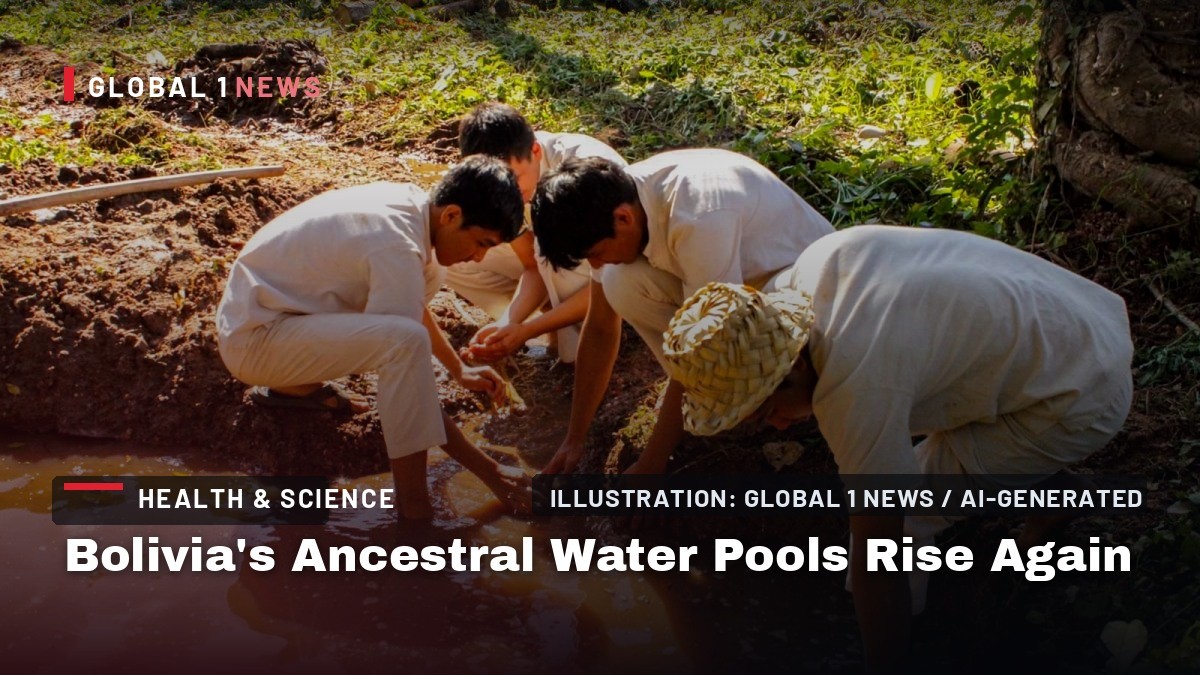
Santa Cruz de la Sierra, Bolivia — The road to understanding Bolivia’s water crisis runs through a high school competition, a forgotten pool, and the determination of a teenager who refused to let ancestral knowledge disappear. Rolando Ágreda, now a university student and the founder of the MAPEKO collective, recalls the confusion and sadness that gripped his community when the paúros—sacred, spring-fed pools that have provided water for generations—began to evaporate during the severe drought of 2022. “Confusion was the strongest feeling,” he says. “But also sadness, because for everyone I know that place represents joy.”
Ancestral Systems Meet a Modern Crisis
The revival of the paúros in Ascensión de Guarayos is part of a broader, global trend. According to Musaed Aklan, a senior researcher focused on water and climate change at the Sana’a Center for Strategic Studies, Indigenous water management systems are typically smaller, more decentralized, and reliant on local materials compared to modern infrastructure. “It comes from the accumulated knowledge of generation after generation,” Aklan says. These systems, which include rooftop rainwater harvesting, flood and overland flow harvesting, and groundwater harvesting, are uniquely suited to the climate crisis because they can store water during scarcity and divert it during floods. “Sometimes it is flash floods, other times drought, and sometimes both in the same area,” he adds. In the Andes, Indigenous nations developed a remarkable diversity of these systems: raised fields known as camellones, communal rainwater reservoirs called q’otañas, infiltration canals known as amunas, and managed wetland systems called bofedales. “Everyone has their own system. But even if the ideas are different, the fundamentals are almost the same. They are global,” Aklan explains. Yet, for decades, these systems have been in decline. Climate change has drained some, while rural abandonment and the construction of large modern infrastructure—which depletes groundwater and disrupts local ecologies—have led to the deterioration of others. In Ascensión de Guarayos, the drought exposed the paúros’ neglect, but they had fallen into disrepair long before. “Little by little, people forgot how important it was to maintain them, to ask permission in those places and to take only what they needed,” Ágreda says.The Spirit of the Paúro
Restoring a paúro is not merely a technical exercise. For the Guarayú, each pool has its own spirit, and the community living nearby is responsible for perceiving and determining who that spirit is. “No two paúros are cleaned the same way and that’s because each has its own spirit,” Ágreda explains. Before any work begins, the community must ask permission to proceed. They must also learn about the surrounding nature, distinguishing between plants that can be eliminated and those that are vital. This knowledge is passed down through an intergenerational exchange, with elders guiding the younger generations. “A son might know less than his father, but the father would guide his son, and the father in turn would be guided by the grandmother,” Ágreda says. This cultural dimension is central to the success of Indigenous water systems. Aklan emphasizes that these are “community-based systems, community-based management, community-based solutions.” The local ownership makes them more self-sufficient, durable, and adaptable than high-tech centralized systems that depend entirely on outside expertise. “Even if there is a catastrophic flash flood or even if the Indigenous systems are destroyed, there is a way for locals themselves to construct them back,” he says. This resilience is critical in a region where extreme weather events are becoming more frequent and intense.From Restoration to Legislation
The success of the paúro project in Ascensión de Guarayos has had ripple effects far beyond water security. After launching the initiative while still in school, Ágreda began university in Santa Cruz de la Sierra in 2023, where he met young professionals passionate about conservation. Together, they formed MAPEKO, a collective of lawyers, environmental engineers, biologists, and other specialists—all under 30—who work with Indigenous elders to restore paúros using a blend of ancestral and modern techniques. Their studies revealed that a channel extending over two city blocks connects the paúros and is critical not only for water security but also for local microclimate regulation in a region facing land degradation and record-breaking temperatures of up to 40° Celsius (104° Fahrenheit). These findings laid the groundwork for a broader conservation initiative. In 2024 and 2025, MAPEKO successfully campaigned for the passage of two municipal conservation laws, including the Yande I Yar Ecological Corridor Law, which establishes and legally protects an ecological corridor inside the Ascensión de Guarayos city limits, restricting land use and development. Rodrigo E. Herrera Sánchez, a lawyer and representative of the civil legal organization Justicia Ambiental, calls this “a very important legislative precedent.” While other municipalities have laws restricting mining, he notes that “in this case we have a much more precise rule that defines a corridor, a specific area, and a broader range of restricted activities.” The law also demonstrates how municipalities can create meaningful environmental protections without waiting for the national government.A Latin American Blueprint
The lessons from Ascensión de Guarayos resonate across Latin America, where Indigenous communities are often on the front lines of the climate crisis. In Brazil, the Amazon faces similar pressures from drought, deforestation, and the expansion of agribusiness, which threaten both water resources and the Indigenous territories that help protect them. The revival of Indigenous water systems offers a model for how to address these challenges in a way that is both sustainable and culturally appropriate. Aklan notes that funding for such restoration is coming not only from communities but also from international development programs, including the World Bank and the UNDP. However, he cautions that new systems, however advanced, are problematic if they are not linked to local habits and sustainability. “New systems are good, and they are very advanced. But if they are not linked to the locals’ habits, if they are not linked to sustainability, they are problematic,” he says. For Ágreda, the path forward is clear: protecting the paúros requires combining ancestral knowledge with modern governance, science, and technical tools. It also requires treating local communities as equal partners with control over water management. The ecological corridor law is a step in that direction, but the work is ongoing. As the world grapples with “global water bankruptcy,” the paúros of Ascensión de Guarayos offer a tangible example of how Indigenous knowledge can provide not just water, but also a sense of community, identity, and hope. “Something we did with that first project was clearly working, it was responding to a real need in the community,” Ágreda remembers. That need, and the response to it, may well define the future of water in Latin America.This article was produced with AI-assisted research and editorial support. Sources: Mongabay (news.mongabay.com).
By Elena Vasquez, Staff Writer
What's Your Reaction?
 Like
0
Like
0
 Dislike
0
Dislike
0
 Love
0
Love
0
 Funny
0
Funny
0
 Wow
0
Wow
0
 Sad
0
Sad
0
 Angry
0
Angry
0

Latin America Correspondent at Global1.News. Based in Mexico City, covering politics, economics, energy, and culture across the region. Brings an on-the-ground perspective to stories spanning from the Rio Grande to Patagonia.














Comments (0)