
A 1,000-mile cloud on Mars may reveal physics never seen in nature
Every morning during the Martian spring and summer, a thin, needle‑long cloud unfurls across the sky near the towering Arsia Mons volcano, stretches to a length that dwarfs most Earthly weather systems, then vanishes by midday.
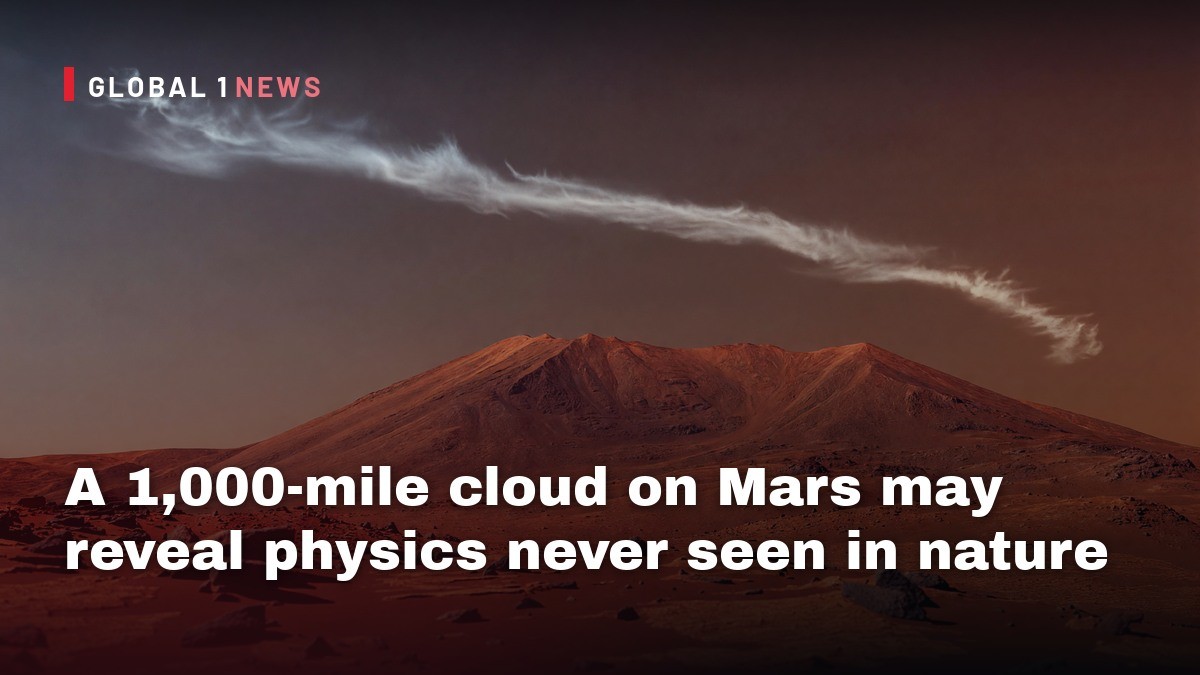
Every morning during the Martian spring and summer, a thin, needle‑long cloud unfurls across the sky near the towering Arsia Mons volcano, stretches to a length that dwarfs most Earthly weather systems, then vanishes by midday. The phenomenon—known to scientists as the Arsia Mons Elongated Cloud, or AMEC—has puzzled planetary researchers since a probe first photographed it in 2018. Now a team led by planetary scientist Jorge Hernández‑Bernal of Sorbonne Université claims to have finally cracked the code, and the answer may rewrite what we think is possible in any planet’s atmosphere.
From mystery to model: a breakthrough in Martian cloud science
The AMEC’s behavior is strikingly simple yet baffling. Each day, a wispy formation appears near the 65,000‑foot‑tall Arsia Mons, elongates over the course of a few hours until it spans more than 1,000 miles—roughly the distance from New York to Kansas City—then dissipates, only to repeat the cycle for several months. Prior attempts to explain the cloud fell short because Earth‑centric cloud formation models rely on particles such as dust or salt to seed droplets, a mechanism that simply does not produce the observed Martian streak.
Hernández‑Bernal’s team took a different tack. By incorporating a rarely invoked process called homogeneous nucleation—where vapor directly becomes ice crystals without any particulate catalyst—into high‑resolution atmospheric simulations, the researchers reproduced the AMEC exactly as observed. “We found that we needed to include some exotic physics… physics that, while included in textbooks, is treated as theoretical and usually thought not to happen in nature,” Hernández‑Bernal said in a press release. The model’s success suggests that the AMEC is not a freak of local topography alone, but a manifestation of a physical regime previously unseen in planetary atmospheres.
The exotic physics behind the cloud
On Earth, clouds form when water vapor condenses onto aerosols, forming droplets or ice crystals that grow into visible masses. The AMEC, however, appears to bypass that step entirely. The study published in Nature Geoscience proposes that the cloud originates from homogeneous nucleation, a process that requires a sudden, extreme temperature plunge—about a 30 °C drop within ten minutes—paired with an extraordinary relative humidity.
Such humidity levels are described as “more than 100,000 times greater than any value measured on Earth.” In other words, the Martian atmosphere in the vicinity of Arsia Mons must become saturated far beyond anything we have ever recorded, allowing vapor to freeze spontaneously. This is the first time any planetary scientist has documented conditions capable of supporting homogeneous nucleation on a real planet, making the AMEC a natural laboratory for a theoretical concept.
How Arsia Mons powers the phenomenon
The volcano’s sheer height plays a pivotal role. When wind currents slam into the 65,000‑foot edifice, they generate a powerful atmospheric wave that thrusts moist air upward at remarkable speed. Within minutes, this uplifted air reaches altitudes where the temperature can plunge sharply enough to trigger the homogeneous nucleation cascade.
Because the wave is sustained each morning during the relevant season, the process repeats daily, giving the cloud its regular, predictable rhythm. The model shows that without the volcano’s wind‑deflection effect, the necessary humidity and temperature conditions would not co‑locate, and the AMEC would never form.
Implications for other planetary atmospheres
Scientists have long speculated that homogeneous nucleation could occur in the upper atmospheres of Venus, Earth, and even gas giants, but direct observation has remained elusive. The AMEC provides the first concrete example that such extreme humidity and rapid cooling can coexist, albeit in a very specific Martian setting.
“Scientists have assumed a similar phenomenon could occur in the upper atmospheres of other planets, including Venus and even Earth, but it has never been observed,” the source notes. The discovery therefore expands the toolbox for interpreting exotic cloud formations elsewhere, offering a new benchmark for atmospheric models that must now account for the possibility of particle‑free ice crystal formation under the right conditions.
Why the finding matters for Mars exploration
Understanding the AMEC is more than an academic exercise; it informs how we interpret Martian weather, climate cycles, and potential habitability. If humidity can spike to levels 100,000 times higher than Earth’s maximum, even locally, it suggests that water vapor reservoirs—perhaps trapped in subsurface ice or released by volcanic activity—are more dynamic than previously thought.
Moreover, the cloud’s predictable daily cycle could serve future missions as a natural tracer for atmospheric dynamics. Instruments on orbiters or landers could use the AMEC’s appearance and disappearance to calibrate wind models, temperature gradients, and moisture transport, sharpening our overall picture of the Red Planet’s climate system.
Scientific rigor and the road ahead
The breakthrough rests on a careful marriage of observation and theory. The team started with the 2018 probe data that first documented the cloud’s length, timing, and seasonal recurrence. By iteratively adjusting their simulation to match those parameters, they identified the missing physics—homogeneous nucleation—and demonstrated that its inclusion reproduces the AMEC with fidelity.
Hernández‑Bernal emphasizes that “the result is remarkable” because it shows that even with limited direct measurements of Mars’ atmosphere, a well‑constructed model can fill gaps and predict phenomena that were previously inexplicable. The next step, according to the researchers, is to seek direct in‑situ measurements of humidity and temperature near Arsia Mons during the cloud’s formation window, to confirm the model’s assumptions.
Broader context: a reminder of nature’s surprises
The AMEC story underscores a timeless lesson for science: nature often finds pathways that textbooks deem “theoretical.” By daring to include exotic physics that most models treat as academic curiosities, the team turned a puzzling Martian cloud into a proof‑of‑concept for a process never before seen in action.
For readers of Global1.News, the takeaway is clear. While we chase headlines about rockets and rovers, the real breakthroughs often hide in the subtle, daily rhythms of another world’s weather. The Arsia Mons Elongated Cloud is a reminder that even a planet we thought we knew well can still surprise us with phenomena that challenge our fundamental understanding of atmospheric physics. And as we continue to explore, those surprises will keep pushing the boundaries of what we consider possible—both on Mars and back home on Earth.
This article was produced with AI-assisted research and editorial support. Reporting is based on the source material cited below. Sources: Ars Technica; arstechnica.com; Global1.News (24 October 2026).
By Jessica Ali, Staff Writer
What's Your Reaction?
 Like
0
 Dislike
0
 Love
0
 Funny
0
 Wow
0
 Sad
0
 Angry
0

Editor-in-Chief at Global1.News. Atlanta-based journalist who cuts through the BS and tells it like it is. Lead anchor, host, and the voice you hear when the spin stops and the truth starts.















Comments (0)