
‘Still Just a Child’: The Russian Teenagers Fighting and Dying in Ukraine
The death of Russian teenagers on the front lines of the war in Ukraine has moved from a tragic footnote to a stark illustration of how the Kremlin’s recruitment apparatus draws ever younger men into combat.
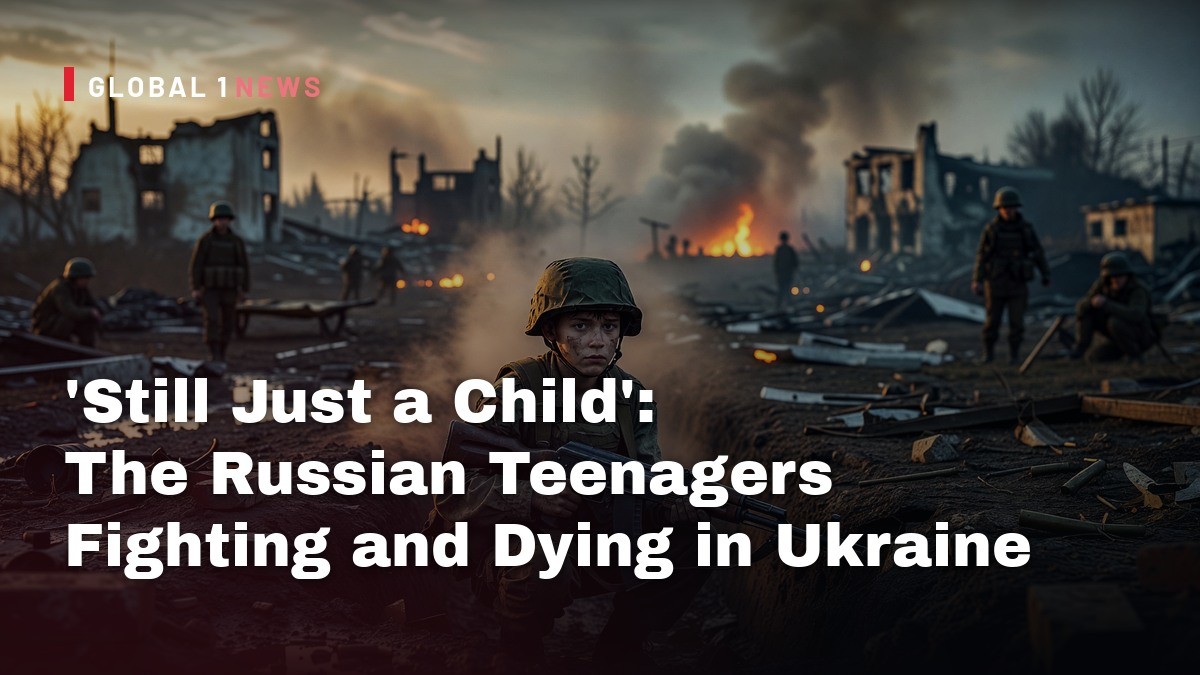
The death of Russian teenagers on the front lines of the war in Ukraine has moved from a tragic footnote to a stark illustration of how the Kremlin’s recruitment apparatus draws ever younger men into combat. Recent online obituaries and eyewitness accounts reveal a pattern: boys who were still in school when the invasion began are now listed among the dead, their stories amplified by state‑sanctioned narratives and grassroots mourning rituals. The phenomenon raises pressing questions about the sustainability of Russia’s manpower pool, the social mechanisms that normalize under‑age enlistment, and the broader political calculus that tolerates the loss of children in pursuit of geopolitical aims.
From schoolchildren to soldiers: the age profile of the dead
According to a count compiled by the BBC’s Russian service and the exiled outlet Mediazona, more than 200 Russian soldiers aged 18 have been killed in Ukraine. The tally, however, excludes those listed as missing and combatants from the Russian‑backed separatist regions of Donetsk and Luhansk, suggesting the true figure is higher. The age of the fallen is not limited to adults; the first publicly identified Russian soldier born in 2008, Alisher Svirin, was killed after serving as a machine‑gunner in a motorised rifle brigade. He was 14 when President Vladimir Putin launched the full‑scale invasion in February 2022, underscoring how the war has recruited children who barely left adolescence.
Other cases illustrate a similar trajectory. Kirill Tretyakov, born on 7 February 2007, turned 15 just as the war began. After completing ninth grade, he entered a vocational college, then signed a contract with the Defence Ministry six days after his 18th birthday. He served as a combat engineer in the 656th Separate Guards Engineer‑Sapper Battalion before being killed on 22 September 2026. In Crimea, 19‑year‑old Nikolai Ruzov, who was six when the peninsula was annexed in 2014 and 14 at the war’s outset, completed a year of compulsory service, signed a contract, and was killed on 18 August 2026 while leading an assault squad in Donetsk. These individual stories, documented by the Moscow Times and corroborated by local VKontakte groups, demonstrate a pipeline that transforms schoolchildren into frontline combatants within a few short years.
The role of Orthodox‑styled online memorials
The pro‑war VKontakte group Synodik, with roughly 50,000 followers, functions as a digital “synodik” – a liturgical list of names for prayer. Its members, predominantly women, post obituaries for teenage soldiers, accompanied by icons, cross emojis, and Orthodox prayers. The group’s language frames the deceased as “newly departed warriors,” a euphemism that sanctifies their sacrifice and integrates it into religious ritual. By presenting these youths as martyrs, the platform reinforces a narrative that aligns personal loss with spiritual redemption, thereby normalising the loss of children as a collective, holy duty.
Synodik’s reach extends beyond Russian heartland to occupied territories. It publishes obituaries for soldiers from annexed Crimea and the self‑declared republics of Donetsk and Luhansk, blurring the line between Russian nationals and separatist fighters. The daily increase in “newly departed warriors” suggests an accelerating flow of teenage casualties, a trend that the Kremlin appears to accept, if not tacitly encourage, as part of its broader mobilisation strategy.
State‑driven narratives and school‑based propaganda
State‑mandated patriotic lessons, such as the “Important Conversations” series introduced on 21 September, deliberately highlight youthful heroes to inspire schoolchildren. The curriculum features soldiers who died in the early months of the war, including Nurmagomed Gadzhimagomedov, a Dagestani killed in March 2022. Footage of President Putin praising Gadzhimagomedov’s sacrifice was incorporated into a seven‑minute video shown to pupils, reinforcing a message that heroism is tied to youthful sacrifice across ethnic lines. By showcasing teenagers who died for the Fatherland, the Kremlin cultivates a mythos that valorises early enlistment and frames death as an honourable contribution to the nation’s destiny.
These educational materials dovetail with the online memorial culture, creating a feedback loop where state‑approved narratives are echoed in civilian‑run groups, further embedding the notion that dying as a teenager is a noble, even expected, outcome of patriotism.
Psychological dimensions of under‑age enlistment
A Russian psychologist who works with adolescents, speaking anonymously for safety, described a “risk of being killed… very high” yet noted that “young people don’t think about that.” The professional linked this to a developmental sense of invulnerability, compounded by a “broader devaluation of life” echoed in television propagandist Vladimir Solovyov’s comment that “life is greatly overrated.” The psychologist argued that teenagers lack the “social circle, the word‑of‑mouth networks” needed to critically assess the war, leaving them susceptible to recruitment narratives that glorify combat.
This assessment aligns with the observable pattern: many of the teenage soldiers entered service shortly after completing compulsory schooling, often without clear deferments or alternative pathways. The case of David Fedorov, forced to sign a contract after police stopped him on the street in May and assigned him as a driver despite lacking a licence, illustrates how coercive mechanisms can bypass the usual legal safeguards meant to protect minors.
Coercion, contracts, and the erosion of deferments
Legal deferments have traditionally shielded some young men from conscription, but the war’s manpower demands have eroded these protections. In the case of David Fedorov, police intervention in Cheboksary led to a forced contract with the Defence Ministry. His mother, speaking to the independent outlet Astra, reported that he was assigned a driver role despite not possessing a driver’s licence, highlighting a mismatch between official duties and individual capability. Such incidents suggest that authorities are willing to overlook standard qualifications to fill ranks, accelerating the flow of under‑age volunteers and conscripts into combat units.
Similarly, Kirill Tretyakov’s rapid transition from vocational student to contract soldier within days of his 18th birthday points to a streamlined recruitment pipeline that prioritises speed over thorough vetting. The pattern of teenagers signing contracts shortly after reaching legal adulthood, combined with reports of police‑mediated enlistments, indicates an expanding coercive apparatus that blurs the line between voluntary service and forced conscription.
Implications for Russia’s war effort and domestic stability
The steady stream of teenage casualties carries profound implications for Russia’s military capacity and internal cohesion. On the battlefield, the loss of young, often under‑trained soldiers can erode unit effectiveness, especially when they are placed in leadership roles, as with 19‑year‑old Nikolai Ruzov commanding an assault squad. The rapid turnover of such personnel may necessitate continual replenishment, straining recruitment channels and increasing reliance on coercive measures.
Domestically, the visible mourning of teenage soldiers on social media and in Orthodox‑styled memorials creates a dual narrative: on one hand, it fuels patriotic fervour; on the other, it exposes the human cost of the conflict to families and communities. Comments from mothers grieving lost sons, such as Tamara Romanova’s tribute on Odnoklassniki, reveal a personal grief that coexists with state propaganda. Over time, the cumulative trauma of losing children could undermine public support for the war, especially if the perception grows that the state is sacrificing its youth for dubious geopolitical gains.
In sum, the emergence of teenage soldiers on the front lines is not an isolated tragedy but a symptom of a broader mobilisation strategy that leverages religious symbolism, state‑driven propaganda, and coercive recruitment to sustain a war effort increasingly dependent on the youngest generation. As the Kremlin continues to normalise the loss of children, the long‑term social and military consequences remain uncertain, but the pattern documented in online obituaries and eyewitness testimony signals a deepening crisis at the intersection of war, ideology, and the future of Russia’s youth.
This article was produced with AI-assisted research and editorial support. Reporting is based on the source material cited below. Sources: The Moscow Times; themoscowtimes.com; Global1.News (28 October 2026).
By Irina Volkov, Staff Writer
What's Your Reaction?
 Like
0
 Dislike
0
 Love
0
 Funny
0
 Wow
0
 Sad
0
 Angry
0
Russia/Eastern Europe Correspondent at Global1.News. Covering Russian politics, energy, security, and the shifting dynamics of the post-Soviet space. Provides clear-eyed analysis on one of the world's most opaque regions.









Comments (0)