
BOK: 94% of Korea's Lost Youth Jobs in AI-Exposed Sectors
The release of a new Issue Note by the Bank of Korea (BOK) on August 18, 2026, has provided the most granular evidence yet of a structural rupture in the Republic of Korea's labor market. The report, titled "Is the Contraction in Youth Employment Due to AI? Changing Career Ladders and Policy Tasks," quantifies a phenomenon many have long suspected: the displacement of entry-level workers is not a cyclical downturn but a technological recalibration.
The release of a new Issue Note by the Bank of Korea (BOK) on August 18, 2026, has provided the most granular evidence yet of a structural rupture in the Republic of Korea's labor market. The report, titled "Is the Contraction in Youth Employment Due to AI? Changing Career Ladders and Policy Tasks," quantifies a phenomenon many have long suspected: the displacement of entry-level workers is not a cyclical downturn but a technological recalibration. By isolating the period following the launch of ChatGPT in late 2022, the BOK's Employment Research Team has drawn a direct line between the diffusion of generative AI and the erosion of traditional career pathways for young Koreans.
This is not merely a statistical exercise; it is a fundamental challenge to the social contract that has underpinned Korea's educational and economic ascent. The findings demand that policymakers, educators, and the chaebol reconsider the very nature of the "career ladder" in an era where machines increasingly perform the foundational tasks that once served as apprenticeships for the nation's youth.
BOK Report: 94% of Youth Job Losses Concentrated in AI-Exposed Industries
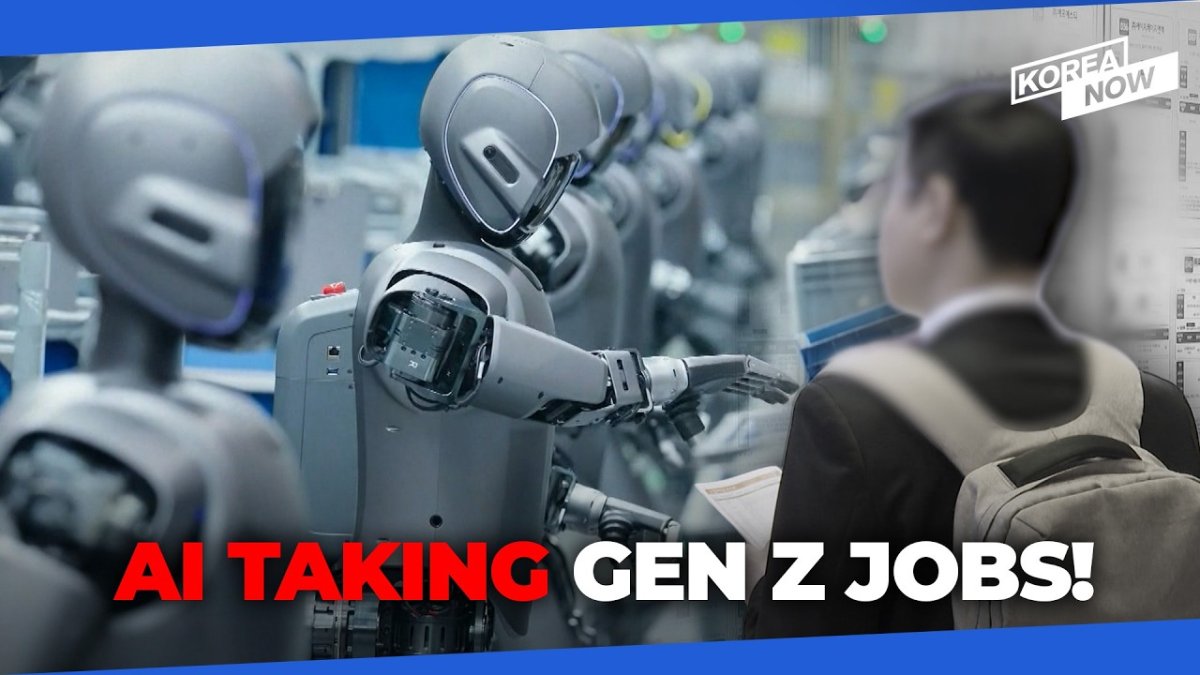
Seoul, South Korea – August 19, 2026 — The Bank of Korea's Employment Research Team has released a comprehensive analysis demonstrating that the contraction in youth employment is overwhelmingly concentrated in sectors highly exposed to artificial intelligence. The report, which sets June 2022 as its baseline—coinciding with the public launch of ChatGPT—reveals that between June 2022 and June 2026, jobs held by individuals aged 15-29 fell by 285,000. Of that stark decline, a staggering 268,000 positions (94 percent) were located in industries with high AI exposure.
The BOK Findings: A Quantitative Breakdown of the AI Effect
The sectoral data provided by the BOK paints a precise picture of where the losses have occurred. The most significant contractions were observed in IT services, which saw a 31.4 percent decline in youth employment, followed by publishing—including software and web design—at 27.4 percent. Computer programming and system integration roles fell by 16.6 percent, while professional services contracted by 11.6 percent. These are precisely the knowledge-intensive sectors that historically absorbed Korea's highly educated workforce.
Over the same period, employment for individuals in their 50s rose by 230,000, with 173,000 (75.2 percent) of those gains occurring in the same high AI-exposure sectors. The BOK describes this as "seniority-biased technological change," a term that encapsulates a troubling dynamic: as AI automates routine tasks, the value of experience and managerial oversight increases, while the value of entry-level execution diminishes. AI is not destroying jobs wholesale but redistributing them up the seniority hierarchy, closing the first rung of the career ladder for young entrants.
The Education Paradox: Higher Degrees, Higher Exposure
The BOK report introduces a counterintuitive finding that challenges Korea's entrenched belief in the protective power of higher education. The data reveals an "unemployment gap" that has inverted the traditional hierarchy of educational attainment. Since November 2022, the average unemployment rate among young college graduates has been 7.0 percent, compared to 5.4 percent for those with junior-college education or less—a 1.6 percentage point gap. This stands in stark contrast to the pre-ChatGPT era (January 2019 to October 2022), when the rates were nearly identical at 8.2 percent and 8.0 percent respectively.
The reason for this inversion lies in the correlation between education and AI exposure. The BOK's analysis shows that AI exposure rises with educational attainment: 0.23 for high school graduates, 0.25 for two-year college graduates, and 0.27 for those holding a four-year degree or higher. This means that the very credentials Korean society has long treated as the gateway to stable, prestigious employment are now the strongest predictors of displacement risk. The entry-level tasks most susceptible to automation—searching and organizing data, drafting documents, basic analysis, translation, and simple coding—are precisely the tasks assigned to new university graduates in their first years at Korean firms. Even traditionally protected professions are not immune; the BOK classifies accountants and lawyers as high AI-exposure occupations, alongside data scientists and programmers.
Worker Flows and the Weakening Career Ladder
Beyond the stock of jobs, the BOK's analysis of worker flows reveals the mechanisms driving this structural change. The average monthly entries of young workers into regular jobs in high-exposure industries fell from 32,600 in the 2016-2019 period to 29,100 between July 2022 and June 2026. More concerning is the fate of those who do enter: exits into non-employment rose by approximately 32 percent, from 3,700 to 4,900 per month. This suggests that young workers are not merely failing to find jobs; they are being actively displaced from positions they already hold, with fewer safety nets to catch them.
The overall share of youth in new hires has plummeted to 29.3 percent in the 2024-2026 period, down from 36.9 percent through 2019. This decline reflects a fundamental shift in hiring behavior. The BOK notes that firms are increasingly favoring experienced recruits over entry-level candidates, a rational response to an environment where AI can perform the routine tasks that once required a cohort of junior staff. Combined with reduced internal training and weaker informal mentoring under remote and hybrid work, this has effectively dismantled the traditional Korean career ladder: the apprenticeship model, where juniors learned by doing under senior guidance, is being replaced by one in which AI performs the "doing" without a junior cohort to guide.

Automation vs. Augmentation: How AI Is Deployed Matters
A critical contribution of the BOK report is its distinction between two modes of AI deployment: automation and augmentation. In industries where AI is used primarily to automate tasks—replacing human labor with algorithmic processes—the BOK observed significantly larger declines in youth employment. Conversely, industries that use AI mainly to augment human work, enhancing the capabilities of existing employees rather than replacing them, did not exhibit the same pattern of youth displacement.
This distinction has profound implications for corporate strategy and public policy. The BOK researcher Oh Sam-il, head of the Employment Research Team, articulated the core issue: "AI mainly handles tasks outlined in manuals, which can substitute for the youth workforce... As a result, a phenomenon occurs where junior workers take a hit in the early stages of AI adoption." The "manual" nature of entry-level work is precisely what makes it vulnerable. The report's findings suggest that the problem is not AI per se, but the strategic choice by firms to deploy AI as a substitute rather than a complement to human labor. This is a choice that can be influenced by policy, corporate governance, and cultural norms.
Policy Implications and BOK Recommendations
The BOK report is not merely diagnostic; it offers a concrete policy framework designed to address the structural mismatch between AI adoption and youth employment. The central recommendation is the creation of "AI-era apprenticeship programs" that combine real workplace assignments with AI tool usage and structured guidance from experienced employees. This model seeks to formalize the informal mentoring that has been eroded by hybrid work and cost-cutting, ensuring that young workers acquire the tacit knowledge and judgment that AI cannot provide.
Complementing this is a proposed "career formation subsidy" to support the mentoring and training costs borne by firms: the BOK argues firms bear training costs without capturing the long-term benefits, as trained workers may move to competitors, and a subsidy would internalize this externality. Finally, the BOK recommends that tax and financial incentives be kept strictly neutral between technology investment and human capital investment, noting that current tax codes often favor capital investment in machinery and software over investment in people, inadvertently accelerating the substitution of AI for entry-level labor.
It is important to note the BOK's own caution that AI is not the sole cause of the youth employment contraction. The report acknowledges that the unwinding of pandemic-era overhiring, a broader shift toward experienced recruits, and the structural decline in long-term internal training all contribute to the trend. However, the concentration of losses in AI-exposed sectors, the timing relative to ChatGPT's launch, and the divergent patterns between automation-focused and augmentation-focused industries all point to AI as the primary accelerant.
Looking Ahead: Korea's AI-Era Competition and Demographic Reality
The implications of this report extend far beyond the labor market. Korea's demographic decline—one of the most rapid in the developed world—means that the country cannot afford to waste the productive potential of its youth. The current trajectory, where young people face prolonged unemployment or precarious non-regular work, risks creating a "lost generation" with diminished lifetime earnings and weakened social cohesion. This is not merely an economic issue but a national security and social stability concern.
The BOK's findings also intersect with Korea's education policy and chaebol hiring practices. The inversion of the unemployment gap by education level calls into question the relentless pursuit of elite university credentials. If a four-year degree increases AI exposure without a corresponding increase in resilience, the entire "education arms race" that defines Korean society may need recalibration. Furthermore, the chaebol's traditional preference for large cohorts of new graduates, trained internally over decades, is being disrupted. The report suggests that this model, which served Korea well during its industrialization and digitalization phases, is ill-suited to the AI era.
Korea is not alone in this transition, but it is uniquely exposed. The BOK notes that an estimated 51.8 percent of Korean workers used generative AI at work in 2025, nearly double the 26.5 percent recorded in the United States. This rapid adoption rate, driven by Korea's world-class digital infrastructure and tech-savvy population, means that the disruption is arriving faster and hitting harder than in other advanced economies. The policy response, therefore, must be equally swift and innovative. The BOK's recommendations for apprenticeships, career formation subsidies, and tax neutrality provide a starting point, but the ultimate solution will require a societal conversation about the value of work, the purpose of education, and the role of technology in human flourishing. The decisions made in the next few years will determine whether Korea's AI revolution becomes a story of inclusive growth or generational division.
By Prof. David Park, Staff Writer
This article was produced with AI-assisted research and editorial support. Reporting is based on sources cited in the article.
What's Your Reaction?
 Like
0
Like
0
 Dislike
0
Dislike
0
 Love
0
Love
0
 Funny
0
Funny
0
 Wow
0
Wow
0
 Sad
0
Sad
0
 Angry
0
Angry
0

East Asia/Technology Correspondent at Global1.News. Seoul-based voice covering Korean politics, technology, business, and culture. Analyzes how technology and geopolitics intersect across East Asia.















Comments (0)