
A New Voice in Bangkok: The Boiling Frog Institute Opens Its Doors
BANGKOK — A new independent think tank has begun its work in the Thai capital, and its founders are hoping to wake the country from a long, quiet slumber.
A New Voice in Bangkok: The Boiling Frog Institute Opens Its Doors
BANGKOK — A new independent think tank has begun its work in the Thai capital, and its founders are hoping to wake the country from a long, quiet slumber. The Boiling Frog Institute, known as BFI Thailand, was established to confront the kingdom's long-term structural challenges before they harden into deeper economic and social crises. The institute's name is a direct reference to the metaphor its founder, Dr. Suthikorn Kingkaew, first used in March 2017 to describe Thailand's economic trajectory.
Back then, Dr. Suthikorn warned that the greatest risk to the nation was not a sudden financial collapse, but the gradual erosion of competitiveness across key industries while the deterioration went largely unnoticed. He pointed to Thai manufacturing sectors—automobiles, textiles, and hard-disk drives—as areas where the country was losing ground. The image was stark: a frog in a pot of slowly heating water, failing to notice the rising temperature until it is too late. Nearly a decade later, BFI Thailand has been formally established around the principles of "Bridging, Framework, Impact"—bringing different sectors together, developing practical frameworks for complex problems, and translating ideas into meaningful change.
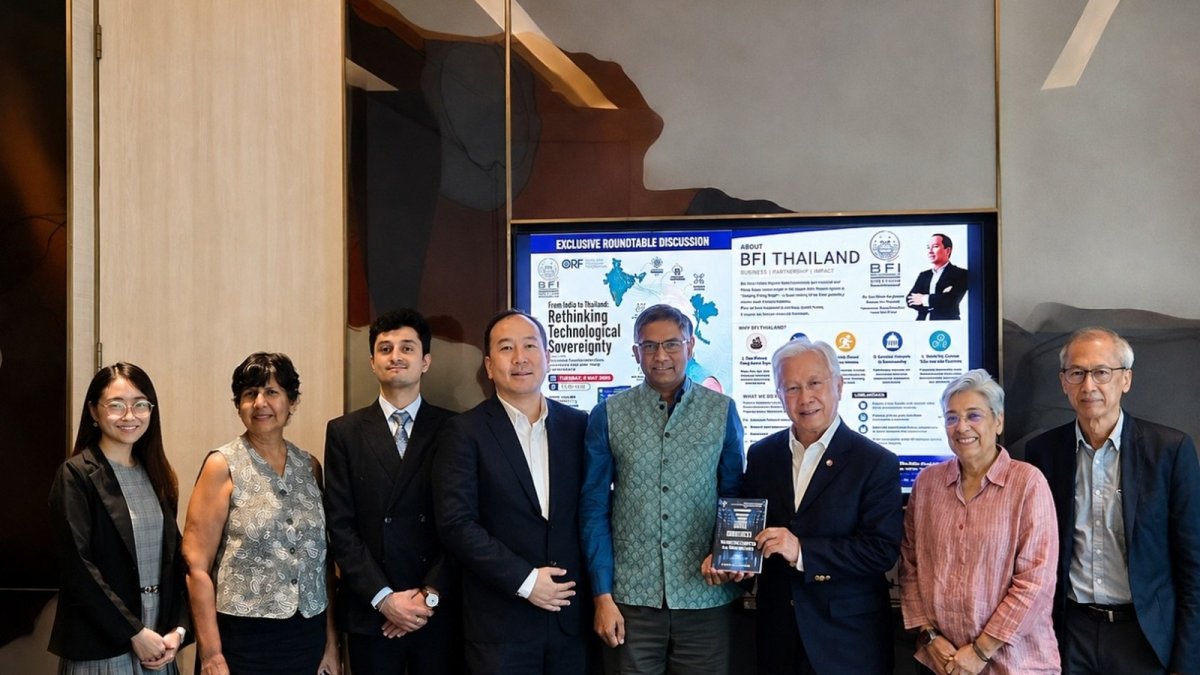
This week, the institute hosted its first major public-facing event, an Exclusive Roundtable Discussion titled "From India to Thailand: Rethinking Technological Sovereignty." The gathering brought together senior representatives from government, diplomacy, business, and academia for a closed-door exchange with Indian author and strategic thinker Pranjal Sharma. For a country like Thailand, long accustomed to positioning itself as a hub for foreign investment, the conversation marked a significant shift in how local policymakers are beginning to think about the future.
The Boiling Frog Crisis: A Warning From 2017
To understand why BFI Thailand matters, one must revisit the warning Dr. Suthikorn issued in March 2017. At the time, he was a lone voice in the wilderness, cautioning that Thailand's economic model was facing a slow-burning crisis. The country's manufacturing base, once the engine of its growth, was being squeezed by regional competitors. Automobile production faced new pressures from electric vehicle transitions. Textiles, a traditional strength, were losing ground to cheaper producers in Vietnam and Bangladesh. Even the hard-disk drive industry, where Thailand once dominated global production, was seeing its relevance fade with the rise of cloud storage and solid-state drives.
The "Boiling Frog Crisis" metaphor was not just about industrial decline. It was about the psychology of complacency. Dr. Suthikorn argued that because the deterioration was gradual, it did not trigger the alarm bells that a sudden shock would. The country was adapting to a slow decline, normalizing it, and failing to take the drastic action needed to reverse course. BFI Thailand is, in many ways, the institutional answer to that warning—a dedicated space where these uncomfortable truths can be examined without the constraints of government bureaucracy or corporate interests.
The institute's founding principles are deliberately simple. "Bridging" refers to connecting disparate sectors—government, private industry, academia, and civil society—that often operate in silos. "Framework" is about developing practical, actionable models for tackling complex problems rather than relying on abstract theory. And "Impact" is the ultimate goal: translating ideas into policies and practices that create meaningful, measurable change in the lives of Thai citizens.
Learning From India: The Roundtable Discussion
The roundtable discussion this week was the first test of this framework. The central question posed to participants was deliberately practical: Which technologies must Thailand own, which should it co-develop, and which can safely be sourced through trusted global partners? This is a far cry from the binary debate between self-sufficiency and open markets. Instead, it asks Thai policymakers to think strategically about where to draw the line.
The discussion was anchored by Pranjal Sharma, whose latest book, "India Innovates: Technological Sovereignty in a Weaponized World," published in 2026, provided the intellectual starting point. Sharma's work examines India's attempt to reduce excessive dependence on foreign technologies that could become strategic vulnerabilities during periods of geopolitical tension. His definition of technological sovereignty is broad, extending far beyond artificial intelligence to encompass data, computing, digital infrastructure, rare earths, navigation and space, defense and national security, manufacturing, and agriculture.
The room was filled with influential figures. Dr. Kanok Wongtrangarn, Advisor to the Minister of Industry, represented the Thai government's perspective. Navodit Verma, Head of Chancery at the Embassy of India in Thailand, offered diplomatic insights into how New Delhi views its own strategic positioning. Veena Upadhya, a prominent business leader, brought the private sector's pragmatic view. The presence of these figures signals that the debate is being taken seriously at the highest levels of Thai society.
A Partnership With the Observer Research Foundation
This event was not a one-off. It reflects a formal collaboration between BFI Thailand and the Observer Research Foundation (ORF), one of India's leading think tanks. The partnership aims to deepen the exchange of ideas, policy perspectives, and strategic thinking between Thailand and India. Both Dr. Suthikorn Kingkaew and Pranjal Sharma are ORF Fellows, providing a strong intellectual foundation for continued dialogue and closer cooperation between the two countries.
For Thailand, this partnership is strategically significant. India is not just a fellow Asian nation; it is a rising power navigating the same treacherous waters of US-China competition. By aligning with ORF, BFI Thailand gains access to a network of scholars and policymakers who have been grappling with these questions for years. The collaboration also signals a shift in Thailand's intellectual orientation, looking beyond its traditional partners in the West and Japan toward new models emerging in South Asia.
The choice of India as the first case study is deliberate. India's approach combines foreign investment with policies aimed at creating domestic production capacity and technological capability. These include outcome-linked manufacturing incentives, efforts to develop local alternatives in strategically important digital sectors, support for electronics and semiconductor manufacturing, and targeted development in areas ranging from electric vehicles to defense and space. It is a model of selective engagement rather than isolation.
Technological Sovereignty in a Weaponized World
The underlying argument of Sharma's book, and the roundtable discussion, is not that every country should produce everything domestically. That would be economically absurd. Instead, the argument is that no country should allow excessive dependence on a single external supplier to undermine its ability to make independent economic and security decisions. This issue has become increasingly urgent as US-China strategic competition reshapes the global economic landscape.
Technology, semiconductors, critical minerals, cloud and data infrastructure, digital platforms, and industrial supply chains are no longer purely commercial matters. They have become instruments of geopolitical power. Countries caught between the two major powers face a difficult choice: align with Washington, align with Beijing, or try to navigate a middle path. The roundtable discussion stressed that the goal should be to avoid choosing dependence on one side over dependence on another. Instead, countries should diversify their technology partners, suppliers, energy sources, and trade relationships while simultaneously developing selected domestic capabilities.
For Thailand, this is not an abstract academic question. The country sits at the heart of Southeast Asia, a region that is increasingly the battleground for influence between the US and China. Thailand's economy is deeply integrated into global supply chains, particularly in electronics and automotive manufacturing. Its geographic position makes it a natural transit hub. But this integration comes with risks. If a major power decides to weaponize its technological advantage, Thailand could find itself caught in the crossfire.
What This Means for Thailand's Industrial Strategy
The most relevant lesson for Thailand, participants stressed, is not to copy India's policies wholesale. The contexts are too different. Instead, the lesson is that foreign investment should leave capabilities behind—skilled workers, local suppliers, manufacturing know-how, research capacity, and eventually some degree of technological ownership. For decades, Thailand has attracted foreign direct investment (FDI) based on its low costs, infrastructure, and open markets. But the value of that investment cannot be measured solely by the capital inflows.
This raises a fundamental question about the country's industrial strategy. Attracting FDI remains important, but investment value alone cannot be the final measure of success. The Eastern Economic Corridor (EEC), Thailand's flagship development project, has been successful in attracting investment in next-generation automotive, smart electronics, and digital industries. But how much of that investment has actually transferred technology and skills to Thai workers and companies? How many Thai engineers are leading research and development efforts? How many Thai firms are integrated into the supply chains of the multinationals operating in the EEC?
These are the questions that BFI Thailand hopes to force into the open. The institute's founders believe that Thailand has been too passive in its approach to development, relying on foreign capital to drive growth without demanding a fair share of the knowledge and capabilities that come with it. The roundtable discussion was a first step toward changing that mindset.
A Regional Perspective: ASEAN and the Middle Path
Thailand is not alone in facing these questions. Across ASEAN, neighbors are grappling with the same challenges. Vietnam has aggressively courted semiconductor manufacturers, positioning itself as a reliable alternative to China. Malaysia has deep expertise in electronics packaging and testing. Singapore has become a hub for data centers and financial technology. Indonesia is leveraging its vast reserves of nickel to attract electric vehicle battery makers. Each country is trying to find its niche in the new geopolitical landscape.
But the question of technological sovereignty is particularly acute for Thailand. The country has traditionally been a follower rather than a leader in technology policy. It has relied on its openness and neutrality to attract investment from all sides. That strategy has worked well for decades, but it may no longer be sufficient. As the US-China competition intensifies, Thailand will be forced to make choices about which technologies to develop domestically, which to co-develop with partners, and which to source from abroad.
The roundtable discussion suggested that the answer lies in a middle path. Thailand should not seek to replicate India's ambitious self-reliance programs, which are driven by its size and strategic ambitions. Nor should it continue its passive reliance on foreign investment. Instead, it should identify a small number of strategic technologies where it can build genuine domestic capability, while diversifying its sources for everything else. This requires a level of strategic thinking that has often been lacking in Thai policy circles.
The Road Ahead: From Discussion to Action
BFI Thailand's work is just beginning. The roundtable with Pranjal Sharma was an important first step, but it was only a conversation. The real test will be whether the ideas discussed can be translated into concrete policy recommendations and, ultimately, into action. The institute has signaled that it intends to be a persistent voice in Thai public discourse, pushing for long-term thinking in a political culture that often prioritizes short-term gains.
For Thai readers, the concept of technological sovereignty may seem abstract, but its implications are deeply personal. It affects the kinds of jobs that will be available to the next generation. It determines whether Thai engineers will be designing the technologies of the future or merely operating the machines built elsewhere. It shapes the country's ability to make independent decisions in times of crisis. As the global economy becomes increasingly weaponized, these questions will only grow more urgent.
The Boiling Frog Institute's founding is a recognition that Thailand cannot afford to remain complacent. The water is heating up, and the country must decide whether to jump or to boil. The conversation has begun, and the hope is that it will lead to action before it is too late.
By Ann Srisawat, Staff Writer
This article was produced with AI-assisted research and editorial support. Sources: Khaosod English
What's Your Reaction?
 Like
0
Like
0
 Dislike
0
Dislike
0
 Love
0
Love
0
 Funny
0
Funny
0
 Wow
0
Wow
0
 Sad
0
Sad
0
 Angry
0
Angry
0

Southeast Asia Correspondent at Global1.News. Based in Bangkok, covering Thai and Southeast Asian politics, economy, technology, and culture. Deep regional perspective on one of the world's most dynamic regions.














Comments (0)