
Andy Burnham Becomes Prime Minister After Starmer Resigns
Andy Burnham has arrived at Number 10 Downing Street as Britain’s new Prime Minister, ending Keir Starmer’s troubled tenure and promising a sharper, more regionally rooted style of leadership. The former Manchester mayor took the oath at Buckingham Palace earlier today before returning to Westminster to begin forming his government. Supporters gathered outside the famous black door, waving placards that read “Burnham’s Britain” as the political centre of gravity shifted no...
Andy Burnham has arrived at Number 10 Downing Street as Britain’s new Prime Minister, ending Keir Starmer’s troubled tenure and promising a sharper, more regionally rooted style of leadership. The former Manchester mayor took the oath at Buckingham Palace earlier today before returning to Westminster to begin forming his government. Supporters gathered outside the famous black door, waving placards that read “Burnham’s Britain” as the political centre of gravity shifted northwards.
Andy Burnham's Britain: New PM Names Cabinet After Starmer Exit
London, UK – 20 July 2026 — Andy Burnham has been confirmed as Prime Minister after Keir Starmer formally tendered his resignation to the King this morning. The swift transition follows weeks of internal Labour pressure and disappointing local election results that left Starmer’s authority fatally weakened. Burnham now faces the immediate task of stabilising public finances while delivering on his long-standing pledges to reshape the welfare state.
The Transfer of Power: From Starmer to Burnham
Keir Starmer’s farewell address in the Commons yesterday was brief and notably subdued. The outgoing Prime Minister thanked his colleagues for their service but offered little reflection on the policy shortcomings that precipitated his departure. Senior figures on the backbenches remained seated in silence as he concluded, a telling indication of the fractured state of the parliamentary Labour Party after months of speculation about his future.
The formal handover at Buckingham Palace proceeded with customary constitutional precision. Burnham arrived shortly after 11 a.m. and spent forty minutes with the King discussing the composition of the new administration. Observers noted that the audience lasted longer than the equivalent meeting between Starmer and the monarch in 2024, suggesting detailed conversations about the challenges facing devolved administrations and the strained public purse.
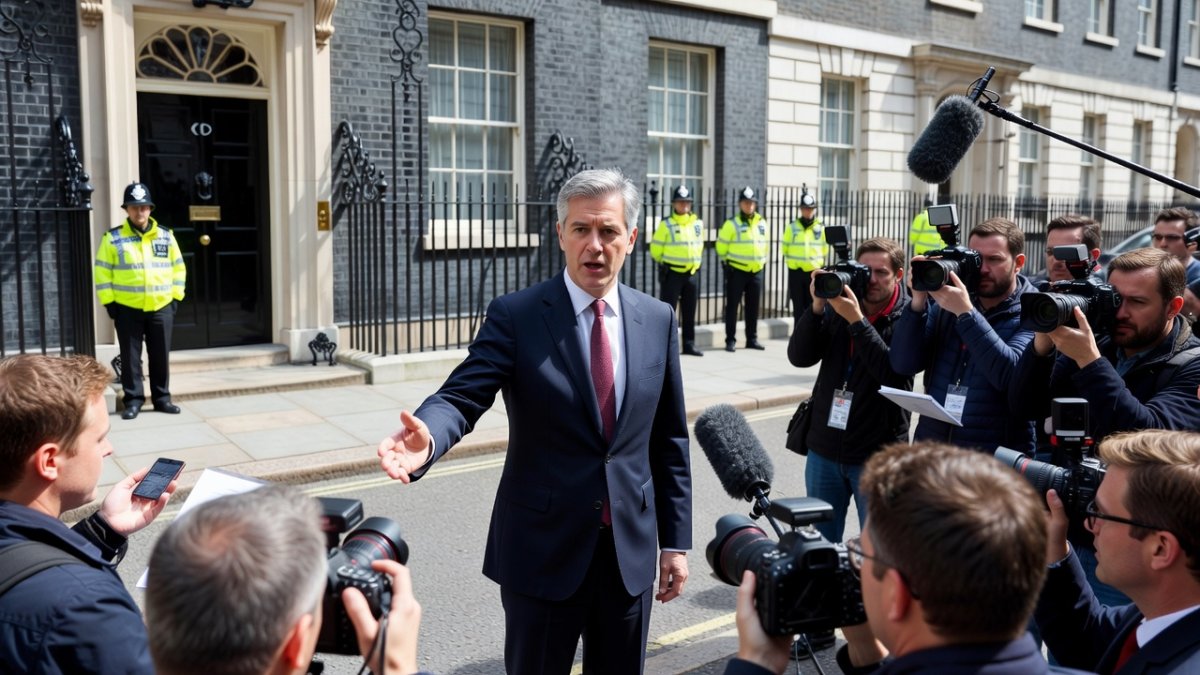
Burnham’s first public remarks outside Number 10 were delivered without a lectern, a deliberate symbolic break from the formal style that characterised the Starmer years. Standing on the doorstep, he spoke of restoring trust in politics through visible action rather than polished rhetoric. The absence of notes and the direct eye contact with assembled journalists conveyed a calculated informality designed to signal accessibility and regional authenticity from the outset.
Burnham's Cabinet: A New Generation Takes Charge
John Healey’s appointment as Chancellor has been widely interpreted as a signal that fiscal discipline will remain central to the new government’s economic strategy. The former shadow defence secretary brings extensive experience of departmental management and is expected to work closely with Treasury officials to address borrowing levels that have exceeded forecasts for three consecutive quarters. Markets reacted calmly to the news, with gilt yields showing only modest movement in early trading.
Ed Miliband returns to frontline government as Foreign Secretary, a move that underscores Burnham’s determination to place climate and energy security at the heart of Britain’s international engagement. Colleagues who worked with Miliband during his previous ministerial career have welcomed the appointment, noting his detailed grasp of European policy networks that will prove essential as the UK seeks to deepen trade ties outside the European Union framework.
Shabana Mahmood remains at the Home Office, providing continuity in a department that has faced sustained criticism over asylum processing backlogs. Louise Haigh, widely tipped for a senior role, has been given enhanced responsibilities that effectively position her as Deputy Prime Minister, overseeing the coordination of domestic policy across Whitehall. Yvette Cooper moves to Health and Social Care, where she will lead the long-promised overhaul of social care funding.
Angela Rayner’s return to cabinet after a period on the backbenches completes a careful balancing act between different wings of the Labour Party. Her appointment as Levelling Up Secretary is expected to accelerate the Manchester regional model that Burnham has championed since his time as mayor. These choices collectively indicate a government that intends to blend experienced operators with figures who can deliver visible change in housing, transport and public service reform.
What 'Burnhamism' Means for Britain
Burnhamism represents a clear departure from the cautious incrementalism of the Starmer period. Where the previous administration emphasised stability and institutional continuity, the new Prime Minister has repeatedly invoked the practical successes achieved in Greater Manchester on transport integration and homelessness reduction. This approach privileges demonstrable local outcomes over abstract national targets and is expected to shape legislation in the forthcoming King’s Speech.
The cost-of-living pledge forms the centrepiece of the early legislative programme. Burnham has committed to freezing energy bills for households on universal credit for two years while accelerating investment in insulation programmes across the North and Midlands. Treasury sources indicate that funding will be drawn from a combination of windfall taxes on energy companies and reallocated departmental budgets rather than additional borrowing.
Social care reform and the target of ending rough sleeping within a single parliamentary term are presented as non-negotiable priorities. Officials in Manchester have already begun modelling a national version of the city’s “housing first” initiative, which reduced street homelessness by 38 per cent between 2022 and 2025. Civil servants have been instructed to produce detailed implementation plans within ninety days, a timetable that reflects Burnham’s insistence on measurable progress rather than extended consultation exercises.
Devolved Nations and the Regions
John Swinney has already requested an urgent meeting with the new Prime Minister to discuss the fiscal framework governing Scotland’s budget. Burnham’s team has indicated that the meeting will take place in Edinburgh rather than London, a gesture intended to acknowledge the distinct political realities of the devolved nations. Early discussions are expected to focus on the replacement of the current block grant mechanism with a system that better reflects population needs and economic performance.
In Wales, ministers have welcomed the promise of greater clarity on capital funding for rail electrification and hospital modernisation. Burnham has suggested that the Barnett formula may be supplemented by targeted regional investment funds modelled on the successful Greater Manchester transport settlement. Cardiff Bay sources believe this could unlock projects that have been stalled since the collapse of the previous UK government’s levelling-up programme.
The Manchester regional model itself is likely to be replicated in other combined authorities. Burnham has spoken of granting mayors enhanced powers over skills funding and housing targets, arguing that centralised decision-making has repeatedly failed to address entrenched inequalities. Civil service briefings indicate that legislation enabling these changes could be introduced before the end of the year, provided the new cabinet can secure cross-party support in the House of Lords.
Economic Inheritance: Markets and the Fiscal Reality
The new administration inherits public finances that remain under considerable strain. Official figures released last week showed that borrowing in the first quarter of the financial year exceeded the Office for Budget Responsibility’s forecast by £7.4 billion. Gilt yields have risen steadily since the spring, reflecting investor concern about the sustainability of current spending commitments without corresponding revenue measures.
Burnham has reiterated his commitment to reducing the tax burden on working households, yet Treasury officials have cautioned against early moves that could widen the deficit further. Preparations are already under way for a comprehensive spending review that will examine every departmental budget line. The review is expected to conclude by November and will set the parameters for the next three years of public expenditure.
Shadow Chancellor Mel Stride’s successor, Kemi Badenoch, has already signalled that the Conservatives will scrutinise any proposed tax increases closely. Meanwhile, former minister Robert Jenrick told broadcasters that the opposition would support measures to control welfare spending provided they are accompanied by genuine reform rather than simple cuts. Markets are watching for early indications of whether Burnham intends to maintain the fiscal rules inherited from his predecessor or introduce a revised framework.
International Response: Trump, Macron and the UK's Place
Donald Trump and Emmanuel Macron both spoke with Burnham within hours of his appointment. The conversations focused on continuity in security cooperation and the importance of maintaining open trade channels amid ongoing global tensions. A joint statement issued from the Élysée Palace emphasised the enduring strength of the UK-France defence relationship, while the White House noted that discussions on future trade arrangements would resume in the autumn.
European Commission officials have welcomed the prospect of more predictable engagement after the turbulence of the Starmer years. Burnham’s team has indicated that the UK will seek to deepen participation in Horizon Europe and other research programmes, reversing the partial withdrawal that occurred under the previous administration. Early diplomatic traffic suggests that European partners view the change of leadership as an opportunity to reset relations without reopening the divisive question of single market membership.
The Bottom Line — What Comes Next
The immediate test for Burnham will be the autumn budget, which must reconcile ambitious social policy pledges with the reality of constrained public finances. Success will depend on his ability to maintain party discipline while persuading sceptical financial markets that the new direction is both deliverable and sustainable. Early polling suggests public appetite for change remains strong, yet that goodwill could evaporate quickly if visible improvements in living standards fail to materialise.
Over the longer term, Burnham’s premiership will be judged on whether the Manchester model can be scaled nationally without losing the pragmatism that made it effective at city level. The coming months will reveal whether the new Prime Minister can translate regional experience into coherent national policy or whether the complexities of governing from Westminster will blunt the distinctive edge he has cultivated over the past decade.
By Erica Thornton, Staff Writer
This article was produced with AI-assisted research and editorial support. Reporting is based on sources cited in the article.
What's Your Reaction?
 Like
0
Like
0
 Dislike
0
Dislike
0
 Love
0
Love
0
 Funny
0
Funny
0
 Wow
0
Wow
0
 Sad
0
Sad
0
 Angry
0
Angry
0

US Politics and Policy Correspondent at Global1.News. Based in Washington DC, covering American politics, policy, elections, and the courts. Knows how the system works and tells you what it actually means.













Comments (0)