
AMLC Opens Bank Enforcement Cases in Flood Control Scandal
The Anti-Money Laundering Council has opened enforcement action proceedings against banks linked to the flood control corruption scandal, an official told the Senate Finance Committee on Thursday. Senators questioned Landbank's failure to flag suspicious cash withdrawals by a contractor, including P520 million every two weeks.
AMLC Opens Enforcement Cases Against Banks in Flood Control Scandal
In a recent ANC 24/7 report on The World Tonight, the Philippines' Anti-Money Laundering Council (AMLC) confirmed it has opened enforcement action proceedings against banks linked to the sprawling flood control corruption scandal — a move that could reshape how financial institutions handle government money and red-flag suspicious transactions.
AMLC Secretariat Director Atty. Arnold Kabanlit made the revelation on Thursday during the Senate Finance Committee's deliberations on the proposed 2027 national budget. The proceedings are ongoing and will examine whether banks had lapses in compliance with covered transaction reports (CTR) and suspicious transactions reports (STR) requirements.
"As to the government bank mentioned... and the other banks that were involved in the flood control controversy, we have opened enforcement action proceedings against them," Kabanlit told senators.
The announcement comes as the Senate zeroes in on the Landbank of the Philippines' alleged failure to curb the flow of funds to a contractor implicated in the scandal — a case that has exposed gaping holes in the country's anti-money laundering safeguards and raised uncomfortable questions about who is watching the watchers.
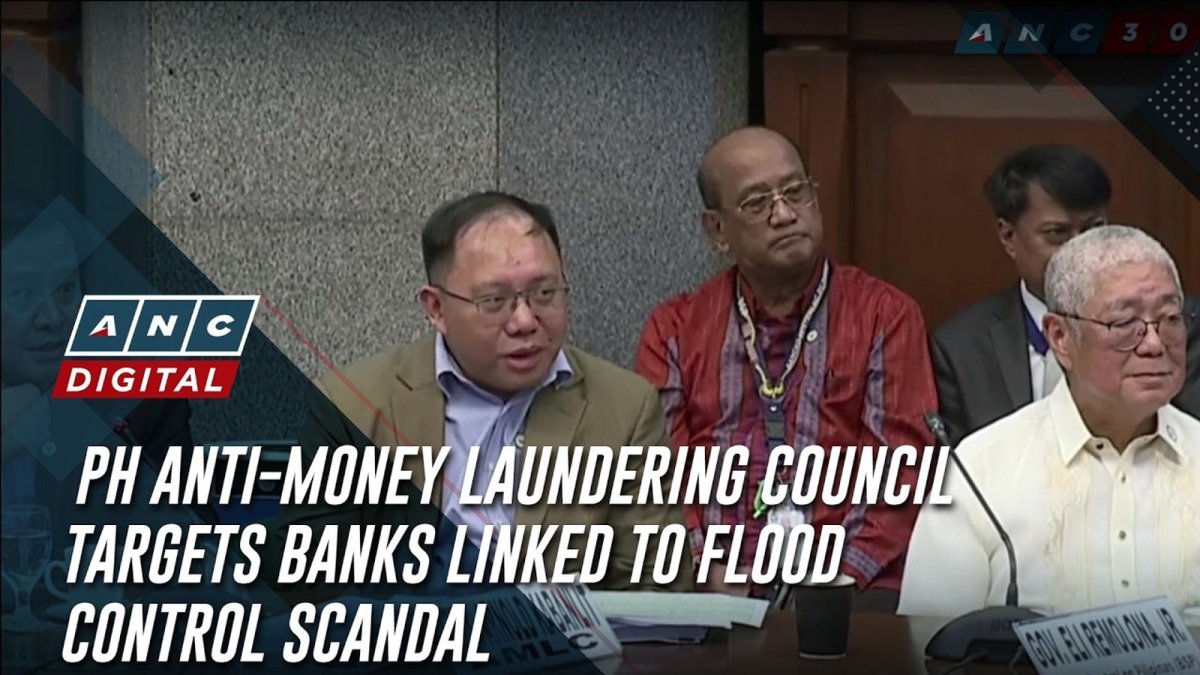
Senators Grill Landbank: P520 Million in Cash Every Two Weeks
The Senate Finance Committee hearing turned tense as senators confronted Landbank officials over transactions that, on paper, appeared perfectly legal but in practice should have triggered every alarm bell in the banking system.
Sen. Francis Pangilinan zeroed in on the absurdity of the situation, questioning how a contractor could withdraw staggering amounts of cash without raising a single eyebrow at the state-run bank.
"Sinabi ng Landbank, everything was above board... So ibig sabihin pwede mag-withdraw ng P520 million cash every two weeks and it's still above board, 'di ba? At contractor... isn't that part of 'know your customer' rule? Contractor 'yan. Cash ang nilalabas, 'di ba?" Pangilinan said, his voice carrying the frustration of a lawmaker who has seen too many scandals slip through regulatory cracks.
The senator's point was sharp: if a contractor is withdrawing P520 million in cold cash every two weeks, that is not normal business behavior. That is a red flag so large it should have been impossible to miss. The know-your-customer (KYC) rule exists precisely to catch this kind of anomaly, and Pangilinan made clear he believes Landbank failed in that duty.
Senate President Sherwin Gatchalian went further, painting a picture of what legitimate business actually looks like in the Philippines — and how far removed the contractor's behavior was from that reality.
"Kung ikaw ang legitimate na negosyo, tatanggapin mo cheque, 'di ba? Baka matatakot kang manakawan o maholdap. Hindi ka magre-request ng isang billion na cash, 'di ba? Kaagad, questionable and red flag na yun, 'di ba? ...For me, that's unacceptable because that's precisely why AMLC exists – to stop all of this crime from happening or blowing up at one time," Gatchalian said.
The Senate President's logic is difficult to argue with. In a country where armed robbery remains a genuine concern, no legitimate business owner in their right mind would request a billion pesos in physical cash. That is the kind of transaction that gets you flagged, investigated, and frozen — not waved through with a stamp of approval.
BSP Governor Remolona Defends Landbank, Cites Bank Secrecy Limits
Bangko Sentral ng Pilipinas Governor Eli Remolona offered a defense of Landbank's actions, but his explanation may have raised more questions than it answered.
Remolona explained that Landbank had presumed regularity on the part of government funds — meaning the bank operated on the assumption that money coming from government coffers was legitimate by default. It is a presumption that, in light of the scandal, now looks dangerously naive.
The BSP chief also laid out the legal constraints that bind the AMLC and the central bank, pointing to the wall of bank secrecy that prevents regulators from peeking into accounts without going through the proper legal channels.
"Wala kaming power to, dahil sa bank secrecy, na silipin yung mga bank accounts mismo. Hanggang STR lang kami at tsaka CTR. At tapos pagdating sa Court of Appeals, pwede silang pumayag na i-freeze. Pwede hindi sila pumayag na i-freeze. Kailangan kasi ng probable cause. Kailangan ng predicate crime at tsaka probable cause. So medyo nakatali yung mga kamay namin diyan," Remolona said.
Translation: the AMLC can only see transaction reports, not the actual bank balances behind them. And even when they do identify suspicious activity, freezing accounts requires probable cause and a predicate crime — a legal hurdle that gives the Court of Appeals discretion to approve or deny freeze requests.
Remolona also noted that the AMLC is already overwhelmed by the sheer volume of reports it receives, a candid admission that the country's financial intelligence unit is drowning in data even as it tries to chase down billions in stolen public funds.
The AMLC, for its part, said it is now using artificial intelligence to help process and analyze transaction reports — a technological upgrade that may help, but cannot fully compensate for the legal and institutional limits Remolona described.
The Broader Scandal: Davao as 'Epicenter,' Freeze Orders, and a Speaker Named
The flood control corruption scandal has metastasized far beyond a single contractor or a single bank. This week, Ombudsman Jesus Crispin "Boying" Remulla called Davao City the "epicenter" of flood control corruption under the previous administration — a statement that drew a sharp response from Paolo Duterte, who has been implicated in the widening probe.
Remulla noted that the Ombudsman is coordinating with the AMLC to track fund movements, signaling that the investigation is far from over and that more heads may roll.
The AMLC has already secured multiple freeze orders from the Court of Appeals in the probe. The third order alone covered a staggering 836 bank accounts, 12 e-wallets, 24 insurance policies, 81 motor vehicles, and 12 real estate properties. Frozen assets in the probe have reached nearly P12 billion to P13 billion — an astronomical sum that represents public money diverted from flood control projects meant to protect Filipino communities from devastating typhoons and flooding.
In April, Ombudsman Remulla confirmed that a freeze order was also secured against a "prominent incumbent legislator" — later identified as House Speaker Martin Romualdez — linked to the flood control mess. The AMLC has also filed petitions for civil forfeiture against assets allegedly linked to the scandal, and the Department of Justice has said more flood control funds are to be recovered.
Landbank has previously maintained that all its transactions related to flood control projects were above board. But the mounting evidence — the cash withdrawals, the freeze orders, the enforcement proceedings — tells a different story.
What This Means for Ordinary Filipinos
For the average Filipino, this scandal is not abstract. Flood control projects are supposed to protect communities in Marikina, in Cagayan de Oro, in Iligan, in Davao — cities that have seen catastrophic flooding in recent years, displacing thousands of families and destroying homes and livelihoods.
Every peso stolen from flood control is a peso that does not go toward drainage systems, river walls, and pumping stations. It is a peso that does not go toward protecting a sari-sari store owner in a flood-prone barangay or a jeepney driver whose route becomes impassable during heavy rains.
The scandal also strikes at the heart of public trust in institutions. When a government bank like Landbank — an institution that Filipinos rely on for savings, loans, and government transactions — fails to flag obviously suspicious activity, it erodes confidence in the entire financial system.
Sen. Gatchalian's words resonate here: the AMLC exists precisely to stop this kind of crime from happening or blowing up at one time. When the system fails, it is not just the government that suffers — it is every Filipino who deposits money in a bank, every taxpayer who funds these projects, every family that loses a home to flooding that better infrastructure could have prevented.
The Ombudsman's coordination with the AMLC and the enforcement proceedings against banks signal that accountability may finally be coming. But for the families who have already suffered from inadequate flood control, the damage is done.
What to Watch For Next
The 2027 national budget deliberations are ongoing in the Senate Finance Committee, and the flood control scandal is now front and center in those discussions. The Department of Public Works and Highways is seeking P83.84 billion for locally-funded flood control projects and insists there is no "leadership fund" in the 2027 budget — a claim senators are likely to scrutinize given the scandal's scope.
Several key developments bear watching in the coming weeks and months:
First, the outcome of the AMLC's enforcement action proceedings against the banks involved. If the AMLC finds lapses in CTR and STR compliance, the penalties could be significant — and could force banks across the country to take their anti-money laundering obligations more seriously.
Second, the fate of the freeze orders and civil forfeiture petitions. The Court of Appeals has already shown willingness to grant freeze orders, but the legal battles ahead will test whether the AMLC can convert frozen assets into recovered funds that can be returned to the public treasury.
Third, the political fallout. With a House Speaker named in the probe and the Ombudsman calling out Davao City as the epicenter, the scandal has become a political lightning rod. How the Senate, the House, and the executive branch navigate this will shape the remainder of the current administration.
Fourth, the BSP's response. Remolona's admission that the AMLC is overwhelmed and that bank secrecy limits regulators' reach suggests that legislative reform may be needed. Will Congress move to strengthen the AMLC's powers, or will bank secrecy remain sacrosanct?
Finally, the human cost. As the investigation continues, the question that should animate every hearing, every freeze order, and every enforcement action is simple: how many Filipino communities were left vulnerable because this money was stolen? The answer should drive the urgency of the pursuit.
The AMLC's enforcement action against the banks is a welcome step, but it is only the beginning. For the flood control scandal to truly be resolved, the stolen funds must be recovered, the responsible parties must be held accountable, and the systemic failures that allowed this to happen must be fixed. The Filipino people deserve nothing less.
By Bella Reyes, Staff Writer
This article was produced with AI-assisted research and editorial support. Reporting is based on sources cited in the article.
What's Your Reaction?
 Like
0
Like
0
 Dislike
0
Dislike
0
 Love
0
Love
0
 Funny
0
Funny
0
 Wow
0
Wow
0
 Sad
0
Sad
0
 Angry
0
Angry
0

Philippines/Southeast Asia Correspondent at Global1.News. Manila-based journalist covering Philippine politics, environment, maritime security, and social issues. Passionate about marine conservation and the communities protecting the Philippines' natural heritage.














Comments (0)