
China's Economy Grew 4.5% in the Third Quarter, but the Growth Is Lopsided
China's economy grew 4.5% in the third quarter, up from a three-year low, but the strength sits in factories and exports while property investment fell 20.6% and retail sales barely moved.
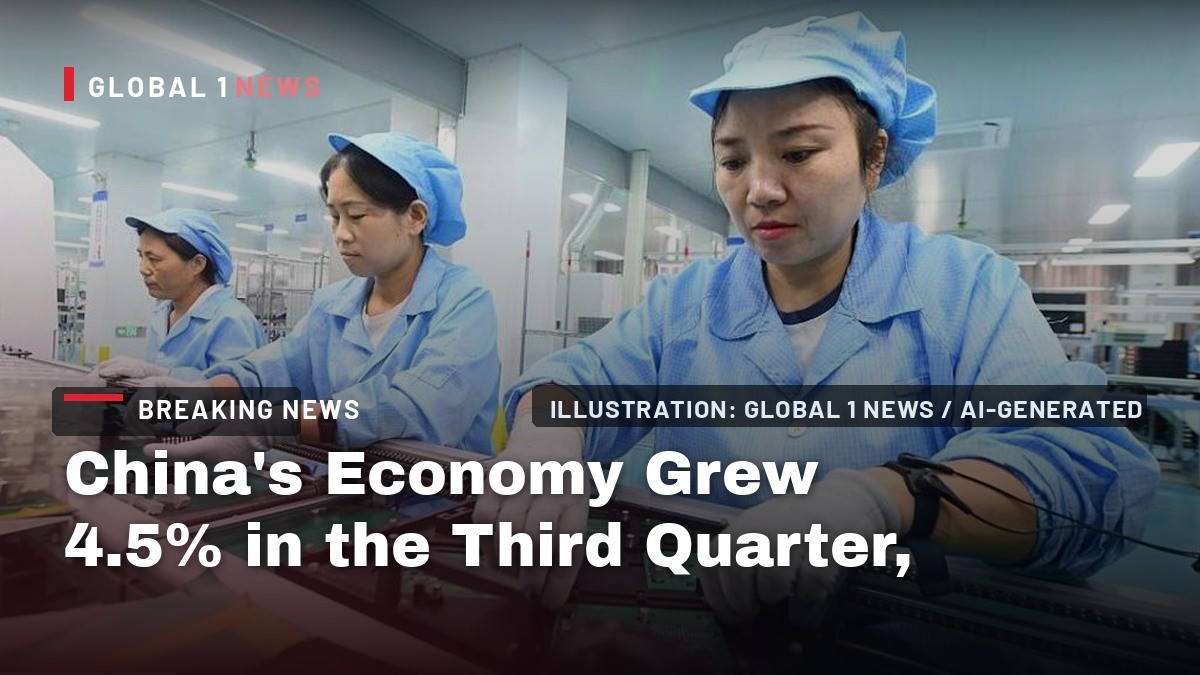
China's economy grew 4.5% in the third quarter, an acceleration from the three-year low of 4.3% recorded in the previous three months, and a figure that lands in the bottom half of Beijing's annual target range. It matters because this is the last major reading before the year closes, and because the strength is concentrated in factories and ports rather than in households and construction sites.
China's Economy Grew 4.5% in the Third Quarter, but the Growth Is Lopsided
Beijing — The National Bureau of Statistics published the quarterly figures on Monday morning, alongside a statement that the economy had "sustained steady development against pressure," and a press conference at which the bureau's deputy head, Mao Shengyong, took questions on domestic demand.
The Number Beijing Wanted
The headline figure was 4.5% year on year for July-September, up two-tenths of a point from the 4.3% recorded in the second quarter, which the Associated Press described as the slowest expansion in more than three years. The first quarter had come in at 5.0%, so the year traced a downward line that finally bent upward. The National Bureau of Statistics put January-September output at about 107.11 trillion yuan, or about 15.94 trillion U.S. dollars, with growth of 4.6% across the nine months. Beijing's target for the year is 4.5% to 5%, and last year's expansion was 5%. Economists polled by Reuters had expected 4.4%, so the print beat the consensus, and the Financial Times said it exceeded the median forecast. Mao said the economy added 5.7 trillion yuan in output over the period, the largest increase for the same period in five years.
What Actually Grew
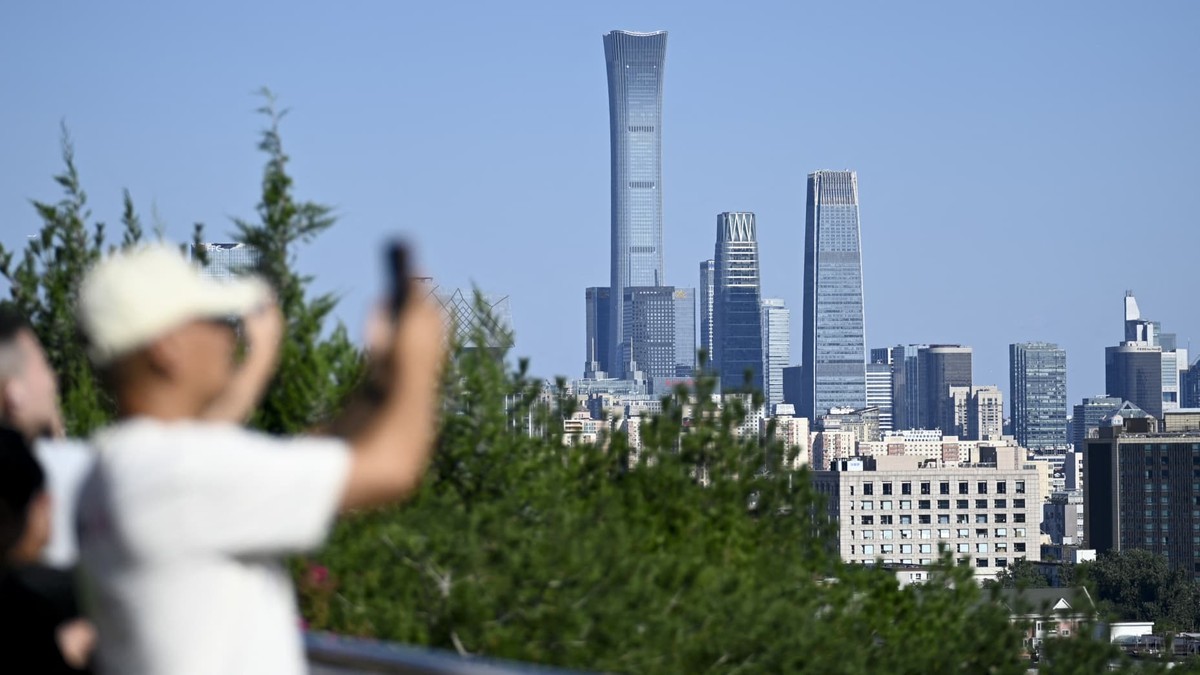
Look past the aggregate and the composition is stark. September value-added industrial output rose 5.5% year on year, three-tenths of a point faster than August, and was up 5.3% across the first three quarters. Equipment manufacturing climbed 10.2% and high-tech manufacturing 14.3%. Industrial robots rose 29.1%, lithium-ion batteries 39.5%, and 3D printing equipment 62.5%. The services production index gained 4.8% in September, with information transmission, software and IT services up 10.4% and leasing and business services up 12.3%. Retail sales rose 1.1% in September against a forecast of 0.6%, and 2.6% over January-September. The surveyed urban unemployment rate was 5.2% in September, down a tenth of a point. Manufacturing held 25.7% of GDP in the first three quarters, up six-tenths of a point, and new growth drivers contributed more than 40% of growth, according to the statistics bureau. New energy vehicle penetration stayed above 60% for a sixth consecutive month, and energy consumption per unit of GDP fell 3.1%.
The Property Hole Got Deeper
The sector that once did so much of the lifting is still subtracting. Real estate development investment fell 20.6% in January-September from a year earlier, a steeper decline than the 19.9% recorded in January-August, according to CNBC, citing the statistics bureau. Fixed asset investment in urban areas dropped 7.2% over the same period, against a Reuters poll estimate of a 7.3% fall. Sheana Yue of Oxford Economics, speaking to CNBC, said the prolonged housing slump will continue to limit the spillover from stronger industrial activity to the wider economy, and she dismissed the idea that green shoots have emerged, saying home sales, construction starts and prices offer little indication the downturn is bottoming out. The BBC noted the slump follows years of overbuilding and excessive borrowing by private developers. Whatever the September stabilization in other indicators, the investment ledger shows where the money is not going.
A Consumer Who Still Will Not Spend
The retail number looks better than it feels. September's 1.1% gain beat forecasts, but it sits against industrial output growing five times as fast, and the January-September figure of 2.6% is thin for an economy of this size. Mao said the international environment is complex and volatile, that the problem of insufficient domestic demand remains relatively prominent, and that the foundation for a stable, improving economy still needs consolidation. The BBC reported that high youth unemployment and weak wage growth have weighed on consumer spending, and that Chinese consumers have turned more pessimistic and unwilling to spend because of trade uncertainties and geopolitical issues, a judgment it attributed to Yue of Oxford Economics. Dave Chia, an economist at Moody's Analytics, told the Associated Press: "Domestic demand was weak, while trade grew strongly." That single sentence describes the quarter better than the headline does.
The Export Engine and Who Pays For It
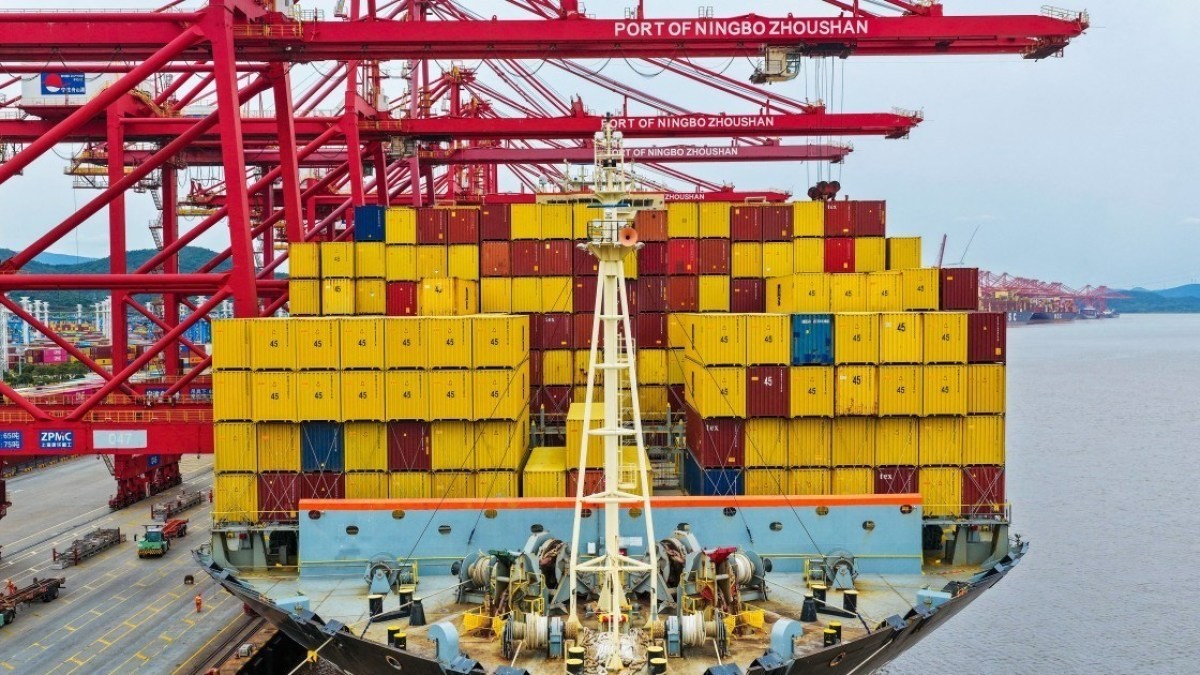
Trade did the heavy lifting. Exports grew 36% last month, according to the Associated Press, and the monthly trade surplus reached a record $133.5 billion, CNBC reported. The surplus already stood at $938 billion between January and September, and China is on track to surpass last year's $1.2 trillion, the BBC reported. Goods trade rose 18.8% year on year to 39.94 trillion yuan in the first three quarters, with September alone up 27.5%, per the statistics bureau. Mechanical and electrical products climbed 23.7% and made up 64.3% of total exports, while intermediate goods were more than half of all exports. Foreign-invested enterprises' imports and exports rose 19% to 11.69 trillion yuan, a record high for the same period, with their high-tech product exports jumping 42.1%. Chinese exports to the EU were up 16% in the first nine months. Eswar Prasad of Cornell University told the Associated Press: "It is untenable and unsustainable for the world's second largest economy to rely on foreign demand to prop up its own growth."
Europe Draws a Line
The destination for much of that output is now pushing back. The European Union runs a trade deficit with China of more than $1.1 billion a day, according to the Associated Press, and this month it reached an agreement with China to roughly halve the number of Chinese hybrid vehicle imports over the next few years, a framework framed in years rather than as an immediate cut. Elevated U.S. tariffs have hit some bilateral trade and forced China to look elsewhere, including Southeast Asia, Latin America and Europe, the Associated Press reported. Ecaterina Bigos, senior market strategist at BNP Paribas Asset Management, told the Associated Press that an export-reliant, tech-driven model has shown limited job creation and broad income gains, and that the world is likely to see continued resistance, rising protectionism, and persistent pressure from economies globally to protect their industries and jobs, notably in high value sectors. Gary Ng of Natixis said China can likely still sell more made-by-China products in the longer run while avoiding a broad tariff hike.
The Deflation Puzzle
Prices tell a story the growth figure cannot. Producer prices rose 5% in September, the fastest pace in more than four years, CNBC reported, while consumer inflation remains below 1%. CNBC attributed the gap to persistent excess capacity and weak demand that are constraining businesses' pricing power, and Yue of Oxford Economics said it potentially leaves firms to absorb more of the cost shock through lower margins rather than higher selling prices. The BBC noted concerns over the billions being spent on AI infrastructure and whether investors can deliver promised profits, a question that hangs over the high-tech categories driving the industrial numbers. Lynn Song, chief economist for Greater China at ING, told the Associated Press that trade imbalances will be difficult to resolve quickly. Pan Gongsheng, governor of China's central bank, said on Friday that countries with trade deficits and those with surpluses should work together, and that China, as a responsible country, is committed to expanding domestic demand. China insists it does not seek a large trade surplus.
What Beijing Is Doing About It
The policy response has been targeted rather than broad. In September Beijing unveiled support measures including lower interest rates for some businesses and subsidies for property buyers, the BBC reported. Late in September came a package of targeted rate cuts and mortgage subsidies, according to CNBC. Earlier this month, 550 billion yuan of unused debt quota was allocated to ease local government financial strains and bolster infrastructure spending, CNBC reported. Economists largely expect the People's Bank of China to hold benchmark lending rates unchanged through this year, leaving fiscal measures to do most of the work. Mao said China will step up efforts to expand domestic demand, improve supply and make macro policies more effective. Tianchen Xu of the Economist Intelligence Unit told CNBC that improved government investment arrested the worsening in fixed asset investment, that the external sector was ever-strong, and that a weak base helped; Xu forecasts full-year growth of 4.7%. Wen Bin of China Minsheng Bank, via Xinhua, said growth momentum showed signs of marginal improvement in September and expected continued improvement in the fourth quarter as policies take effect.
The Economists Who Say the Headline Is Lying
Not everyone reads 4.5% as good news. Max Zenglein, Asia Pacific senior economist at The Conference Board, told the Associated Press the headline figure is becoming an increasingly poor indicator of how the broader economy is performing because it masks widening disparities across industries, regions, and households. Prasad of Cornell went further, saying China has become a drag on world growth rather than an engine that pulls the rest of the world along. Bigos of BNP Paribas pointed to limited job creation and broad income gains from the export and tech model. The official read is different. The statistics bureau said the economy showed momentum with new growth drivers and an improving structure, and that it continued to shift toward innovation-driven, high-quality development. Zhu Qigui of the China Academy of Financial Research, via Xinhua, said the foundations of the economy remain solid.
What Comes Next
The fourth quarter now carries the weight of the target. The IMF trimmed its forecast for China's 2026 growth to 4.5% earlier this month, the lower end of Beijing's goal, and the EIU's Xu expects 4.7% for the full year. The question is what kind of growth delivers it. But the arithmetic of the first nine months is hard to escape: industry and exports accelerating, property investment falling by a fifth, retail sales crawling, and consumer inflation below 1%. China is a major trading partner of as many as 169 countries and regions, Xinhua noted. Kristalina Georgieva, the IMF managing director, said in January that China's contribution to global growth is expected to stay at roughly 30 percent in the coming years. Whether that contribution is welcomed or resisted is no longer Beijing's decision alone.
The quarter's lesson is that a headline can be accurate and still mislead. China hit the number it needed, and it hit it with factories, robots and container ships rather than with households and construction crews. That is a durable model only if someone keeps buying, and the buyers abroad are increasingly reluctant. Beijing's own statistics bureau concedes that domestic demand remains insufficient and that the foundation needs consolidation. Until retail sales and property investment turn, every GDP print will carry the same asterisk: strong at the top, thin underneath, and dependent on a trade surplus the rest of the world is beginning to question.
By Jessica Ali, Staff Writer
This article was produced with AI-assisted research and editorial support. Sources: Associated Press, BBC News, CNBC, the Financial Times and Xinhua.
What's Your Reaction?
 Like
0
 Dislike
0
 Love
0
 Funny
0
 Wow
0
 Sad
0
 Angry
0

Editor-in-Chief at Global1.News. Atlanta-based journalist who cuts through the BS and tells it like it is. Lead anchor, host, and the voice you hear when the spin stops and the truth starts.














Comments (0)