
Meet Voxel51 3.0: A Unified Multimodal Data Platform for Physical AI
Voxel51 just dropped version 3.0, and the buzz around it is louder than a factory floor at shift change. The new release promises a single pane of glass for everything you need to wrangle sensor data—search, curation, annotation, evaluation—all glued together by the Voxel51 Agent.
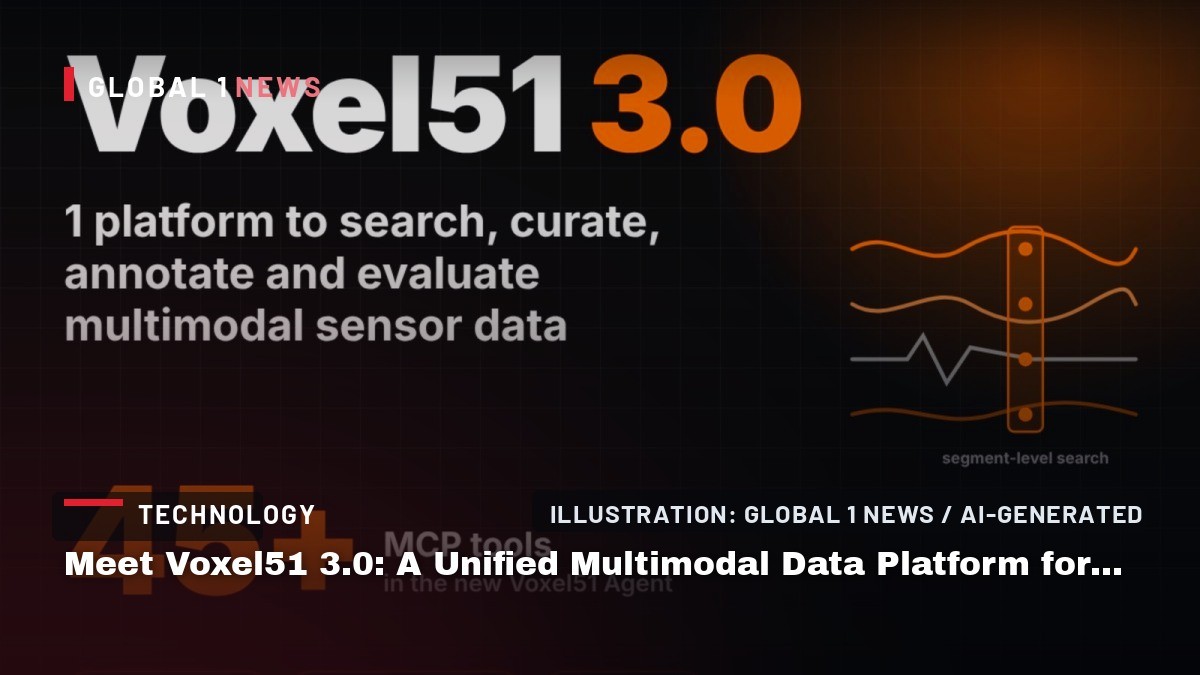
Voxel51 just dropped version 3.0, and the buzz around it is louder than a factory floor at shift change. The new release promises a single pane of glass for everything you need to wrangle sensor data—search, curation, annotation, evaluation—all glued together by the Voxel51 Agent. For anyone running a data pipeline for robots, autonomous vehicles or industrial IoT, the claim is seductive: stop cobbling together three‑plus tools and start feeding a unified platform. But as a founder who’s spent a decade battling the same data‑churn, I’m more interested in what the platform actually does in production, where the hidden costs lie, and whether the “free tier” really lets a scrappy startup get off the ground without selling a kidney to a hyperscaler.
What Voxel51 3.0 Actually Adds
The headline features are straightforward. Voxel51 3.0 expands beyond pure visual data into a multimodal zoo that includes MCAP logs, images, video, 3D point clouds, meshes, DICOM, NIfTI, geospatial layers and audio. In practice that means you can drop a mixed‑sensor dataset—say a robot arm’s camera feed, LiDAR sweeps and vibration logs—into a single repository and start querying it without building separate pipelines for each modality.
The platform’s new search engine is a “persistent hybrid index.” It automatically computes embeddings for whatever you feed it, so you can start doing semantic look‑ups from day one. You also get lexical and structured queries that can drill into timestamps, sensor fields or any metadata you’ve attached. The vector store runs on LanceDB, which separates storage from compute and lets you choose when and how to embed new samples. Incremental updates avoid the nightmare of rebuilding an entire index every time a new batch lands.
Voxel51 Agent: The Glue or a New Lock‑In?
The Voxel51 Agent is the centerpiece of the 3.0 rollout. It stitches together search, curation, annotation and evaluation into repeatable workflows. The vendor says the Agent ships with over 45 “MCP tools,” 80‑plus operators and 18 open‑source skills, but the real question is how much of that is usable out‑of‑the‑box versus how much you’ll need to custom‑code. The Agent can even generate code for custom plugins, which sounds handy until you realize you’re still writing code—just in a different language and under a different license.
All workflows inherit your organization’s permission model and governance controls, which is a plus for compliance‑heavy sectors like medical imaging (they support DICOM and NIfTI). However, the provenance layer adds four new logs: deployment‑level activity, dataset‑level activity, sample‑level edit history and immutable dataset version snapshots. While that gives you a clear audit trail, it also means you’re now dependent on Voxel51’s “fiftyone‑mq” for job scheduling and “Activity Core” for event tracking. If those services hiccup, your entire data pipeline could stall—a risk you can’t ignore when you’re feeding a production robot fleet.
Free Tier: A Generous Hand‑out or a Feature Trap?
Voxel51’s free tier is pitched as a no‑credit‑card entry point: you get the Agent, 30,000 inference requests and 30 compute hours per month, but you’re capped at three datasets, each limited to 10,000 samples and 20 GB of storage. For a tiny proof‑of‑concept that stays under those limits, it’s a decent way to test the water. Yet most real‑world projects quickly outgrow those numbers—think of a single day of autonomous vehicle runs that can produce millions of frames and terabytes of sensor logs.
Once you cross the free limits, you’ll need to move to a paid plan. The source material doesn’t disclose the pricing, but the comparison table shows Encord’s entry plan includes 1 TB of storage and a “Team” tier with eight seats and 2,800 compute hours per month (price undisclosed). Voxel51’s free tier is generous on compute requests but stingy on storage, which forces you to either prune data aggressively or pay for extra storage. That trade‑off can become a hidden cost if you’re not careful about data retention policies.
How It Stacks Up Against Competitors
When you line Voxel51 up against Encord and Foxglove, the differences are stark. Encord focuses on annotation, curation and data management, while Foxglove leans into robotics visualization and observability. Voxel51 tries to be a one‑stop shop, offering both search and annotation plus the Agent for workflow automation. The table in the source material shows Foxglove’s free tier gives 10 GB storage and three users, while Encord’s free tier mirrors Voxel51’s three‑dataset limit but doesn’t disclose storage caps.
The key competitive edge Voxel51 claims is the hybrid search that blends semantic, lexical and metadata queries. Foxglove’s “Semantic Search (beta)” plus structured search is a narrower offering, and Encord’s feature set doesn’t mention semantic retrieval at all. If your team relies heavily on finding “the moment” in long recordings—say a robot’s failure mode that only appears for a few seconds—the ability to query by segment‑level embeddings could shave days off data labeling cycles.
Data Provenance: Nice to Have or Must‑Have?
The four‑layer provenance model is a response to the growing demand for reproducibility in AI. Deployment‑level logs capture who did what and when across the whole system, while dataset‑level logs track how a dataset evolves over time. Sample‑level edit history records every label change, metadata tweak or property edit per sample, and immutable snapshots let you freeze a dataset for a specific training run.
In a regulated environment—think medical imaging or autonomous driving—those logs are non‑negotiable. They give you the audit trail needed for compliance audits and for troubleshooting when a model underperforms. But they also add storage overhead and processing latency. Every edit spawns a new log entry, and the immutable snapshots can quickly balloon storage requirements if you’re versioning large point‑cloud datasets. That’s a cost you’ll need to factor into any budgeting exercise.
Business‑Risk Lens: Where the Real Costs Hide
From a founder’s perspective, the biggest risk isn’t the headline features; it’s the lock‑in and the hidden operational expenses. Voxel51’s platform is model‑agnostic—you can start with a foundation model and later swap in a domain‑specific one—but the integration points (fiftyone‑mq, Activity Core, LanceDB) are all proprietary. If you ever need to migrate off the platform, you’ll have to export data, re‑index it in a new vector store, and rebuild any custom plugins you wrote for the Agent.
Another hidden cost is the compute budget. The free tier gives 30,000 inference requests and 30 compute hours per month, but there’s no public benchmark for performance. If your workloads are GPU‑heavy, you may find the “no local GPU requirement disclosed” note a red flag—meaning you’ll likely need to provision your own GPU instances in the cloud, which can quickly outpace the free compute allocation.
Actionable Advice for Independent Hosting Providers
If you’re running an independent hosting business or a boutique AI consultancy, treat Voxel51 3.0 as a potential component rather than a wholesale replacement for your existing stack. Start by piloting the free tier on a non‑critical dataset to evaluate the hybrid search quality and the ease of building Agent workflows. Keep a separate backup of raw data outside Voxel51’s storage to avoid vendor lock‑in.
When you move to a paid plan, negotiate storage and compute caps that align with your growth projections. Consider hybrid deployment: run the Voxel51 web app in a VPC you control while keeping the heavy compute (embedding generation, model inference) on your own GPU farm. That way you retain control over the most expensive part of the pipeline.
Finally, embed provenance checks into your CI/CD pipeline. Use the dataset‑level and sample‑level logs to automatically verify that any new data version passes sanity checks before it feeds downstream models. By treating Voxel51 as a data‑curation layer rather than the entire data platform, you can reap the productivity gains without surrendering the flexibility that independent providers need to stay competitive.
— Allan Ali, Founder
This article was produced with AI-assisted research and editorial support. Reporting is based on the source material cited below. Sources: MarkTechPost; marktechpost.com; Global1.News (18 October 2026).
By Allan Ali, Global1.News
What's Your Reaction?
 Like
0
Like
0
 Dislike
0
Dislike
0
 Love
0
Love
0
 Funny
0
Funny
0
 Wow
0
Wow
0
 Sad
0
Sad
0
 Angry
0
Angry
0

Publisher of Global1.News. Automation architect, systems builder, and the guy making sure the truth gets published.












Comments (0)