
Mexico in Numbers: Which states have the most welfare beneficiaries?
President Claudia Sheinbaum’s September 1 speech marked a milestone for Mexico’s social safety net, announcing that federal welfare, social and employment programs would reach almost 43 million people in 2026.
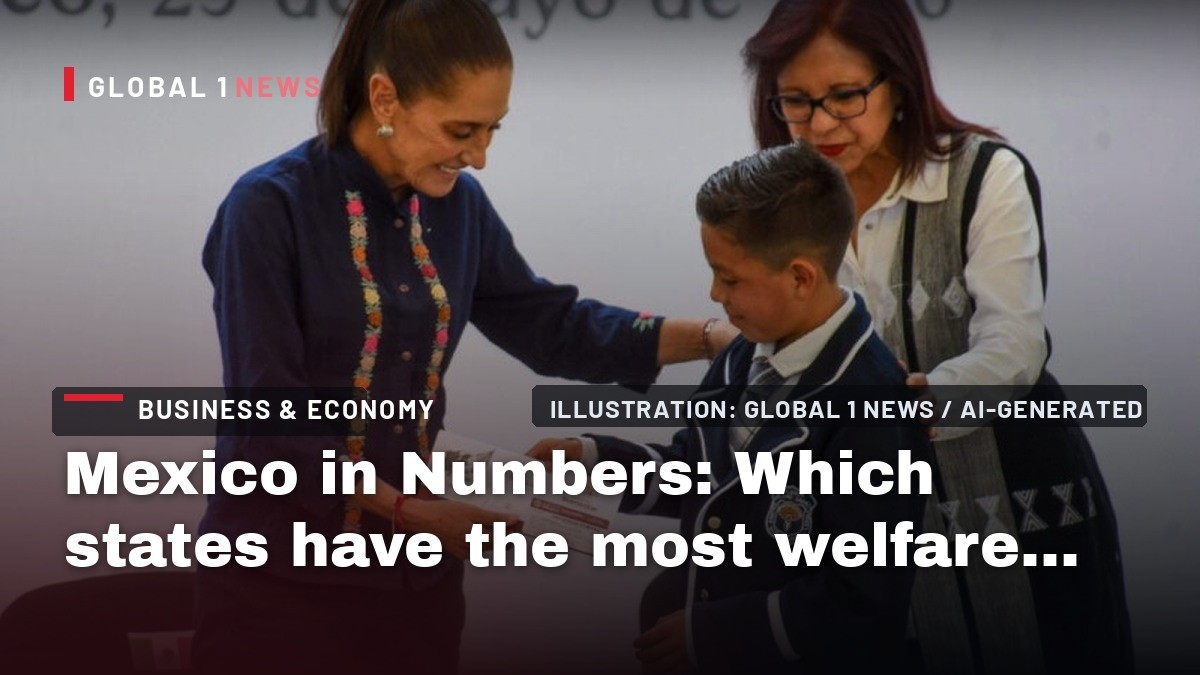
President Claudia Sheinbaum’s September 1 speech marked a milestone for Mexico’s social safety net, announcing that federal welfare, social and employment programs would reach almost 43 million people in 2026. That figure translates to roughly one in three Mexicans receiving direct monetary support, whether through pension schemes, job‑creation initiatives or scholarships for public‑school students. The administration, echoing the “Por el Bien de Todos: Primero los Pobres” mantra, framed this expansion as a concrete achievement of its commitment to the most vulnerable.
National reach of government assistance
According to the Intercensal Survey released by INEGI for 2025, 41.4 % of Mexican households reported at least one member receiving income from a federal or state program. This represents a jump of 16.2 points from the 25 % recorded in 2020, underscoring a rapid broadening of the safety net over the past five years. The surge reflects the government’s one‑trillion‑peso outlay on welfare, social and employment initiatives in 2026, a budgetary commitment that analysts say also reinforces political support for Morena.
The national picture masks stark regional disparities. While the average household participation sits just above the 40 % mark, certain states see far higher penetration, revealing how geography and historic poverty intersect with policy delivery.
Southern states lead the rankings
Three southern states—Guerrero, Oaxaca and Chiapas—top the list with more than half of their households benefiting from government payments. Guerrero leads with 57 % of households reporting a beneficiary, followed closely by Oaxaca at 56.9 % and Chiapas at 53 %. These figures align with the political map: the same states delivered some of the strongest vote shares for Sheinbaum in the 2024 presidential election, suggesting a feedback loop between program reach and electoral support.
The high coverage in these regions reflects the legacy of Andrés Manuel López Obrador’s “pobre primero” agenda, which laid the groundwork for expansive cash transfers and employment schemes that the Sheinbaum administration has continued to expand.
Mid‑range coverage in a diverse set of states
Nine states fall into the 45 % to 50 % bracket, indicating a solid but not overwhelming presence of welfare beneficiaries. This group includes Tabasco, Mexico City, Veracruz, Campeche, Zacatecas, Yucatán, Sinaloa, Colima and Guanajuato. Tabasco, like its southern neighbors, surpasses the 45 % threshold, while the capital, Mexico City, also registers strong program penetration despite its higher average income levels.
These states illustrate how the federal safety net has penetrated both traditionally poorer regions and more economically diversified areas, suggesting that the programs are not solely a tool for poverty alleviation but also a broader instrument of social inclusion.
States with moderate beneficiary rates
Eight states register household participation between 40 % and 45 %: Hidalgo, San Luis Potosí, Puebla, Michoacán, Morelos, Nayarit, Durango and Tlaxcala. In these locales, the presence of a program beneficiary is common, yet a sizable share of households remain outside the safety net. The distribution hints at uneven implementation, possibly influenced by local administrative capacity or the intensity of prior social‑development projects.
For families in these states, the chance of receiving a stipend or employment grant can be a lifeline, especially in rural ejidos where seasonal work is scarce. Yet the gap between those who receive aid and those who do not remains a point of concern for community leaders and civil‑society groups monitoring inequality.
Lower‑coverage states and lingering gaps
In nine states, the share of households with at least one beneficiary falls between 30 % and 40 %. These include the state of México, Sonora, Tamaulipas, Aguascalientes, Jalisco, Querétaro, Chihuahua, Coahuila and Baja California Sur. While still significant, the lower rates suggest that many families in these regions have yet to tap into federal assistance, either due to lack of awareness, bureaucratic hurdles, or limited program eligibility.
For many families in these areas, especially those living in urban colonias or working in informal sectors, the absence of a direct cash transfer can exacerbate economic precarity. Community organizers in towns from Sonora to Jalisco have begun to call for more outreach and simplified enrollment processes to bridge this gap.
States with the smallest reach
Three states record the lowest household participation, each under the 30 % mark: Baja California (28.4 %), Nuevo León (28.3 %) and Quintana Roo (25.8 %). These northern and coastal states, generally wealthier on average, still have sizable pockets of poverty where families remain outside the safety net.
The modest coverage in these states raises questions about the criteria used to allocate benefits and whether the programs are adequately targeting the most vulnerable households in regions that, while affluent overall, contain marginalized communities—such as migrant workers in Baja California’s agricultural valleys or informal workers in Nuevo León’s industrial zones.
Implications for policy and democracy
The INEGI data paints a nuanced portrait of Mexico’s welfare landscape in 2025. While the expansion to over 40 % of households marks a historic reach, the uneven distribution across states underscores the need for tailored policy interventions. Southern states, where the majority of households now receive aid, have seen tangible improvements in household income stability, but the persistence of lower‑coverage areas suggests that the “poor first” slogan must translate into more granular outreach.
For the Sheinbaum administration, the numbers serve both a social and a political purpose. The correlation between high beneficiary rates and strong electoral performance in Guerrero, Oaxaca, Chiapas and Tabasco illustrates how welfare programs can reinforce political legitimacy. Yet the challenge remains to ensure that the safety net does not become merely a tool of patronage, but a durable mechanism for reducing inequality across the entire federation.
Looking ahead, analysts will watch how the 2026 budget—still projected at one trillion pesos for welfare, social and employment programs—will be allocated to close the gaps in Baja California, Nuevo León and Quintana Roo, and whether new initiatives will lift the national average beyond the current 41 % threshold. For the families in colonia streets, tianguis stalls and remote ejidos, the promise of “Primero los Pobres” will be measured not just in percentages, but in the everyday reality of being able to put food on the table and send a child to school.
This article was produced with AI-assisted research and editorial support. Reporting is based on the source material cited below. Sources: Mexico News Daily; mexiconewsdaily.com; Global1.News (15 October 2026).
By Rosa Martinez, Staff Writer
What's Your Reaction?
 Like
0
Like
0
 Dislike
0
Dislike
0
 Love
0
Love
0
 Funny
0
Funny
0
 Wow
0
Wow
0
 Sad
0
Sad
0
 Angry
0
Angry
0
Latin America/Andes Correspondent at Global1.News. Based in Bogota, covering politics, environment, energy, and social movements across the Andean region. Passionate about environmental journalism and communities protecting their land.















Comments (0)