
Amy Acton Declines Debate in Ohio Governor Race
The Ohio governor's race took a sharp turn on September 2 when Democratic nominee Amy Acton's campaign formally declined to participate in any debates with Republican nominee Vivek Ramaswamy, a decision that has intensified a governor's race already defined by record outside spending and bitter personal attacks.
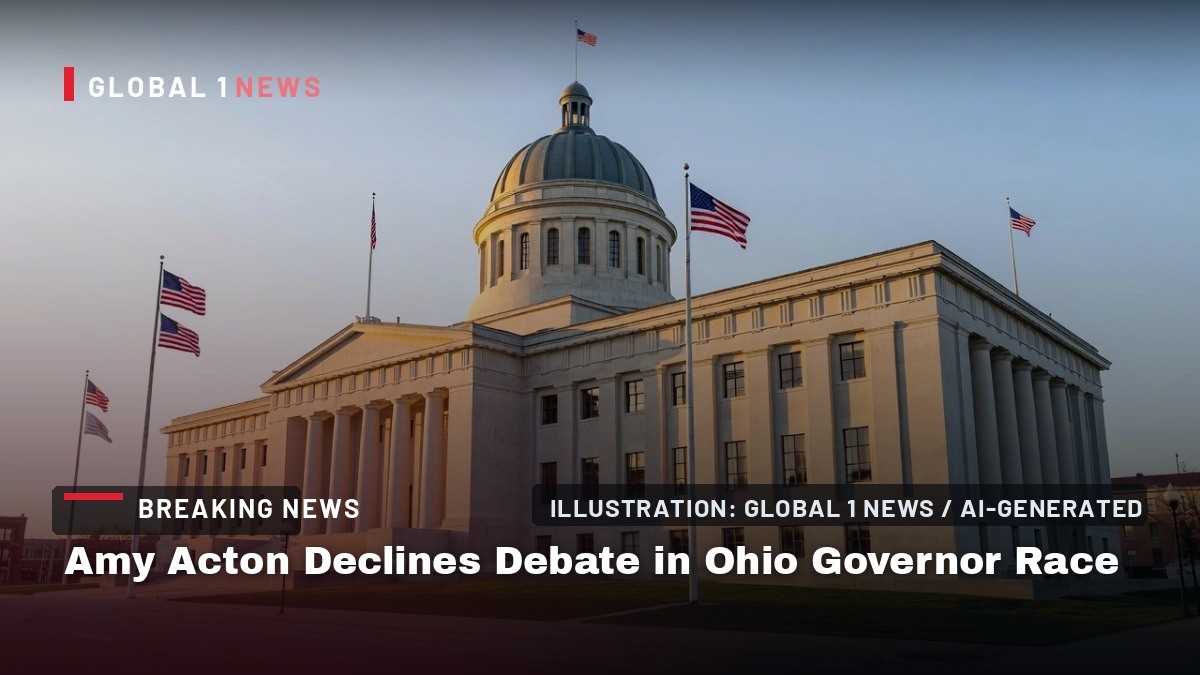
The Ohio governor's race took a sharp turn on September 2 when Democratic nominee Amy Acton's campaign formally declined to participate in any debates with Republican nominee Vivek Ramaswamy, a decision that has intensified a governor's race already defined by record outside spending and bitter personal attacks.
COLUMBUS, Ohio — With about two months until the November 3 general election, the two candidates are locked in a statistical dead heat, but they are no longer speaking to each other on the same terms. Acton's refusal to share a stage has handed Ramaswamy a potent line of attack, even as her campaign argues that the Republican's own advertising tactics have made traditional political discourse impossible. The result is a race defined not by policy debates over taxes or education, but by personal accusations and a fundamental disagreement over what constitutes a legitimate campaign.
A Debate Rejected
The immediate trigger was a September 2 announcement from the Ramaswamy campaign. His team said he had accepted debate invitations from CNN and Cincinnati NBC affiliate WLWT, and challenged Acton to join him. "Ohioans deserve a substantive debate between their two candidates for governor," Ramaswamy said in a statement. "I challenge Amy Acton to join me on the debate stage so voters can make a well-informed choice in November."
Hours later, Acton's campaign manager, Phil Stein, closed the door. "Dr. Acton's focus is talking with Ohioans, not platforming a scam artist who spreads baseless lies about her and her family, uses AI to falsely paint her as someone with a substance abuse problem, and shames Dr. Acton for being sexually abused as a child," Stein said. He added that Ramaswamy and his allies "have spent more than $50 million on disgusting, inaccurate attack ads" that have been condemned as the "most vile and repulsive lies" Ohio has ever seen.
Ramaswamy responded swiftly, framing the refusal as an evasion of accountability. "Debates are the equivalent of a job interview for candidates running for office," he said. "Candidates need to be willing to publicly debate and not shy away from them out of fear of scrutiny." He went further, questioning her record and her fitness for office. "It's too bad for Ohio voters that Acton won't take voter questions, won't debate, quit after failing as Ohio's health director, and has some serious issues now surfaced in multiple police reports. We pray for her, but this isn't someone fit to lead our state of 12 million people."
The exchange crystallizes the strategic chasm between the two camps. Ramaswamy, trailing slightly in some polls and needing to change the trajectory of the race, sees a debate as his best opportunity to force a confrontation. Acton, leading in several surveys, sees the debate stage as a platform for Ramaswamy to amplify what she characterizes as a campaign of personal destruction.
The Ads at the Center of the Fight
The advertising blitz that has consumed Ohio's airwaves is largely the work of V-PAC, a Republican-aligned independent expenditure committee formally named "Victors, Not Victims." The group has poured tens of millions of dollars into the state, and its messaging has moved beyond traditional policy contrasts into deeply personal territory.
The ads blame Acton for pandemic shutdowns, labeling her "the liberal who shut down Ohio" and accusing her of closing "your child's school and your friend's business." They highlight her 2020 resignation as director of the Ohio Department of Health. They reference a 2019 police call to her home. And they allege substance abuse, a claim the Acton campaign says is fabricated using artificial intelligence to manipulate images and video.
One ad features Cincinnati-area GOP official Linda Caudill, who says her mother died alone in a nursing home after Acton "shut down the state," telling viewers "Amy Acton is to blame for this." Reporting by cleveland.com and other outlets has established that the woman was in a nursing home in Kentucky and died after Ohio had already lifted its stay-at-home order. Columbus City Attorney Zach Klein, who has endorsed Acton, called the ad's implication "a lie; it's a complete fabrication."
The Acton campaign's "$50 million" figure refers to combined outside and allied spending against her. The campaign and its allies say the ads have been condemned as the vilest in modern Ohio politics. Ramaswamy's campaign has not disavowed the V-PAC efforts, and the candidate has echoed some of their themes in his own statements.
Checking the Claims
The factual record surrounding the key accusations is now well-documented, and it does not favor Ramaswamy's advertising coalition. cleveland.com reviewed three Ramaswamy ad themes in August and found one legitimate, a second vicious, and a third false. The Cincinnati Enquirer reported on August 28 that records dispute a key claim in a Ramaswamy ad. The Columbus Dispatch fact-checked an ad blaming Acton for delaying Ohio's 2020 primary and found it false.
The most persistent attack concerns the COVID-19 shutdowns. Acton served as director of the Ohio Department of Health under Republican Gov. Mike DeWine beginning in March 2020, and it was DeWine who issued the shutdown orders. DeWine has repeatedly and publicly taken responsibility for those decisions. "The decisions that were made during COVID; they were my decisions, so no one should blame someone else if they don't like it," DeWine said. He has also said "the buck stops with me."
The 2019 incident at Acton's home has also been scrutinized. Police responded to a call at her residence and found no physical violence. Officers classified it as a verbal argument over her extended work hours. No arrest was made, and no charges were filed. Reporter Henry Gomez reported that Acton told officers she had been drinking and had taken an unknown amount of prescription medication. Her campaign says she had one drink and that the medications were long-prescribed. The broader accusations against her have not been substantiated.
Ramaswamy's statement pointed to "multiple police reports." The 2019 incident is the one publicly documented in detail; the Acton campaign has said the broader accusations against her have not been substantiated and has dismissed the attacks as a coordinated effort to humiliate a female candidate and distract from substantive policy discussions.
The Money Behind the Message
The scale of money pouring into this race is enormous. FEC records show V-PAC raised $41,774,674.63 for the 2026 cycle through June 30 and finished the quarter with about $25.85 million on hand. Five donors account for roughly $37 million — about 88 cents of every dollar. Pennsylvania investor Jeff Yass gave $20 million. New York financier Ross Stevens gave $6 million. Ratmir Timashev, who lists a Connecticut address, gave $5 million. Elon Musk gave $5 million in May. William Ackman gave $1 million in June. None of the five lists an Ohio address.
V-PAC reported about $8.2 million in disbursements opposing Acton in June 2026 alone, including a single $7,963,282 payment to media buyer Flexpoint Media on June 5. The money has funded the sustained television, digital, and mail campaign that has saturated the state.

Ramaswamy has also lent his own campaign $25 million and raised roughly 10 times as much as Acton in early fundraising. Acton's $10.4 million raised before the primary set a record for an Ohio Democratic gubernatorial candidate at that stage of the race, much of it from low-dollar grassroots donations. Her campaign says she receives twice as many donations from Ohioans as Ramaswamy.
In late August, Acton began airing her first television ad, part of a week-long buy of about $629,000 in Cincinnati, Cleveland, and Columbus. The biographical spot focuses on overcoming childhood poverty and pursuing an education. The Democratic Governors Association, via a political action committee called "Ohioans for Lower Costs," has reserved television time beginning September 8 and running through Election Day, signaling that Democrats intend to compete on the airwaves despite the financial disparity.
A Toss-Up Race With High Stakes
The Cook Political Report moved the governor's contest from Lean Republican to Toss Up on July 10, reflecting the race's competitive nature. Public polls through mid-August showed the race effectively tied. Wedgewood Polls on August 13 had Acton at 47 percent to Ramaswamy's 46 percent. Beacon Research/Shaw & Co. Research on August 10 had Ramaswamy ahead 50-48. Tulchin Research on August 4 had Acton up 46-44.
Analysts note that Ohio's governor races have been dominated by Republicans for two decades, but Democrats see an opening with Acton's name recognition. She became a household name during daily COVID-19 briefings under DeWine, where her calm, data-driven presentations earned her a following that transcended party lines. That same profile has made her a target for those who opposed the state's pandemic restrictions.
The policy contrast between the candidates is stark. Ramaswamy has made abolishing Ohio's state income tax a centerpiece of his campaign, arguing that it would spur economic growth and attract residents from neighboring states. DeWine, a fellow Republican, said in early September that Ohio has cut income taxes enough, undercutting Ramaswamy's platform from within his own party.
Acton has focused on corruption and governance. In August, she released an anti-corruption plan proposing three day-one executive orders aimed at the appointment process that let FirstEnergy install Sam Randazzo at the state utilities commission before his bribery scandal. The proposal is designed to appeal to voters weary of the pay-to-play culture that has plagued Ohio politics.
What to Watch
The debate question is unlikely to disappear. Ramaswamy has positioned himself as the candidate willing to face voters directly, and he is likely to continue hammering Acton's refusal. His campaign has already signaled that it will use the absence of debates to question her readiness for the rigors of governing.
Sam Nelson, a University of Toledo political science professor, offered a different interpretation of Ramaswamy's insistence on debating. "That means he's sweating," Nelson said. "If he thought he was within three points, I don't think he would be doing this."
Acton's strategy appears to be to run a campaign of direct voter contact — town halls, rallies, and grassroots events — while allowing the Democratic Governors Association and allied groups to counter the V-PAC advertising. Her campaign has signaled that she will not be pressured into changing course, even as Ramaswamy and his allies paint her refusal as an act of cowardice.
The coming weeks will test whether a candidate can win Ohio's governorship without ever sharing a stage with her opponent. The air war will intensify, with both sides and their allies spending heavily. The fact-checking record has been established, but whether voters are paying attention to it — or to the ads themselves — remains an open question.
For now, the race remains a toss-up, with both campaigns convinced they have the winning formula. Ramaswamy believes debates would expose Acton's vulnerabilities. Acton believes debates would legitimize a campaign she considers built on lies. Ohio voters will decide on November 3 which approach they trust.
By Jessica Ali, Staff Writer
This article was produced with AI-assisted research and editorial support. Sources: Ohio Capital Journal, cleveland.com, The Cincinnati Enquirer, The Columbus Dispatch, WVXU, The Toledo Blade, TiffinOhio.net, PollingSource/RealClearPolitics polling data, FEC records and campaign statements.
What's Your Reaction?
 Like
0
Like
0
 Dislike
0
Dislike
0
 Love
0
Love
0
 Funny
0
Funny
0
 Wow
0
Wow
0
 Sad
0
Sad
0
 Angry
0
Angry
0

Editor-in-Chief at Global1.News. Atlanta-based journalist who cuts through the BS and tells it like it is. Lead anchor, host, and the voice you hear when the spin stops and the truth starts.











Comments (0)