
600,000 Families Report Less Hunger Under DSWD's Walang Gutom Program, SWS Survey Shows
Some 600,000 families under the DSWD's Walang Gutom Program reported less hunger and better food security in a two-round SWS survey, with hunger among beneficiaries dropping 6.7 points. The program is adding 150,000 households this year toward 750,000 food-poor families.
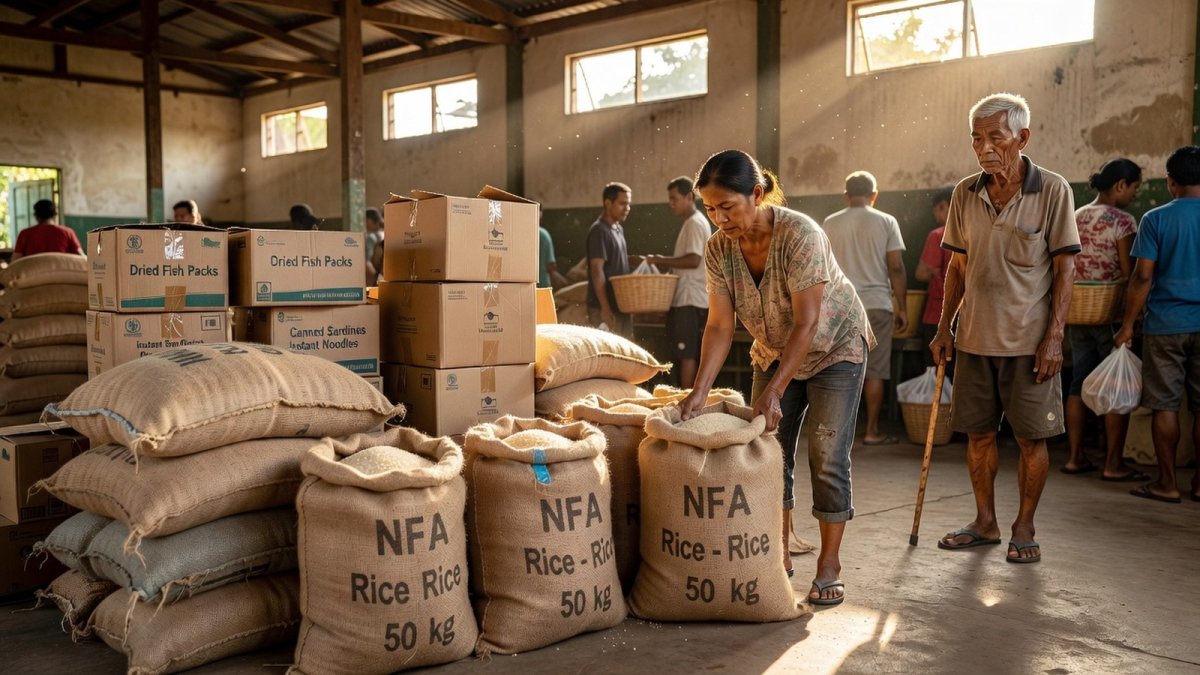
MANILA, Philippines - Some 600,000 Filipino families enrolled in the Department of Social Welfare and Development's Walang Gutom Program (DSWD-WGP) have reported significant improvements in their experiences of hunger and food poverty, according to a two-round survey by the Social Weather Stations (SWS). Social Welfare Secretary Rex Gatchalian highlighted the results during a press briefing by the Presidential Communications Office at Malacañang on Aug. 13, framing them as a tangible step forward in the Marcos administration's battle against involuntary hunger.
DSWD's Walang Gutom Program Shows Promise: 600,000 Families Report Less Hunger
MANILA, Philippines - The survey, commissioned by Globe Telecoms, covered 2,400 respondents in two rounds: the first from Feb. 24 to March 8, and the second from June 22 to July 1. It measured changes in the condition of WGP household-beneficiaries and non-beneficiary households, focusing on their experiences of hunger, food insecurity, and their own assessment of their food poverty status. While the numbers point to real progress, officials were careful not to overstate the findings.
Hunger Declines Among Beneficiaries
Among WGP beneficiaries, the incidence of hunger declined by 6.7 percentage points, from 33.6 percent in the first round to 26.9 percent in the second round. This was a considerably larger improvement compared with the 1.4 percentage point decline recorded among non-WGP beneficiaries, whose reported experience of hunger decreased from 38.3 percent to 36.9 percent. In other words, while both groups saw some improvement, the drop was nearly five times steeper for families actively enrolled in the program.
Secretary Gatchalian told Palace reporters that they cannot yet say 600,000 families are eating right. He emphasized instead that the survey aimed to determine changes in the condition of beneficiary and non-beneficiary households - particularly their experiences of hunger, food insecurity, and their own assessment of their food poverty status. That distinction matters: the data shows progress, but it also reveals that more than a quarter of beneficiary families still experience hunger at some point.
Food Security and Self-Perception
Beyond the headline hunger numbers, the survey tracked food insecurity - a broader measure that includes worrying about running out of food or having to skip meals. Among WGP beneficiaries, the proportion experiencing food insecurity declined by 4.7 percentage points, from 94.0 percent to 89.3 percent between the two survey rounds. This contrasts with non-WGP beneficiaries, who saw a slight increase of 0.6 percentage point, from 95.9 percent to 96.5 percent.
Respondents' own perception of their situation followed a similar pattern. WGP beneficiaries who considered themselves food poor declined by 1.4 percentage points, from 79.0 percent in the first round to 77.6 percent in the second round. Among non-WGP beneficiaries, however, the proportion increased by 1.3 percentage points, from 84.4 percent to 85.7 percent. The self-assessment is significant because it captures not just physical hunger but the anxiety of not knowing where the next meal will come from - a feeling familiar to many Filipino households.
Expanding the Program: 150,000 More Families
For this year, Gatchalian said the WGP will continue to strengthen its implementation by adding 150,000 household beneficiaries "to form the entire 750,000 food-poor families." The expansion is part of the program's phased approach. Launched in 2023 and institutionalized in 2024 through Executive Order 44, the WGP serves as the government's flagship anti-hunger program, based on President Marcos' directive to combat food insecurity and reduce involuntary hunger among Filipino families.
The program is conditional, meaning beneficiaries do not simply receive food assistance. They are required to undergo the Kalusugan, Kakayahan at Kabuhayan (3K) sessions, where they are provided with knowledge on nutrition as well as capacity building and upskilling activities. The design is intentional - the goal is not just to feed families today but to equip them with the tools to feed themselves tomorrow.
The 3K Sessions: Beyond Food, Building Kakayahan
The 3K sessions - Kalusugan (Health), Kakayahan (Capacity), and Kabuhayan (Livelihood) - sit at the heart of the WGP's sustainability strategy. During these sessions, beneficiaries receive knowledge on proper nutrition and take part in capacity building and upskilling activities that can help them generate income. The conditional structure also encourages participation: beneficiaries attend the sessions as part of their engagement with the program, and the assistance is tied to that participation.
For families like that of Junrey Flores of Ipil, Zamboanga Sibugay, winner of the WGP 2026 Cook-off Challenge, the program has made a concrete difference. Flores expressed his gratitude to the DSWD and to President Marcos for being considered for the anti-hunger program. "Thank you po sa tulong sa mga programa na ginawa ninyo... thank you po sa lahat ng mga nagawa niyong kabutihan," he said. His story is a reminder that behind every statistic is a real person - a father, a mother, a child - whose life has been touched by the program.
Challenges Ahead: The Road to 750,000
While the survey results are encouraging, the program faces significant challenges. Expanding to 750,000 families will require substantial resources, coordination with local government units (LGUs), and careful targeting to ensure that the most vulnerable households are reached. The DSWD works with barangay captains and local social welfare officers to identify eligible families, a process that demands constant attention at the community level.
There is also the question of sustainability. The WGP is funded through the national budget, and its long-term viability depends on continued political will and fiscal support. Its institutionalization through an executive order provides a measure of stability, but the fight against hunger requires consistent investment year after year.
The survey itself also has limitations. It was commissioned by Globe Telecoms, a private corporation, and while SWS is a reputable polling firm, the results reflect a specific period and a specific sample. Still, the fact that WGP beneficiaries showed significantly larger improvements than non-beneficiaries suggests the program is having a real impact - a point the DSWD chief himself underscored in presenting the data.
What This Means for Ordinary Filipinos
For the average Filipino family, the WGP's progress is a glimmer of hope in a country where food prices continue to rise and many households struggle to make ends meet. The program's focus on nutrition and capacity building aligns with the broader goal of improving the quality of life for the poorest and most vulnerable sectors of society.
But the work is far from done. Even with the improvements, nearly 27 percent of WGP beneficiaries still report experiencing hunger, and almost 90 percent still face some form of food insecurity. These numbers are a stark reminder that the program, while helpful, is not a panacea. Structural issues - such as low wages, underemployment, and the high cost of food - continue to drive food poverty across the country.
As the WGP expands toward 750,000 families, the government will need to ensure that the program's benefits are felt not just in statistics but in the daily lives of Filipinos. The SWS survey provides a valuable baseline, but the true measure of success will be whether the gains are sustained and deepened over time. For now, the 600,000 families who have reported improvements are a testament to what targeted, well-designed interventions can achieve - and a reminder of how much more remains to be done.
This article was produced with AI-assisted research and editorial support. Sources: Philstar.com, Social Weather Stations, DSWD.
By Bella Reyes, Staff Writer
What's Your Reaction?
 Like
0
Like
0
 Dislike
0
Dislike
0
 Love
0
Love
0
 Funny
0
Funny
0
 Wow
0
Wow
0
 Sad
0
Sad
0
 Angry
0
Angry
0

Philippines/Southeast Asia Correspondent at Global1.News. Manila-based journalist covering Philippine politics, environment, maritime security, and social issues. Passionate about marine conservation and the communities protecting the Philippines' natural heritage.














Comments (0)