
58 Percent of Voters Don't Want a Data Center Near Them — and November Is Coming
58% of registered voters oppose data center construction near them as the backlash becomes a 2026 midterm issue. Candidates run on moratoriums, 300+ bans exist, and the AI buildout faces a new political risk.
58 Percent of Voters Don't Want a Data Center Near Them — and November Is Coming
Let me tell you something that's been sitting heavy with me all week. I've been running hosting infrastructure for over a decade, and I've watched this AI buildout from the inside — the GPU orders, the power contracts, the colo lease signings. And I'm here to tell you that the biggest risk to this industry right now isn't the chip shortage, isn't the power grid, isn't even the debt markets. It's the ballot box.
The data center revolt has stopped being a zoning fight. It has become a midterm election issue — candidates cutting ads about it, protesters showing up at presidential events over it, and polling that should terrify anyone whose business plan depends on building power-hungry buildings in somebody's backyard. I've been covering this backlash since it was a smattering of county fights. It is no longer a smattering of anything.
The Numbers Nobody in This Industry Wants to Talk About
Let's start with the polling, because that's where the denial lives. A Yale Program on Climate Communication poll from June — cited by CNBC — found that 58% of registered voters oppose data center construction in their own area. Not 58% of activists. And before you tell me it's just coastal liberals, check the breakdown: 74% of liberal Democrats feel that way — but so do 53% of conservative Republicans. That is a majority of the country, split down the middle of both parties.
Gallup polling from March is even starker — seven in ten Americans oppose data center construction near where they live. And the movement has the receipts: The Information counts 300+ cities, towns, and counties with bans or moratoriums on hyperscale construction. Data Center Watch tallied 75 major projects worth more than $130 billion delayed or canceled in Q1 2026 alone — roughly matching all of 2025. In one quarter. This is not a blip — it is a structural constraint on where the AI buildout can happen, and it is tightening.
The Ballot Box — Where This Actually Gets Decided Now
Here's what's new: the fight has moved from the zoning hearing room to the campaign trail, and candidates are running toward it. In South Carolina, Rep. Nancy Mace — running in a competitive Republican primary for governor — is calling for a one-year moratorium on new data center construction, arguing families and small businesses are footing the bill for surging power demand. She's posted about it more than two dozen times in the past few months. A Republican, running on stopping data centers.
In Wisconsin, State Rep. Francesca Hong, the leading Democratic candidate for governor, is campaigning on a pledge to, as the AP put it, "tax the rich, fund our schools and stop AI data centers." In Michigan, gubernatorial candidate Jocelyn Benson wants "statewide standards and guardrails" and says data centers should bear the costs of the infrastructure they require instead of passing them to ratepayers — though notably she does not support a moratorium, which probably has nothing to do with her husband working for a data center company. Jon Ossoff in Georgia launched a federal inquiry into data centers' impact on power bills.
And the down-ballot results are already in. In North Carolina, a Vietnam War veteran ran for a county commission seat on an explicit anti-data-center platform and unseated a four-term incumbent. In Monterey Park, California, voters passed a permanent ban on data centers at the ballot box. And New York Governor Kathy Hochul just signed the nation's first statewide moratorium this month. If you think that stays the only one, I've got a bridge in Brooklyn to sell you.
The Streets — Where the Anger Lives Now
A real political issue shows up in the street. On July 18, there were 142 coordinated protests across 42 states — organized by Tea Party veteran Amy Kremer, who declared "America is not for sale" and predicted data centers on the ballot in November and again in 2028. At the end of July, demonstrators greeted President Trump at his own event in Michigan with "Stop Data Centers" signs.
The human toll is getting ugly, and I don't say that lightly. In April, an unknown attacker fired 13 shots into the home of an Indianapolis councilman who had voted for an AI facility, leaving a note that read "No Data Centers." This week, a Kansas physics teacher was arrested for clapping in opposition to a proposed data center during a city council meeting — while the commission passed the zoning anyway. A high school teacher, arrested, for clapping. That is when a land-use dispute stops being a land-use dispute.
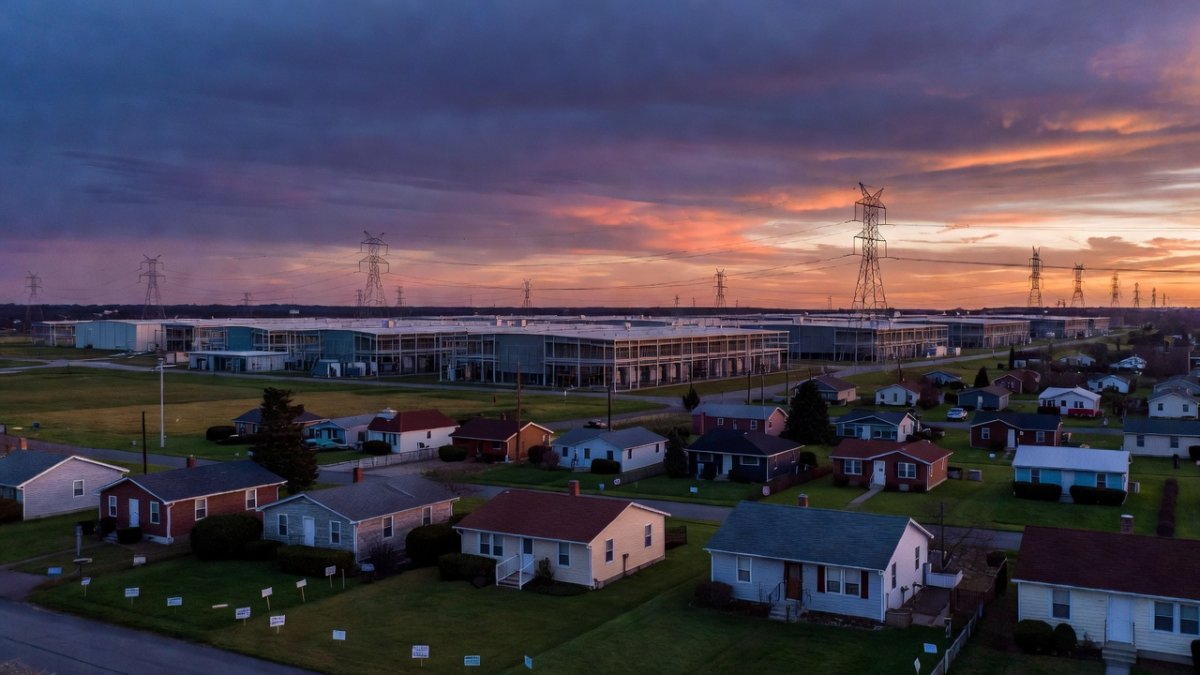
And it's not just the coasts. Take Tucker County, West Virginia — 6,500 people in the Potomac Highlands, a former lumber and mining region rebuilt around outdoor tourism. Fundamental Data, a company out of Northern Virginia, plans to build a power plant and data center on up to 10,000 acres — one of the largest such campuses in the country. The locals had no say — the Republican-controlled West Virginia legislature passed a law prohibiting localities from blocking data center construction. So now you can't drive 50 yards in Tucker County without seeing a yard sign opposing the project. Six thousand five hundred people against one of the biggest data center campuses on earth, with the state legislature on the developer's side. Tell me how that ends well.
The Counter-Argument — and Why It Doesn't Hold
Before you accuse me of parroting the protesters, let me give the industry its due. There is astroturfing on both sides of this. Journalist Taylor Lorenz's investigation found dark money groups tied to the AI industry running paid influencer campaigns, offering creators cash to reframe the debate around competition with China. Kevin O'Leary, backing a massive data center project in Utah, accuses anti-data-center posters of being paid by foreign billionaires — and Tucker Carlson has been going after him over it. Magnitude Media counted 3,000+ leading political accounts posting 15,000+ times about data centers this year — over 700 million views and 45 million engagements. Some of that is manufactured. A lot of it is not.
Here's why that fails: strip out every paid post and astroturfed campaign, and you're still left with the polling. 58% of registered voters. Seven in ten Americans. Those numbers are not manufactured, and they map directly onto something every voter understands in their own wallet — the power bill. When a Republican rancher in Lubbock, Texas — deep in the state JLL projects will overtake northern Virginia as the world's largest data center market by 2030 — says he may not vote for Governor Abbott because of the buildout, and Abbott responds by ordering regulators to keep Texans from paying higher bills for hosting Google, the industry has lost the narrative. When the same issue is a Democratic socialist's headline pledge and a Republican rancher's reason to stay home, no ad buy fixes that.
What This Actually Means for Independent Hosting Providers
So what do you do with this if you're running an independent hosting business and you're not a hyperscaler? Stop pretending this is someone else's problem. First, model community consent into every site decision you make. I know that sounds soft. It isn't. A 6-month permitting delay on a hyperscaler campus is a rounding error on a $14 billion project. A 6-month delay on your colo build is the difference between a profitable year and a dead one. Check the ballot — not just the zoning map — before you sign anything.
Second, watch the permitting window. States and counties are passing moratoriums faster than they can print the ordinances — 300+ already, and the first statewide one just signed. If you have a build planned where the issue is heating up, accelerate the permits now — the window is closing. Third, lock your power contracts early — and read them for what happens when ratepayer politics kicks in. When politicians start forcing data centers to "bear the costs of the infrastructure they require," that cost lands on every wholesale power contract in the region, including yours. Fixed-rate, long-term agreements are cheap insurance right now.
Fourth — and this is the one nobody's saying out loud — position yourself as the low-profile alternative. The backlash is aimed at hyperscale: the 10,000-acre campuses, the gas turbines, the megawatt monsters. A modest independent facility in an existing building with existing grid interconnection doesn't generate the same yard signs. The market is going to push more demand toward operators who can deliver capacity without becoming a campaign issue. That's you. Lean into it.
The Structural Reality — This Isn't a Midterm Blip
Here's what keeps me up at night: this isn't a one-cycle story. Amy Kremer is already talking about 2028. The organizers have infrastructure, the content machine is running, and every month the buildout gets bigger and louder, it recruits more people. The hyperscalers will keep spending — $700 billion plus this year, they can't stop — and every new announcement lands where hundreds of local governments are already hostile. That's a multi-year constraint on the physical buildout, a multi-year tailwind for anyone who already has capacity, and a multi-year hazard for anyone who doesn't.
And don't think the industry's money saves it. The pro-AI super PACs are planning hundreds of millions in 2026 spending, and the best-positioned politicians are the ones with nothing to lose — the challengers, the populist insurgents, the bomb-throwers. You can't outspend a yard sign in Tucker County, West Virginia. You can't out-lobby a teacher getting arrested for clapping. When the pitchforks come out, ent? — they don't check campaign contributions first.
The Bottom Line
Look, I'm not anti-data center. I run infrastructure for a living — this is how I feed my family. But I've been in this business long enough to know the graveyard is full of companies that read the technical risks perfectly and ignored the human ones. The AI buildout's biggest bottleneck was supposed to be chips, then power, then water, then debt. It turns out the final bottleneck is consent — and consent just became a ballot issue, with 58% of the country already on the record against it.
So here's my advice, straight and simple: plan like November is coming, because it is. Check the politics before you check the power prices. Lock in what you can, stay small enough to stay invisible, and be ready for the shakeout when the votes land. The hyperscalers will survive this — they always do. The question is whether you will. Me? I'm making sure my business doesn't need a zoning approval to keep running. You should do the same.
— Allan Ali, Founder
This article was produced with AI-assisted research and editorial support. Reporting is based on sources cited in the article.
What's Your Reaction?
 Like
0
Like
0
 Dislike
0
Dislike
0
 Love
0
Love
0
 Funny
0
Funny
0
 Wow
0
Wow
0
 Sad
0
Sad
0
 Angry
0
Angry
0

Publisher of Global1.News. Automation architect, systems builder, and the guy making sure the truth gets published.











Comments (0)