
Widow Sues Singapore Airlines Over Deadly SQ321 Turbulence That Killed Her Husband
When the Boeing 777-300ER plummeted 178 feet in less than five seconds over Myanmar, the violent forces of nature tore through the cabin of Singapore Airlines flight SQ321, leaving a trail of devastation that would ultimately claim the life of a British grandfather and change the course of a widow’s life forever.
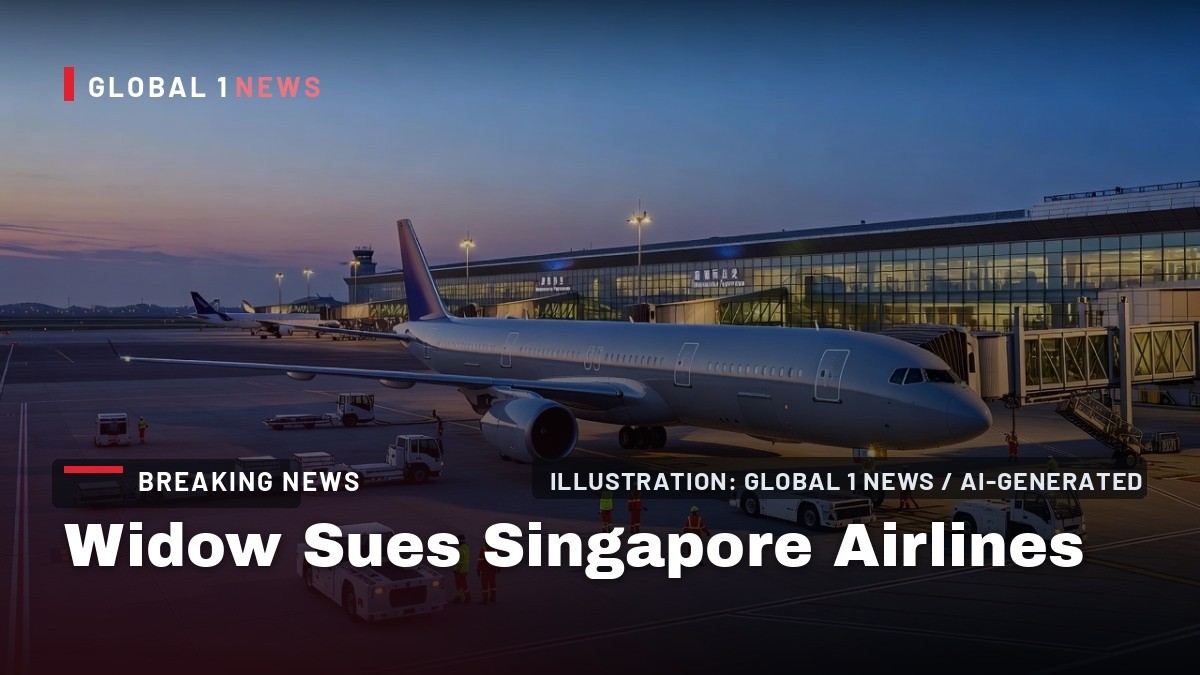
When the Boeing 777-300ER plummeted 178 feet in less than five seconds over Myanmar, the violent forces of nature tore through the cabin of Singapore Airlines flight SQ321, leaving a trail of devastation that would ultimately claim the life of a British grandfather and change the course of a widow’s life forever. Now, more than two years after the deadliest turbulence event in modern aviation history, 74-year-old Linda Kitchen has begun High Court proceedings in Britain against the airline, seeking answers and accountability for the death of her husband, Geoff, and the severe injuries she sustained in the terrifying plunge. The legal action marks a significant escalation in the aftermath of the May 2024 disaster, as the family pushes beyond the airline’s initial compensation offers to demand a full reckoning of what happened at 37,000 feet.
Linda Kitchen, from the Bristol area, was 10 hours into a six-week dream holiday to Singapore, Indonesia, and Australia with her husband of 52 years when the aircraft hit catastrophic turbulence near the Irrawaddy River. The flight, which had departed London Heathrow with 211 passengers and 18 crew, was cruising at 37,000 feet when it encountered a rapidly growing storm cell that the aircraft’s weather radar reportedly failed to detect. In a matter of seconds, the plane dropped approximately 178 feet in 4.6 seconds, with G-forces swinging violently between -1.5G and +1.76G, hurling unrestrained passengers and crew into the cabin ceiling and floor with brutal force.
A Widow’s Fight for Justice and Answers
For Linda Kitchen, the physical and emotional scars of that day remain raw. She spent ten days in a Bangkok hospital after the emergency diversion to Suvarnabhumi Airport, was airlifted back to the UK, and required another week of hospital care in Bristol before being discharged to a home life that suddenly demanded significant assistance. But the most devastating blow came two days after the incident, when she was told that her husband of more than five decades had not survived. Geoff Kitchen, 73, who had a prior heart condition, suffered a fatal heart attack and pulmonary oedema—fluid accumulation in the lungs—during the violent turbulence, making him the first turbulence-related death in civil aviation in 25 years.
“Nothing prepared me for hearing he had died. It was absolutely devastating,” Linda Kitchen said, her words capturing the profound shock of losing her lifelong partner in such sudden and violent circumstances. She added, “I feel I owe it to him to at least get some answers.” Those answers have been slow in coming, prompting the family to turn to the UK High Court. According to court papers cited by The Independent, two claims have been filed: one by Linda Kitchen herself for her own injuries, and a second brought on her behalf for Geoffrey Kitchen’s estate. The family is also awaiting a coroner’s inquest into his death, a process that could shed further light on the precise sequence of events.
Legal Proceedings and the Montreal Convention Framework
The High Court action, led by specialist aviation lawyer Anthe Korelidou, represents a pivotal moment in the family’s quest for closure. Korelidou, who is representing the Kitchen family, said the case “vividly highlights the severity of what happened” and noted that more than two years on, the family still has questions about whether more could have been done to prevent the tragedy. “The issuing of High Court proceedings is a major milestone in being able to provide Geoff’s loved ones with the answers they deserve,” she said in a statement that underscored the emotional weight of the legal battle.
The claims are being brought under the framework of the Montreal Convention, the international treaty that generally governs liability for international air carriers. The convention allows passengers and their families to seek damages beyond the compensation offered by airlines, and UK courts can hear claims involving British passengers. This legal pathway gives the Kitchen family—and several other affected passengers—the opportunity to pursue a more comprehensive accounting of the disaster, including whether Singapore Airlines and the aircraft manufacturer Boeing could have done more to prevent the injuries and loss of life.
Other Passengers Join the Legal Fight
Linda Kitchen is not alone in her pursuit of legal redress. Court records show that several other passengers have also initiated legal action against Singapore Airlines in the UK, including Bradley Richards, Jack Jenkins, Hannah Fullerton, Andrew Dawood, Bryan Matthews, and Pauline and Michael Rainey, according to The Independent. Wikipedia notes that as of August 2026, eight people had sued SIA for damages in British courts. The growing list of claimants reflects the widespread physical and psychological trauma inflicted on the flight’s occupants, many of whom suffered serious injuries during the sudden and unexpected plunge.
The human toll of the incident was staggering. In addition to Geoff Kitchen’s death, 56 people suffered serious injuries and 23 sustained minor injuries, while 149 passengers and crew emerged physically unscathed. The injured included 15 Britons, 12 Australians, 9 Malaysians, 5 Filipinos, 4 New Zealanders, 2 Singaporeans, 1 Myanmar national, and 1 Hong Konger, with 20 people requiring intensive care in Bangkok hospitals. The scale of the injuries—ranging from broken bones and spinal damage to traumatic brain injuries—paints a grim picture of the chaos that unfolded in the cabin when the aircraft lost altitude so abruptly that the seat belt sign, which was switched on only after the turbulence began, came too late to protect anyone.
TSIB Final Report: Weather Radar Under-Detection
The release of the final report by Singapore’s Transport Safety Investigation Bureau (TSIB) in May 2026 provided the most detailed official account of what went wrong. The bureau concluded that the severe turbulence was “convectively induced” and likely associated with a rapidly growing cloud capable of significant updrafts and downdrafts. The analysis estimated that the updraft at the accident site was a staggering 8,000 to 9,000 feet per minute, a meteorological phenomenon powerful enough to overwhelm even a modern commercial airliner. Critically, the TSIB found that the pilots saw no bad weather on their navigational displays in the minutes before the incident, and visual checks indicated a clear flight path.
The investigation’s most significant finding was that the aircraft’s weather radar likely did not detect—or under-detected—the severe weather system. The radar manufacturer told investigators it found no evidence that the system had failed, but the TSIB noted that the same under-detection also occurred on the ferry flight from Bangkok to Singapore after the emergency landing. This pattern of radar under-detection raises troubling questions about the limitations of current weather detection technology in identifying rapidly developing convective storms, particularly in regions like Myanmar where ground-based weather infrastructure may be limited. The TSIB made four recommendations, including calls for Boeing to develop guidelines for pilots and maintenance crews on radar non-detection and under-detection, for the radar manufacturer to record weather display images for future analysis, and for the International Civil Aviation Organization (ICAO) to install flight-display recording systems on aircraft weighing more than 27,000 kg built before 2023.
Singapore Airlines’ Response and Safety Reforms
In the immediate aftermath of the disaster, Singapore Airlines moved quickly to address the crisis. CEO Goh Choon Phong issued a public apology on May 22, 2024, and condolences poured in from Singapore’s Prime Minister Lawrence Wong and President Tharman Shanmugaratnam. The airline offered US$10,000 to passengers with minor injuries, while those with serious injuries were invited to discuss compensation on an individual basis and were offered a US$25,000 advance payment. All passengers received a full refund of their airfare plus S$1,000 for immediate expenses, and the airline arranged flights to Bangkok for relatives of the injured.
Beyond the financial compensation, SIA implemented a series of safety reforms designed to prevent a recurrence. The airline enhanced turbulence monitoring tools on crew tablets, updated its guidance on weather radar under-detection, and provided refresher training on turbulence management for its flight crews. It also reminded passengers to keep their seat belts fastened whenever seated and suspended hot beverage and meal service whenever the seat belt sign was illuminated. These measures, while prudent, have done little to assuage the concerns of the Kitchen family, who believe that more could have been done to protect passengers from the violent forces that turned a routine flight into a nightmare.
The accident aircraft itself, registered as 9V-SWM, was grounded for extensive inspections before completing a functional check flight on July 23, 2026. It returned to service on July 27, 2026, flying the Singapore-Shanghai route as SQ830. An SIA spokesperson said the aircraft “met the safety requirements set by the aircraft manufacturer, passed stringent safety checks by SIA’s engineering and flight operations teams, and successfully completed a functional check flight before its return to service.” The return of the aircraft to commercial service is a testament to the resilience of modern aviation engineering, but for the families of those affected, the memory of what happened aboard that plane will never fade.
Wider Aviation-Safety Context and the Road Ahead
The SQ321 disaster stands as a stark reminder of the unpredictable dangers of turbulence, a phenomenon that remains one of the most challenging hazards in aviation. Geoff Kitchen’s death was the first turbulence-related fatality in civil aviation in 25 years, a statistic that underscores how rare such tragedies are—but also how devastating they can be when they occur. The incident has prompted a broader conversation within the aviation industry about the adequacy of weather radar technology, the protocols for managing turbulence encounters, and the importance of keeping seat belts fastened at all times while seated.
For Linda Kitchen, the legal proceedings are not just about financial compensation; they are about accountability and the need to understand exactly what happened to her husband. The fact that Geoff, who had a pre-existing heart condition, was thrown from his seat and landed on top of his wife, crushing her against the seat armrest, is a detail that speaks to the sheer violence of the event. A doctor onboard performed CPR, and other passengers helped move him, but the combination of the physical trauma and his underlying condition proved fatal. The coroner’s inquest, when it takes place, may provide additional clarity, but the High Court case offers the family a formal platform to press their questions.
Singapore Airlines, for its part, has declined to comment on the pending litigation. In response to queries from CNA and The Straits Times on August 29, 2026, the airline said it was unable to comment on matters before the courts. This reticence is standard practice for corporations facing legal action, but it leaves the families in a state of limbo, waiting for the judicial process to unfold. The outcome of the Kitchen case could set a precedent for how airlines handle turbulence-related claims and whether the Montreal Convention’s liability framework adequately compensates victims of such rare but catastrophic events.
As the legal battle moves forward, the aviation world watches closely. The TSIB’s findings have already prompted calls for improved weather detection systems and better data recording on commercial aircraft, and the industry is grappling with the implications of climate change, which some scientists believe may increase the frequency and severity of clear-air turbulence. For Linda Kitchen, however, the broader policy debates are secondary to a more personal mission. “I feel I owe it to him to at least get some answers,” she said, and with the High Court proceedings now underway, she is one step closer to fulfilling that promise to the man she loved for more than half a century.
By Jessica Ali, Staff Writer
This article was produced with AI-assisted research and editorial support. Sources: BBC, Channel News Asia, Reuters, The Independent, The Straits Times, Singapore Transport Safety Investigation Bureau.
What's Your Reaction?
 Like
0
Like
0
 Dislike
0
Dislike
0
 Love
0
Love
0
 Funny
0
Funny
0
 Wow
0
Wow
0
 Sad
0
Sad
0
 Angry
0
Angry
0

Editor-in-Chief at Global1.News. Atlanta-based journalist who cuts through the BS and tells it like it is. Lead anchor, host, and the voice you hear when the spin stops and the truth starts.













Comments (0)