
Takaichi Is No Abe: Japan's New Conservative Politics
Ten months into her premiership, Japan's Prime Minister Takaichi Sanae has secured a historic electoral mandate, reshaped the country's defense posture, and forged an unlikely diplomatic rapport with Seoul.
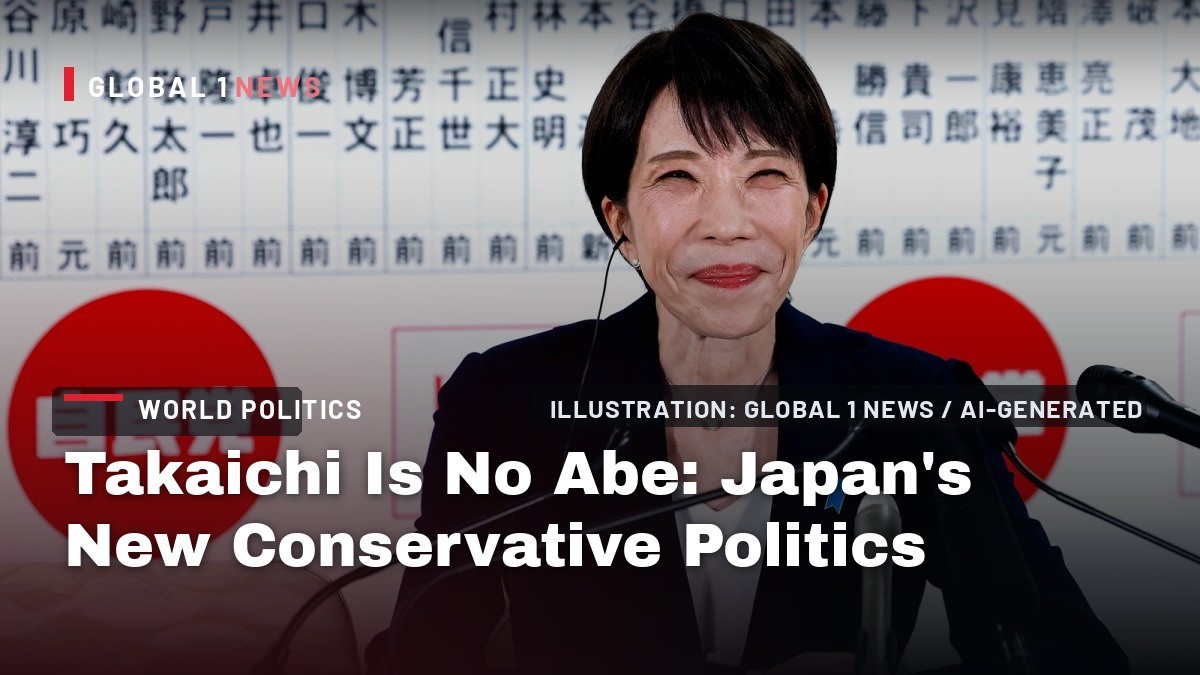
Ten months into her premiership, Japan's Prime Minister Takaichi Sanae has secured a historic electoral mandate, reshaped the country's defense posture, and forged an unlikely diplomatic rapport with Seoul. Yet the central question looming over her government is no longer whether she can govern, but what kind of conservative politics she actually represents. For years, international media framed Takaichi as the natural heir to Abe Shinzo's legacy—a nationalist standard-bearer who would continue the late prime minister's strategic revolution. The reality, as a growing body of evidence suggests, is more complicated. Takaichi may be Abe's heir in grand strategy, but she is governing with a political style that diverges sharply from her mentor's pragmatic playbook.
The distinction matters profoundly for Northeast Asia. As Michael Green recently argued in Foreign Affairs, Takaichi has continued an important part of Abe's strategic legacy: strengthening Japan's defense capabilities, deepening the Japan-U.S. alliance, and responding more assertively to China's challenge. But strategic continuity should not be confused with political continuity. After roughly ten months in power, the differences between Takaichi and Abe are becoming increasingly difficult to ignore. Rather than simply reviving "Abe politics," Takaichi appears to be developing a new political style of her own—more personalized, more confrontational, and more dependent on emotional mobilization through social media. The question for Japan's neighbors, and for the region's security architecture, is whether this new formula can sustain effective governance.
The Heir Apparent
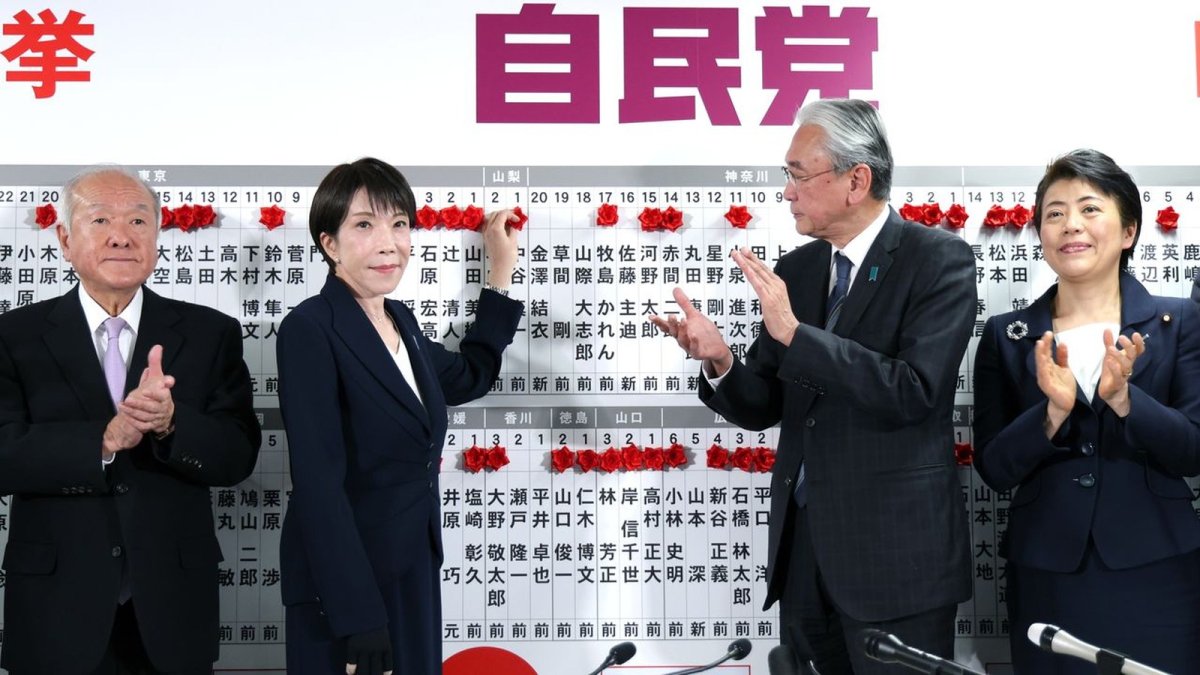
The framing of Takaichi as Abe's successor was never without basis. She emerged from the right wing of the Liberal Democratic Party (LDP) and was long promoted by Abe himself because of their agreement on history, security, and national development vision. When she became Japan's first female prime minister in October 2025, the narrative wrote itself: a nationalist leader, skeptical of the postwar liberal order, determined to strengthen Japan's security posture. Her early moves reinforced this impression. She inherited a minority government in both houses just four months before the February 2026 snap election, and called the vote to capitalize on her popularity. The result was nothing short of transformative. On February 8, 2026, the LDP won 316 of 465 lower-house seats—a gain of 118—securing a two-thirds majority, the largest achieved by a single party in postwar Japan. This surpassed even the 304 seats won in 1986 under Prime Minister Nakasone Yasuhiro and the Democratic Party of Japan's 308 in 2009. With coalition partner Nippon Ishin no Kai (36 seats), the ruling bloc controls 352 seats, enough to override the House of Councillors and to propose constitutional amendments. The opposition Centrist Reform Alliance—formed in January 2026 by the Constitutional Democratic Party of Japan and Komeito, which left the LDP after Takaichi was chosen party president—collapsed from 172 seats to 49. As CSIS analysts Yuko Nakano and Nicholas Szechenyi noted, the decisive win gives Takaichi latitude to advance her domestic agenda and bolsters her diplomatic bona fides ahead of a summit with President Donald Trump. The mandate is real, but it has also accelerated the divergence from Abe's governing style. Abe understood that conservative politics could be sustained only by combining ideology with pragmatism, nationalism with diplomacy, and political mobilization with institutional management. Takaichi is experimenting with a different formula.Strategic Continuity, Political Rupture
On defense and alliance management, the continuity with Abe is unmistakable. Japan has finalized a record defense budget request for the coming fiscal year, roughly $56-60 billion, aligned with its goal of reaching 2 percent of GDP on defense by 2027, prioritizing standoff missiles and uncrewed technologies. A 4 percent corporate defense surtax was implemented earlier this year. Takaichi has continued trilateral cooperation with the United States and South Korea, including participation in the September 2026 Freedom Edge drills off Jeju Island. The Japan-U.S.-South Korea trilateral framework, established at the Camp David summit in August 2023, remains central to Northeast Asian security. Yet the political rupture is visible in how Takaichi manages power. During the Abe era, the prime minister's office was highly sophisticated in managing the media and political narrative, but Abe generally maintained a clearer distinction between political messaging and outright mobilization through antagonism. Takaichi has cultivated a direct relationship with voters through social media, using X to communicate directly with the public rather than relying primarily on Japan's established media organizations. According to the Financial Times, Japanese business leaders have become increasingly frustrated with what they see as Takaichi's unwillingness to listen to views from outside her political circle, and concerned that she has become increasingly hostile toward the mainstream media. The risks of this approach are becoming apparent. A political leader who relies heavily on such platforms can easily find herself governing through the logic of mobilization rather than the logic of consensus-building. The first serious political challenge of Takaichi's premiership emerged from this dynamic. Shukan Bunshun, a Japanese weekly magazine known for exposing political scandals, reported that people close to Takaichi's camp had used AI to produce large numbers of short videos attacking political opponents and circulated them widely online during the 2025 LDP leadership election and the 2026 House of Representatives election. The revelations triggered a public backlash, raising questions about the integrity of her electoral mandate and the sustainability of her political model.A Different China Calculus
The crux of the divergence between Takaichi and Abe lies in their approach to China. Abe is frequently described outside Japan as a China hawk, but that description misses an important and delicate part of his diplomacy. Despite his nationalist reputation, Abe repeatedly demonstrated an ability to separate ideological commitments from strategic interests. In April 2018, according to a memoir written by a Taiwanese political figure, Abe declined to meet former Taiwanese President Lee Teng-hui, who was staying at the same hotel in Okinawa, apparently to avoid unnecessarily provoking Beijing. In 2019, Abe also sent a private letter to Yasukuni Shrine exploring the possibility of removing the enshrined Class-A war criminals, an effort that would have reduced one of the most persistent sources of friction in Japan's relations with its neighbors. (This episode was learned in 2025 while interviewing Kitaoka Shinichi, one of Abe's key foreign policy advisers, at Stanford University.) Abe understood that nationalist symbolism could generate domestic political benefits while imposing substantial diplomatic costs. Takaichi has yet to demonstrate the same degree of restraint. Her approach to China appears to be driven more directly by ideological convictions and political instincts than by a broader strategy for managing Japan's long-term relationship with its most important neighboring power. On November 7, 2025, Takaichi stated in the House of Representatives that if China's invasion of Taiwan "involves the use of warships and the exercise of military force, then by any measure, it could constitute a situation that qualifies as a 'survival-threatening crisis' for Japan"—the first time a Japanese prime minister explicitly linked a Taiwan contingency to Japan's exercise of collective self-defense. Beijing protested sharply, and the timing was particularly sensitive given that 2025 marked the 80th anniversary of the end of the Second Sino-Japanese War. Even some architects of Abe's foreign policy now appear concerned. On July 2, Yachi Shotaro, the former head of Japan's National Security Secretariat, wrote in his Nikkei series "My Life History" that the most important challenge facing Japanese diplomacy in the 21st century is its relationship with China. Japan must think over the medium and long term about how to build a stable and strategic relationship with China while remaining a U.S. ally and recognizing China as an important neighboring country. Yachi is hardly a dove: after Abe returned to power in 2006 he played a central role in improving China-Japan relations, and according to interview records cited in journalist Funabashi Yoichi's 2024 book "Children of Destiny," he accompanied former Prime Minister Fukuda Yasuo to China in 2014 and helped facilitate the resumption of China-Japan summit diplomacy. His public intervention suggests that even within Japan's strategic establishment, there is unease about Takaichi's trajectory.Conservative Populism and Its Risks
The emerging portrait of Takaichi is of a leader who represents something closer to a new form of conservative populism. If Abe represented a conservative politics tempered by strategic pragmatism, Takaichi may represent a more personalized, more confrontational style that depends on emotional mobilization. This is evident in her decision-making processes. In April, the Japanese magazine Sentaku reported that Takaichi had clashed with Imai Nobuya, a senior political adviser during the Abe era, over the possible deployment of the Self-Defense Forces to the Middle East—Imai opposed Takaichi's reported intention to send Japanese forces to the Strait of Hormuz to support U.S. military operations against Iran. The details remain disputed and should be treated with caution, but the broader question is whether Takaichi has the same capacity for institutional and strategic balancing that characterized Abe's leadership. Abe relied heavily on trusted bureaucrats and political advisers and understood the importance of reconciling political ideology with institutional constraints and strategic realities. The economic dimension adds another layer of risk. Takaichi began her term promoting a modified version of "Abenomics," relying heavily on government spending financed by debt. Japan's public debt is roughly $9 trillion—about 240 percent of GDP. Her agenda includes a "responsible but aggressive" stance on fiscal outlays, enhanced defense and security spending, and a campaign pledge of a two-year suspension of the 8 percent consumption tax on food items. The fiscal sustainability of this approach remains an open question, and the political incentives to continue spending are strong given her reliance on popular mobilization. The polling trajectory suggests the limits of this approach. A June poll by Jiji Press put Takaichi's approval rating at roughly 54 percent, down from around 70 percent at the beginning of the year. The decline is not catastrophic, but it signals that the initial euphoria of her historic mandate is fading. The AI video controversy, the friction with business leaders, and the growing perception of insularity are all taking a toll.
The Korea Dimension
For observers of inter-Korean and Japan-Korea relations, the most surprising development of Takaichi's premiership has been her rapport with South Korean President Lee Jae-myung. The two leaders first met at the APEC Economic Leaders' Meeting in Gyeongju, South Korea, in November 2025. Their first bilateral summit was held at an ancient temple in Nara Prefecture on January 14, 2026, where they signaled a "new era of engagement." Lee had met Chinese leader Xi Jinping the week before and has shown a strong willingness to act as a mediator in repairing strained China-Japan relations. The two leaders played drums together at a gathering after the Nara summit. A second summit followed when Takaichi arrived in South Korea in May 2026 for talks with Lee in Andong. A Diplomat analysis in May 2026 described the pair as a "political odd couple" who have "defied expectations," noting they have been all smiles during their two summits. This rapprochement is strategically significant. It suggests that even as Takaichi's China policy hardens, she recognizes the value of the trilateral framework with Seoul and Washington. The Japan-U.S.-South Korea alliance structure, anchored by the Camp David summit and the Freedom Edge exercises, provides a hedge against regional instability. Lee's willingness to mediate between Tokyo and Beijing could prove valuable if Takaichi's ideological approach to China creates diplomatic friction. The personal chemistry between the two leaders, however unusual, may provide a channel for managing differences that institutional mechanisms cannot.Stronger Japan, Less Predictable Japan
The central conclusion from Takaichi's first ten months is that a stronger Japan and a more predictable Japan are not necessarily the same thing. Takaichi may share Abe's nationalism, his skepticism toward the postwar liberal order, and his determination to strengthen Japan's security posture. She may continue many of the strategic policies associated with Abe's legacy. But political inheritance is also about governing instincts. Abe understood that conservative politics could be sustained only by combining ideology with pragmatism, nationalism with diplomacy, and political mobilization with institutional management. Takaichi is experimenting with a different formula—personal leadership, social media politics, emotional mobilization, and confrontation with perceived political and cultural opponents. That may prove effective in an era of fragmented media, where direct communication with voters can bypass traditional gatekeepers. But it carries significant risks. A leader who governs through mobilization rather than consensus-building may find it difficult to manage the complex trade-offs inherent in foreign policy, fiscal policy, and alliance management. The question is whether she can turn her personalized style of conservative politics into an effective governing system. For Japan's neighbors, the implications are profound. A stronger Japan with a more assertive security posture is one thing; a less predictable Japan, driven by ideological conviction and emotional mobilization, is quite another. The region's stability depends not only on Japan's capabilities but on the predictability of its decision-making. Takaichi has yet to demonstrate that she can match Abe's capacity for strategic balancing—separating ideology from interests, nationalism from diplomacy, and mobilization from institutional management. Until she does, the world should treat the heir apparent with caution.This article was produced with AI-assisted research and editorial support. Sources: The Diplomat, Tribune Content Agency, East Asia Forum, CSIS, Nippon.com, The Korea Times, The Washington Times.
By Prof. David Park, Staff Writer
What's Your Reaction?
 Like
0
Like
0
 Dislike
0
Dislike
0
 Love
0
Love
0
 Funny
0
Funny
0
 Wow
0
Wow
0
 Sad
0
Sad
0
 Angry
0
Angry
0

Prof. David Park
East Asia/Technology Correspondent at Global1.News. Seoul-based voice covering Korean politics, technology, business, and culture. Analyzes how technology and geopolitics intersect across East Asia.















Comments (0)