
Nepal Floods: Hundreds Dead, Thousands Missing After Glacial Burst
The water came without warning. Not as a slow rise, not as a creeping tide, but as a wall of brown fury that erased homes, bridges, and lives in the span of a single morning. Along the Nepal-China border, where the mountains meet the sky, the earth shuddered, and then the rivers turned on the people who lived beside them. Nepal Floods: Hundreds Dead, Thousands Missing After Glacial Burst Kathmandu, Nepal – August 30, 2026 — Five days after a catastrophic series of flash floods tore
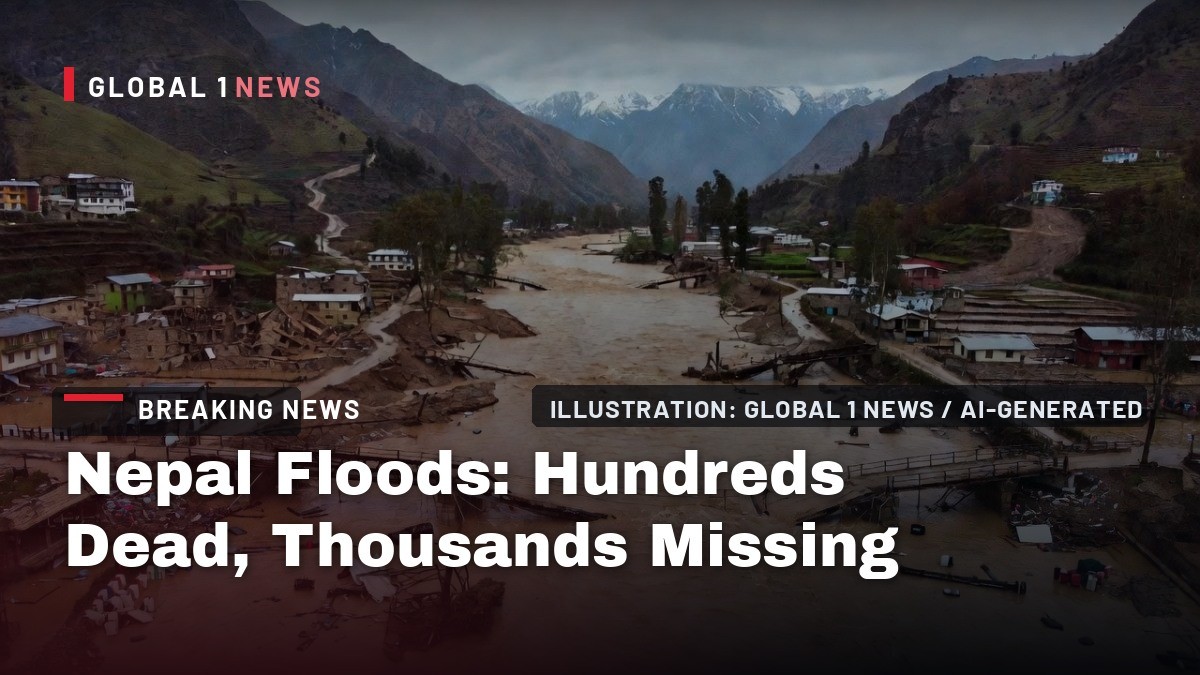
The water came without warning. Not as a slow rise, not as a creeping tide, but as a wall of brown fury that erased homes, bridges, and lives in the span of a single morning. Along the Nepal-China border, where the mountains meet the sky, the earth shuddered, and then the rivers turned on the people who lived beside them.
Nepal Floods: Hundreds Dead, Thousands Missing After Glacial Burst
Kathmandu, Nepal – August 30, 2026 — Five days after a catastrophic series of flash floods tore through the central Himalayas, the numbers keep climbing, and the ground keeps shifting. What began as a suspected glacial collapse on the Tibetan side of the border has become one of the deadliest natural disasters in Nepal's recent history, with nearly 700 confirmed dead as of August 29, according to Nepal's disaster relief agency, and thousands more unaccounted for. The Gyirong Port customs and immigration checkpoint on the China-Nepal border was destroyed in the initial surge, and dozens of settlements along a roughly 72-kilometer (45-mile) stretch of the Trishuli River in Nepal have been reduced to rubble and mud. This is not a story about a single event. It is a story about a system that failed, a landscape that is changing, and the people who are paying the price.
The Day the Mountains Let Go
On the morning of August 26, 2026, a series of sudden flash floods struck along the Nepal-China border region. The Bhote Koshi and Trishuli river systems in central Nepal were the hardest hit, according to officials on the ground. The water did not come from rain alone. Experts suspect a Glacial Lake Outburst Flood (GLOF) — a phenomenon where a lake formed by melting glacier ice suddenly breaches its natural dam and releases a torrent of water and debris. A glacial collapse registered as a magnitude 5.2 seismic event near the border on the morning of the disaster, The Guardian reported, and heavy rainfall on the Tibetan side also contributed to the surge.
Authorities in Nepal and China are still determining the exact origin of the flood, but the pattern is painfully familiar to scientists who study the Himalayas. These mountains are warming faster than the global average, and the lakes that sit at the base of retreating glaciers are growing larger, more unstable, and more dangerous. When one of them lets go, it does not discriminate. It takes everything in its path.
A Landscape Erased
The affected Nepali districts — Rasuwa, Nuwakot, Dhading, and Gorkha — are among the most rugged and remote in the country. They are also among the most vulnerable. Homes, roads, bridges, schools, health posts, and farmland were swept away in the deluge, according to local officials. In Rasuwa, which sits closest to the border, entire villages have been cut off from the outside world. The roads that once connected them to markets, hospitals, and family members are now either buried under debris or hanging over ravines where the river used to be.
Nepal Army spokesman Brig. Gen. Raja Ram Basnet described the situation to The New York Times with a bluntness that cuts through the official statements. "Even where they have located them, it is difficult to enter," he said. That is the reality of this disaster. It is not just that people are missing. It is that the rescuers cannot reach them, and the terrain is fighting back.
The Toll: Counting the Missing
The casualty figures are fluid, and they are climbing daily. As of August 29, the fourth day of rescue operations, nearly 700 deaths had been confirmed, according to Nepal's disaster relief agency. Wikipedia's running tally, which is being updated by volunteers and journalists on the ground, cites at least 794 deaths and 2,502 missing in Nepal, with 16 dead and 546 missing in Tibet. The Guardian reported on August 29 that nearly 3,000 people remain missing across Nepal and Tibet combined. These are not just numbers. They are fathers, mothers, children, and neighbors.
The international dimension of this tragedy is staggering. Al Jazeera reported that more than 800 foreign tourists are among the missing. India's Foreign Ministry said about 320 Indian nationals remain unaccounted for, and around 400 others were stranded on the Chinese side of the border. These are people who came to the Himalayas for the beauty, for the challenge, for the peace. They found instead a wall of water.
Rescue at a Critical Stage
China's Embassy in Nepal has called the rescue operations a "critical stage," and the language is not hyperbolic. Two newly formed barrier lakes on the Tibetan side of the border are at risk of overflowing, ABC News and Wikipedia reported, and they have prompted warnings to officials in Rasuwa. One of those lakes overflowed slightly on August 28, a reminder that the danger is not over. The mountains are still unstable. The water is still moving.
China has dispatched five tunnel experts from Tibet to Nepal to assist with flood-related rescue work, according to Chinese state media. Beijing has also called for international rescue cooperation and emergency aid, a rare and significant gesture from a government that often prefers to handle its own affairs. India, for its part, has said it is ready to extend all possible help to Kathmandu, The Hindu reported. The politics of the region are complicated, but the need is simple: get people out, get them help, and get them home.
The urgency behind that "critical stage" warning is not abstract. The two barrier lakes that have formed on the Tibetan side are essentially new, unstable bodies of water sitting above already devastated communities. When one of them overflowed slightly on August 28, it was a reminder that the terrain is still settling, and the water is still finding its way down. The warning to officials in Rasuwa is not a formality; it is a directive to prepare for the possibility that the worst is not yet over. The ground is saturated, the channels are blocked, and the margin for error is gone.
The response from China and India reflects a rare moment of regional coordination in the face of a shared threat. China's decision to send five tunnel experts from Tibet to Nepal is a practical acknowledgment that the disaster does not respect borders, and that the expertise needed to navigate the wreckage is on both sides of the range. Beijing's call for international rescue cooperation and emergency aid is significant, as is India's stated readiness to help Kathmandu. But the scale of the need is staggering. With roughly 320 Indian nationals still missing and around 400 stranded on the Chinese side, the diplomatic language is being tested by a very human toll. This is not a time for posturing; it is a time for digging.
The Warning System That Failed
Perhaps the most painful part of this disaster is that it was supposed to be preventable. A flash-flood early warning system maintained for years by Chinese and Nepali scientists — credited by the South China Morning Post with consistently preventing casualties — failed to detect this disaster in time. The system's water-level monitors were optimized for detecting monsoon flooding, not an event of this type. A GLOF moves differently, faster, and with far more destructive force than a seasonal flood. The monitors were looking for the wrong thing.
This is not a failure of effort. It is a failure of design. The scientists who built the system did their jobs, and they did them well. But the climate is changing faster than the infrastructure can adapt. The lakes are growing. The glaciers are retreating. And the tools we have to predict the next catastrophe are still calibrated for the last one. The South China Morning Post's reporting makes clear that this system saved lives in the past. It just could not save them this time.
What Happens Next
The immediate priority is rescue. The Nepali Army, along with international teams, is working to reach stranded victims in the rugged, wrecked terrain. But the challenges are immense. Bridges are gone. Roads are impassable. And the weather, which contributed to this disaster, is not cooperating. The barrier lakes on the Tibetan side remain a threat, and officials in Rasuwa have been warned to prepare for the possibility of further flooding.
Beyond the rescue, there is the question of recovery. The farmland that was swept away will not come back this season. The schools that were destroyed will not reopen this month. The health posts that were washed out will not be rebuilt this year. The people of Rasuwa, Nuwakot, Dhading, and Gorkha have lost not just their homes but their livelihoods, their communities, and their sense of safety. The mountains that have sustained them for generations have turned against them, and they need help that will last far longer than the news cycle.
A Region on the Edge
This disaster is not an anomaly. It is a warning. The Himalayas are home to thousands of glacial lakes, and many of them are growing. As the climate warms, the risk of GLOFs increases, and the communities downstream are increasingly exposed. The scientists who study these systems have been sounding the alarm for years. The question is whether the world will listen before the next lake lets go.
For now, the focus is on the people who are still missing, the families who are still waiting, and the rescuers who are still fighting the terrain. The numbers will keep climbing in the coming days, and the full scale of this tragedy will not be known for weeks. But one thing is already clear: the water came without warning, and it changed everything.
The broader context here is uncomfortable but unavoidable. Scientists have been warning for years that the Himalayas are warming faster than the global average, and that the glacial lakes scattered across the range are growing larger and more unstable. A Glacial Lake Outburst Flood is not a rare anomaly anymore; it is a growing risk, and the communities downstream are sitting in the path of a slow-motion threat. The lakes are not static. They are filling, shifting, and in some cases, reaching the point where their natural dams can no longer hold. The disaster on August 26 is not the end of this story. It is a preview of what is likely to come if the underlying conditions do not change.
By Jessica Ali, Staff Writer
This article was produced with AI-assisted research and editorial support. Sources: The Guardian, The New York Times, Al Jazeera, BBC News, ABC News (Australia), The Hindu, ReliefWeb, South China Morning Post, Wikipedia (2026 Nepal floods).
What's Your Reaction?
 Like
0
Like
0
 Dislike
0
Dislike
0
 Love
0
Love
0
 Funny
0
Funny
0
 Wow
0
Wow
0
 Sad
0
Sad
0
 Angry
0
Angry
0

Editor-in-Chief at Global1.News. Atlanta-based journalist who cuts through the BS and tells it like it is. Lead anchor, host, and the voice you hear when the spin stops and the truth starts.











Comments (0)