
Wang Yi Heads to Seoul as Trump Cuts US-South Korea Drills
China's Wang Yi begins a two-day visit to Seoul as Trump orders scaled-back US-South Korea drills, testing alliance trust across the first island chain and handing Beijing an opening to hedge Seoul away from Washington, with Japan watching closely.
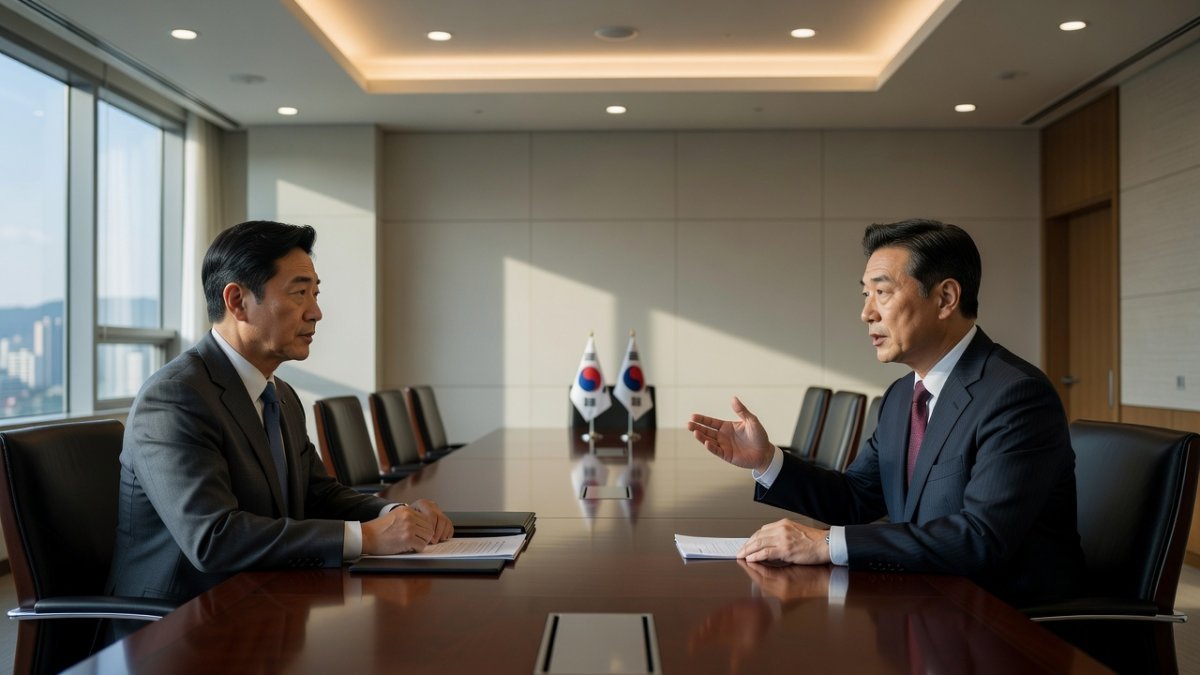
China's Top Diplomat Touches Down as Washington's Commitments Are Questioned
China's Foreign Minister Wang Yi is set to begin a two-day official visit to Seoul on Wednesday, his first solo bilateral exchange trip to South Korea in five years — and it is arriving at a moment of maximum turbulence in the US-South Korea alliance. The visit, confirmed by Seoul's foreign ministry at the invitation of Foreign Minister Cho Hyun, comes days after President Donald Trump ordered the Pentagon to scale back joint military exercises with the South, a decision that has sent ripples of unease through US allies across Asia and handed Beijing an opening it has long sought.
Tags: Wang Yi, South Korea, Trump, Ulchi Freedom Shield, US-China rivalry, North Korea, first island chain, Seoul diplomacy, Japan security, Indo-Pacific alliance
The News Peg: A Rare Solo Trip to Seoul
According to the South Korean foreign ministry, Wang will hold talks with Cho and a luncheon with National Security Adviser Wi Sung-lac, with the agenda expected to cover bilateral relations, developments on the Korean Peninsula, and regional and international issues. The visit is Wang's first solo bilateral exchange trip to Seoul in five years, underscoring both the weight Beijing places on the current moment and the degree to which the diplomatic calendar has been reshaped by Washington's shifting posture.
The timing is not accidental. On Sunday, Trump posted to social media that he had instructed the Pentagon to scale back what he termed "inappropriate and hostile" military drills with South Korea — exercises traditionally aimed at deterring North Korea, a country he described as "unthreatening and respectful." He offered several rationales: cost-saving considerations, a goodwill gesture towards Pyongyang, and dissatisfaction over Seoul's refusal to join US efforts in the Iran conflict. The announcement landed just hours before Washington and Seoul launched the 11-day Ulchi Freedom Shield exercises, one of the two major annual combined drills, which began on August 17.
Trump's Drill Decision and the Trust Deficit It Creates
The order to "substantially reduce" the exercises has been read by analysts as part of a broader pattern in Trump's second term: treating alliance commitments as transactional bargaining chips rather than strategic pillars. Lee Dong-gyu, a senior research fellow at the Asan Institute for Policy Studies, said Trump's statements revealed a willingness to trade alliance security for political gains, such as re-engagement with North Korean leader Kim Jong-un — a calculation that Lee said would increase Seoul's trust deficit in its alliance with Washington.
William Yang, senior analyst for Northeast Asia at the International Crisis Group, said the statement matched Trump's usual playbook of signalling frustration towards allies he views as failing to respond to US demands. "While the order may be a tactical move from the US, it could undermine long-standing trust between the two countries and prompt Seoul to put more resources into hedging between Beijing and Washington," he said. Leif-Eric Easley, professor of international studies at Ewha Womans University in Seoul, warned that curtailing joint manoeuvres risked undermining operational coordination and weakening deterrence against potential conflicts in Asia.
The North Korea Factor: Kim's Overtures and Beijing's Leverage
Trump's directive has also sparked anticipation of renewed engagement with Kim, though it remains unclear whether the North Korean leader will reciprocate. On Monday, Trump told reporters that Kim had responded to his recent overtures and described the current state of communication as "very positive," without elaborating; Kim has not commented publicly. Pyongyang appears to hold more cards than it did at the summits of 2018 and 2019: since the collapse of high-level diplomacy, it has aggressively expanded missile tests and gained battlefield experience by sending soldiers to fight in Russia's war in Ukraine.
Lee Choong-koo, a research fellow at the Korea Institute for Defence Analyses, said Trump's move was part of a broader US diplomatic charm offensive towards North Korea — one that might require China's cooperation. "His move may encourage greater diplomatic engagement between the US and China on North Korea," he said, adding that Beijing might welcome the announcement. "With Foreign Minister Wang Yi expected to visit Seoul this week, China may emphasise that its support is essential to advancing South Korea's diplomatic initiative to launch multilateral peace talks." Beijing has long positioned itself as a broker on the peninsula, and Wang's visit gives it a stage to press that claim just as Washington's reliability comes into question.
Seoul's Hedging Calculus
For South Korea, the dilemma is acute. Seoul hosts roughly 28,500 US troops under a decades-old alliance, and the combined exercises have been a cornerstone of deterrence against the North since the Korean War. But Trump's willingness to link the alliance to unrelated theatres — including Seoul's refusal to join US action against Iran — has strengthened the hand of those in the South who argue for greater strategic autonomy and deeper engagement with Beijing.
Analysts note that Beijing is likely to exploit the scaled-back exercises as a tool to constrain Seoul's participation in the US alliance network and diminish America's military footprint in the region. "At the same time, leveraging its friendly ties with Pyongyang, China is likely to intensify both its appeasement and pressure on South Korea under the pretext of fostering a favourable environment for US-North Korea dialogue," Lee Dong-gyu said. The visit itself is a signal: China is prepared to offer Seoul an alternative lane of diplomacy even as it works to loosen the US alliance system's hold on the peninsula.
Regional Ripples: Japan and the First Island Chain
The implications extend far beyond the Korean Peninsula. Experts noted that the latest remarks would unnerve regional partners such as the Philippines and Japan, whose frictions with Beijing leave them particularly exposed. The first island chain — a series of strategic arcs stretching from Japan and Taiwan through the Philippines to Borneo — underpins the US-aligned security architecture that is meant to check China. Although traditionally not viewed as part of the chain, South Korea, with its 28,500 US troops, is increasingly seen as its northern anchor.
For Japan, the stakes are existential in a quieter way. Tokyo has spent the past two years building up its own defence capabilities — including plans to raise defence spending towards 2 per cent of GDP and acquire counterstrike capabilities — partly out of the same anxiety now gripping Seoul: that Washington's commitments cannot be taken for granted. If the US-South Korea alliance is subject to Trump's transactional calculus, Japanese policymakers will read the drill cut as a preview of what their own alliance might face in a crisis, even as the US Under Secretary of Defence for Policy, Elbridge Colby, insisted during his first Southeast Asia tour last week that Washington was "digging in" to maintain a favourable balance of power in the Indo-Pacific while prioritising burden-sharing.
The mismatch between US strategic documents on defending the first island chain and Trump's decision on joint drills with South Korea would strengthen regional countries' belief that they needed to adopt risk-reduction measures against the US, William Yang said. "This trend will benefit China, as it creates an opportunity for Beijing to drive a wedge between the US and its regional allies."
What to Watch For
Wang's two days in Seoul will be watched closely for the language Beijing chooses: whether it frames its support for South Korea's peace initiative in terms that align with Seoul's own interests, or presses the advantage of Washington's retreat. Equally telling will be whether Trump follows through on "substantially reducing" the drills that are now underway, and whether Kim emerges from silence to respond to the overtures — and at what price.
For Japan and other Asia-Pacific allies, the episode is a reminder that the region's security architecture is only as durable as the commitments behind it. As Seoul hedges between Washington and Beijing, and as China's top diplomat walks the corridors of the South Korean foreign ministry, the deeper question is whether the US-led order in Asia can absorb this shock or whether the first island chain has begun to bend. Tokyo's own defence build-up, and its response to any further signals of US retrenchment, will be the next chapter in that story.
By Kenji Tanaka, Staff Writer
This article was produced with AI-assisted research and editorial support. Sources: SCMP, Yonhap, Reuters, Bloomberg.
What's Your Reaction?
 Like
0
Like
0
 Dislike
0
Dislike
0
 Love
0
Love
0
 Funny
0
Funny
0
 Wow
0
Wow
0
 Sad
0
Sad
0
 Angry
0
Angry
0

Japan Correspondent at Global1.News. Tokyo-based voice covering Japanese politics, technology, economy, and culture. Tracks the intersection of tradition and innovation in one of the world's most dynamic societies.












Comments (0)