
Voyager 1 Went Silent for 48 Hours, Then Answered on Its Own
Voyager 1 missed two scheduled contacts on 18 and 19 October 2026 and its signal came back on its own before engineers sent a troubleshooting command. NASA has not established the cause, and the probe reaches one light-day from Earth on 18 November.
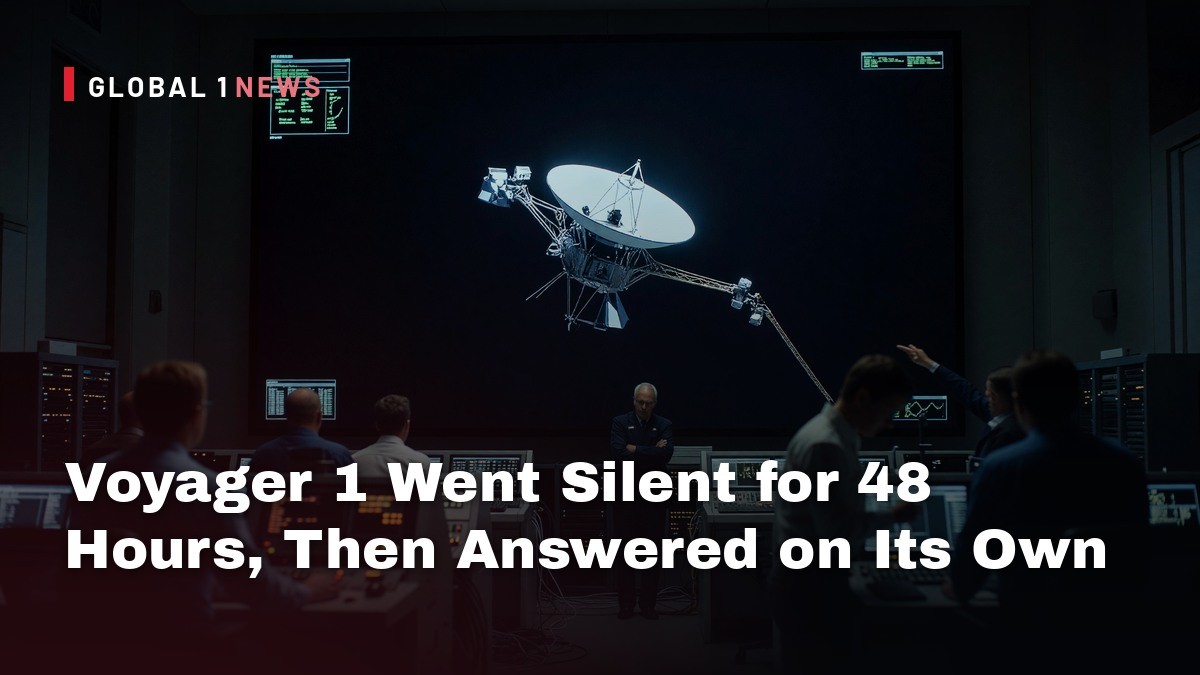
For 48 hours in October, the most distant object humans have ever built simply stopped answering. Then, before anyone on Earth sent a single command to fix it, Voyager 1 came back on its own — 16 billion miles out, on a spacecraft launched in 1977.
Voyager 1 Went Silent for 48 Hours, Then Answered on Its Own
Pasadena, California — The probe is closing on a record no machine has ever reached, and it is doing it on a power supply NASA has spent years stretching.
Two Days of Silence, and Then a Signal
NASA's Deep Space Network went looking for Voyager 1 on 18 October and heard nothing. It tried again 24 hours later, on 19 October. Nothing again.
The spacecraft was roughly 16 billion miles (24 billion kilometers) from Earth and had gone quiet without warning. Then, on 20 October, its signal came back on its own, before engineers on the ground had sent a single troubleshooting command.
The Jet Propulsion Laboratory described the episode in an update published on 29 October as a brief communications pause, and confirmed the team has held contact ever since.
"This is the first time we've seen the spacecraft do something like this, but we are also at a point in the mission where we have to expect the unexpected," said Kareem Badaruddin, the Voyager mission manager at JPL. "We're relieved to be back in contact with Voyager 1 and are eager to understand what happened."
What the Spacecraft Did on Its Own
Here is what the probe did without being told. Engineers have established that one group of thrusters went offline and that their backups switched on.
That handover was not a stroke of luck. Voyager's computers are programmed to make the swap automatically when they detect something wrong with the active thrusters. The routine is called fault protection, and its job is to hold the spacecraft in a safe, stable configuration, pause normal operations and buy the team time to work out what went wrong.
This time the spacecraft did not need the rescue. It stabilised itself, resumed operations and started answering again.
What triggered the fault is still unknown. JPL says engineers continue to investigate the cause and has published no finding.
That gap matters. A spacecraft that fixes itself is not the same as a spacecraft that has been diagnosed, and the difference will shape how the team plans the years it has left.
The Big Bang That Bought Another Year
In early September, engineers completed a months-long effort to stretch Voyager 1's shrinking power supply. They turned off three devices and substituted three lower-power alternatives. The team nicknamed the operation the Big Bang.
It could not be done piecemeal. The six devices involved help keep the spacecraft warm enough to operate in the cold of interstellar space, and only by swapping all three pairs at once could engineers cut the power draw while keeping heat properly distributed through the probe.
The same operation had already been run on Voyager 2, and JPL says the Voyager 1 version was finished about six weeks after its twin's.
The payoff is time. Without the swap, the mission would have needed to shut down another science instrument on Voyager 1 as early as the summer of 2027. With it, the instruments that remain can keep working longer than the team had budgeted for.
A Plutonium Budget Losing Four Watts a Year
Voyager's electricity comes from radioisotope thermoelectric generators, which convert the heat of decaying plutonium into power. The plutonium is running down, and both probes lose about four watts a year.
The bill has come due in instruments. NASA says that since 2024 the dwindling supply has forced it to switch off two science instruments on each spacecraft. Voyager 1 lost its cosmic ray subsystem on 25 February 2025 and its low-energy charged particles experiment on 17 April 2026.
Of the ten instruments Voyager 1 launched with, two are still operating: the magnetometer and the plasma wave subsystem, according to NASA's mission status page. The rest were shut off after the planetary encounters, retired for degraded performance or sacrificed to the power budget.
When the low-energy charged particle experiment went dark, engineers left one small motor running — the 0.5-watt spinner that sweeps its sensor — in case power is ever found to switch the instrument back on.
The Record Falls on 18 November
At 5:16:07 a.m. Eastern time on 18 November, Voyager 1 will be 16.094 billion miles (25.902 billion kilometers) from Earth — up from about 24 billion kilometers when it fell silent in October. That is one light-day: the distance light travels in 24 hours.
No other human-made object has been that far. NASA's mission status page calls it the first human-made object to reach the mark, one more entry on a list the probe has been writing since 1977.
Nothing dramatic happens at the moment of crossing. The spacecraft will not detect a change in its environment, and nothing aboard will change. The milestone measures distance, not an event.
"If you want to say hello to Voyager, you send your message and then you go home and you wait two days before you finally get a response," said Suzanne Dodd, the Voyager project manager at JPL. The probe is travelling at about 38,000 mph, or 61,155 kilometers per hour.
What a 48-Hour Round Trip Means
That two-day wait is the practical meaning of everything above it. Radio travels at the speed of light, so a command sent today takes 24 hours to arrive and the reply takes another 24 to come back.
Science News puts the distance in terms of the neighbourhood we know: 25.9 billion kilometers is more than four times the distance from the Sun to Pluto.
Engineers have lived with that lag for years, and it shapes every decision. A routine correction becomes a two-day conversation. A fault becomes a two-day question. When the Deep Space Network heard nothing on 18 and 19 October, nobody could log in and look.
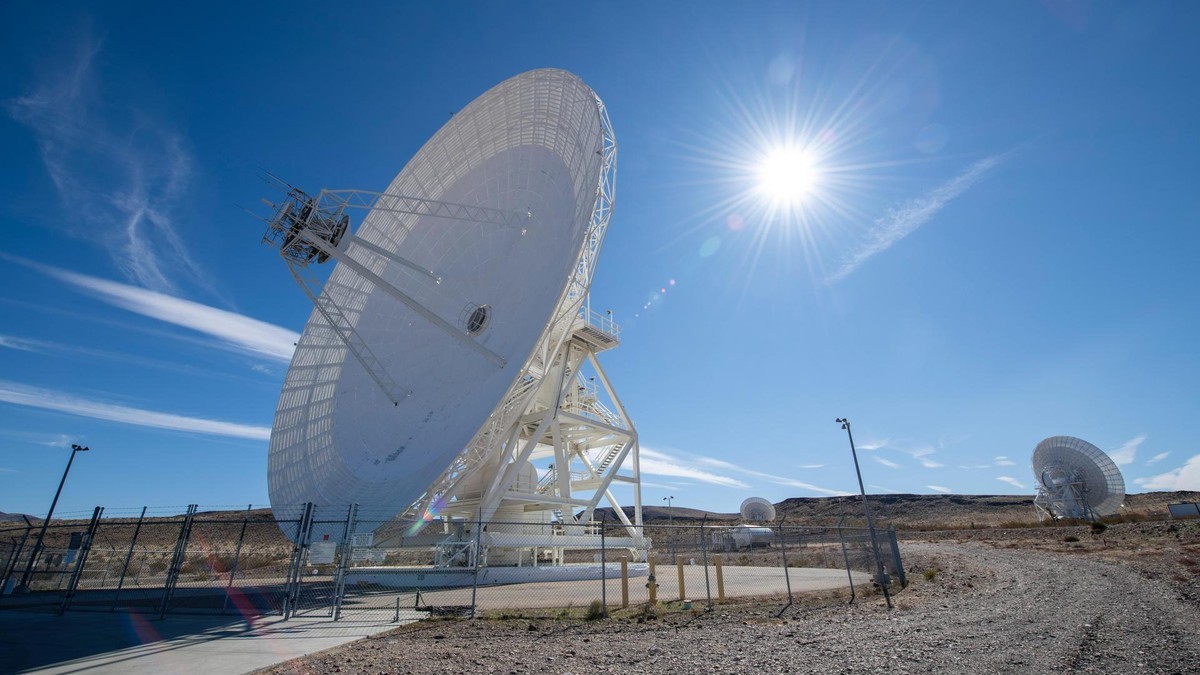
The network is how the conversation happens at all: large antennas at three facilities around the world, built to talk to spacecraft at the Moon and far beyond. For a probe out in interstellar space, those dishes are the only thread home.
It Passed Pioneer 10 in 1998
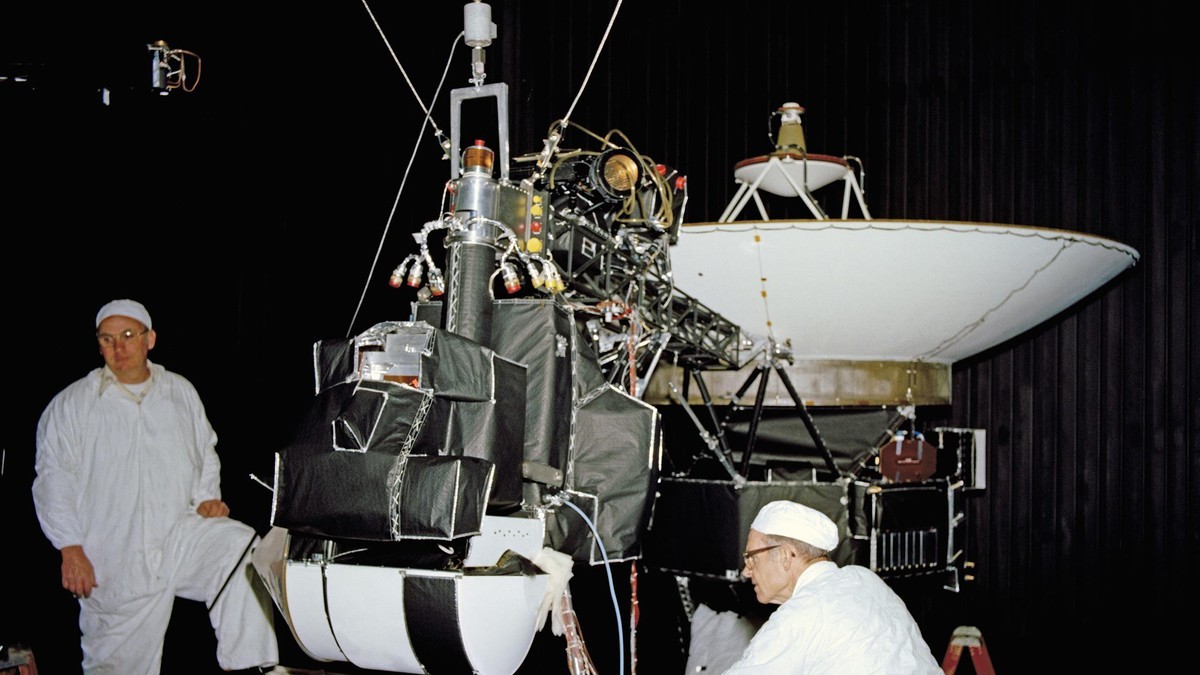
Voyager 1 left Cape Canaveral on 5 September 1977, two weeks after its twin, which took a slower path to Jupiter.
The mission was built on a rare alignment of the outer planets, one that let two spacecraft swing past Jupiter, Saturn, Uranus and Neptune using each planet's gravity as a slingshot. The tour took less than 15 years. The same alignment will not come around again until the 2150s.
In 1998, Voyager 1 overtook Pioneer 10 and became the most distant human-built object in space. It has been extending that lead ever since.
What it sent back from Jupiter and Saturn — volcanic plumes on Io, close detail of the Great Red Spot, hints of geologic activity on Saturn's moon Enceladus — reshaped the study of the outer solar system.
The Boundary It Crossed in 2012
On 25 August 2012, Voyager 1 crossed the heliopause, the boundary where the Sun's wind of charged particles meets interstellar space. Confirmation took months and a lucky break: a solar eruption in April 2013 set electrons around the probe vibrating, which let scientists estimate the density of the surrounding plasma. The numbers showed the crossing had already happened, about 18 billion kilometers out, or 120 times Earth's distance from the Sun.
No other spacecraft has operated beyond that line. Voyager 1 and Voyager 2 are the only two.
The region beyond is quieter than anyone expected. "For the most part, it's been very quiet and very consistent," said Jamie Rankin, a physicist at Princeton University.
It is not silent. Physicist Jeewoo Park of NASA's Goddard Space Flight Center documented four episodes in which magnetic field strength and particle density jumped around the probe. After the fourth, in mid-2020, those readings stayed high. Nobody has explained why.
The People Who Have Kept It Alive
Linda Spilker started on Voyager shortly before launch, was at Cape Canaveral for the first one, and planned the births of her children around mission milestones. She left to lead another mission and came back as Voyager's head scientist.
"I just never imagined it would last that long," she told Science News. "Voyager, to this day, is a multi-generational mission."
That is literal. Two other scientists have been with the programme since the beginning, and others on the team were not yet born when the spacecraft left Earth. Rankin began her doctorate in August 2012, the same month Voyager 1 crossed into interstellar space.
Ed Stone, the mission's original head scientist, put the achievement in a single line in a NASA interview before his death in 2024. "The highlights of Voyager were clearly the planetary encounters," he said. "We had a lifetime of discovery packed into each one."
Where It Is Going, and What It Carries
Nobody knows exactly when the conversation ends. Scientists estimate the generators will stop supplying enough power for instruments within 10 to 15 years. After that, Voyager falls silent for good and keeps going.
The itinerary is already written. Voyager 2 will pass within about 700 light-days of the red dwarf Ross 248 in roughly 42,000 years. Voyager 1 will come near the star Gliese 445 in about 44,000.
Each carries a gold-plated copper phonograph record holding greetings in dozens of languages, the sounds of whales and laughter, and images of Earth.
"The Voyagers become our silent ambassadors, a little bit of us that continues into space," Spilker said. "It may well outlast humanity."
That is the thing to hold on to. Not a machine that failed, but a machine that answered when nobody was calling — and will keep answering, for a while yet, from a day's light away.
By Jessica Ali, Staff Writer
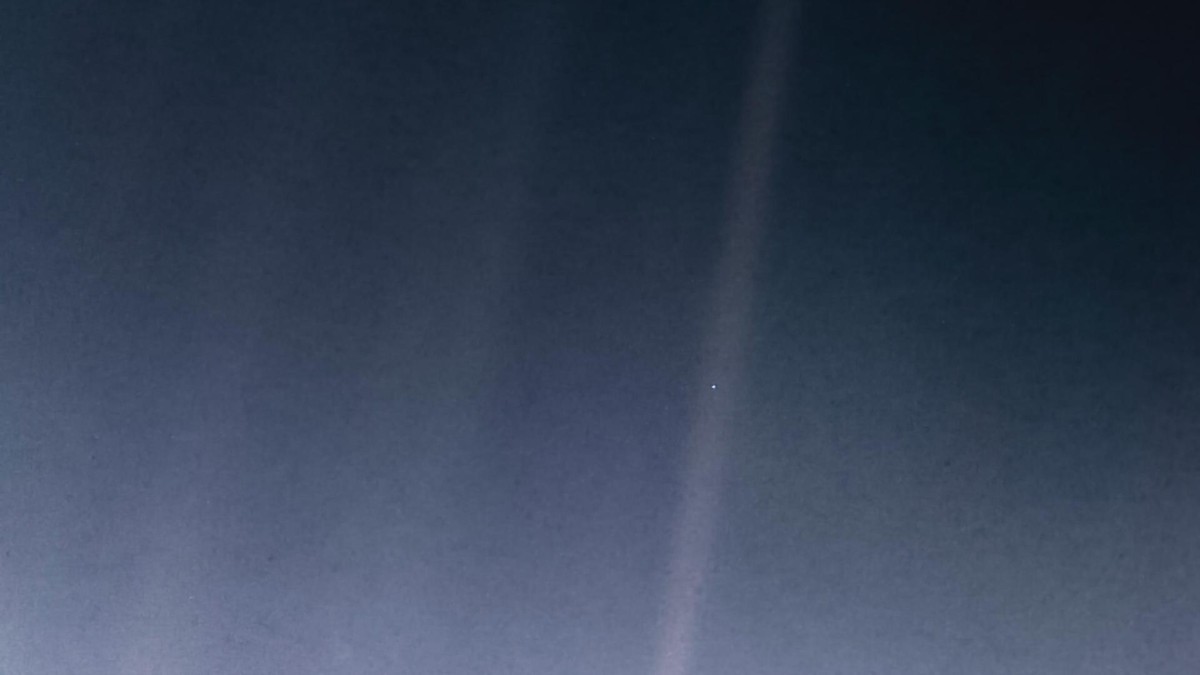
This article was produced with AI-assisted research and editorial support. Sources: NASA Jet Propulsion Laboratory, NASA Science, Science News. Cover: Global 1 News editorial image. Photographs: NASA/JPL-Caltech (Voyager in JPL's 25-foot space simulator chamber, April 1977); NASA/JPL-Caltech (Goldstone Deep Space Communications Complex); NASA/JPL-Caltech (the Pale Blue Dot, Voyager 1, reprocessed 2020).
What's Your Reaction?
 Like
0
 Dislike
0
 Love
0
 Funny
0
 Wow
0
 Sad
0
 Angry
0

Editor-in-Chief at Global1.News. Atlanta-based journalist who cuts through the BS and tells it like it is. Lead anchor, host, and the voice you hear when the spin stops and the truth starts.















Comments (0)