
US Brands China Transshipment 'Great Scam' Ahead of Summit
A White House report brands China-linked goods rerouting 'The Great Transshipment Scam,' targeting 40-plus countries, as the US-China Board of Investment stalls before the Trump-Xi summit. Japan, South Korea and Taiwan are flagged as transshipment-risk economies.
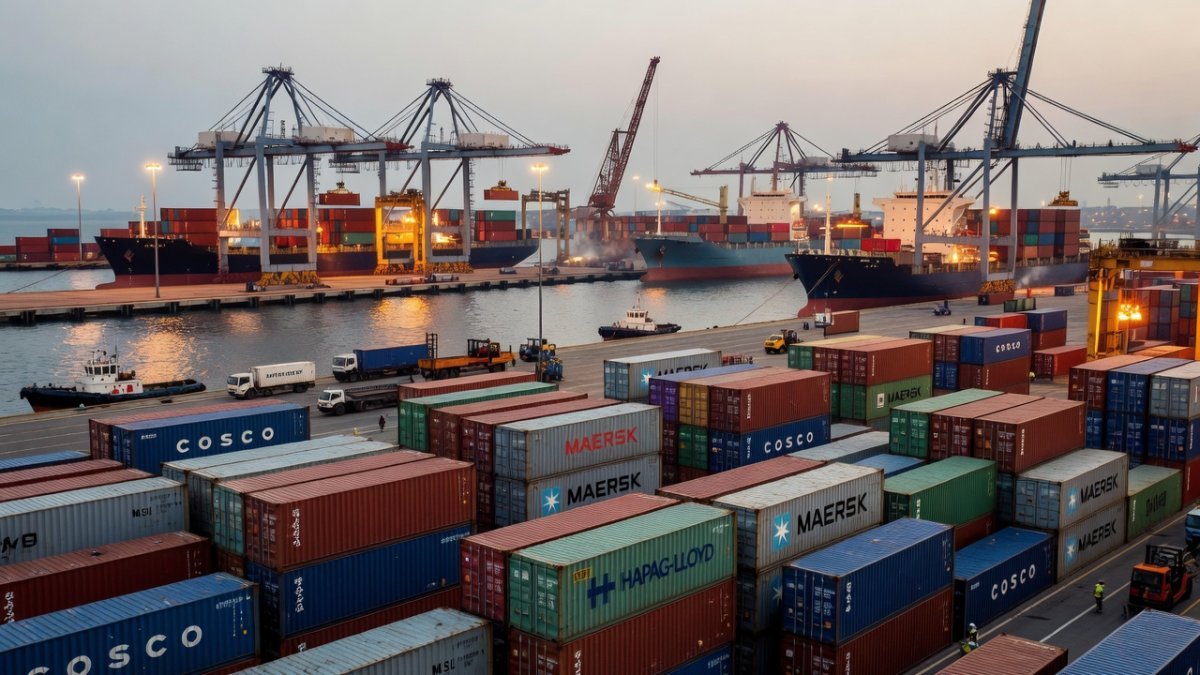
Washington Targets China-Linked Rerouting as Trump-Xi Summit Looms
The Trump administration on Thursday released a sharply worded report accusing Chinese exporters of orchestrating a system of "illegal transshipment" through more than 40 third countries to dodge US tariffs, branding the practice "The Great Transshipment Scam." The 25-page document, issued by the White House Office of Trade and Manufacturing Policy, arrives just weeks before Chinese leader Xi Jinping is expected to visit Washington, where economic deliverables were supposed to signal a stabilisation of the world's two largest economies.
Instead, the report sharpens the confrontation. It alleges that Chinese firms have systematically diverted goods through lower-tariff jurisdictions since the United States kicked off its trade war with China in 2018, using limited assembly, relabelling, repackaging, re-invoicing and false country-of-origin declarations to disguise Chinese-origin products. The timing is deliberate: the release coincided with the US-China Board of Investment, one of the flagship mechanisms from the May Trump-Xi summit, quietly stalling with no consultations initiated on either side.
What the Report Alleges
The White House report says Chinese exporters have "increasingly routed goods through third countries … where limited assembly, finishing, repackaging, relabelling or documentation changes could create the appearance of a different national origin." It cites a range of third-party estimates for the annual value of goods involved in illegal or suspect transshipment, spanning roughly US$40 billion to US$303 billion.
Washington's own model-based illustration assumes US$75 billion in annual illegal transshipment, estimating that roughly 450,000 American jobs have been displaced and up to US$150 billion of GDP lost. Applying illustrative tariffs of between 25 and 45 per cent, the report estimates annual US revenue losses in the "tens of billions of dollars." Trade data earlier this year showed a roughly US$112 billion gap between China's reported exports to the US and arrivals recorded by US Customs and Border Protection — a discrepancy widely seen as a sign of large-scale tariff circumvention.
Asia-Pacific Economies Put on Notice
The report's country classification carries immediate consequences for the Asia-Pacific. It lists South Korea, Japan, Taiwan, the European Union, India, Canada, Mexico and Israel as "diversified scale leaders" — economies with diversified industrial bases and major US-bound export platforms where "transshipment risk is embedded within broad legitimate trade flows." Japan's inclusion is notable: Tokyo is a treaty ally with its own trade disputes with Washington, yet now faces heightened US customs scrutiny of shipments that merely pass through its logistics networks.
A second category — "scale leaders with significant economic integration" — includes Brazil, Indonesia, Malaysia, Thailand, Turkey and Vietnam, which combine illegal transshipment volumes with deeper integration into China-linked supply chains. A third group of "small, opportunistic Chinese targets" — including Switzerland, Singapore, the Philippines, the United Arab Emirates, Chile and Colombia — was singled out for weak-link advantages such as low-cost labour, port access and preferential US market access. The report warns that "over time, these lower-tariff countries, which number more than 40 today, became the launchpads and hubs of a new evasion architecture."
The Enforcement Machine Is Already Moving
Washington says it will deploy artificial intelligence to monitor trade and spot transshipped goods under an initiative it calls the "Detective Border," integrating shipment data and routing histories to identify high-risk consignments. The push builds on existing measures: a July executive order extended a 40 per cent penalty tariff to goods US Customs determines were transshipped to evade duties, applied on top of any country-of-origin tariff, and the administration has begun publishing lists of countries and facilities linked to suspected evasion.
A 2025 framework agreement with Vietnam already imposed a 40 per cent tariff on goods deemed transshipped — twice the rate on ordinary Vietnamese-origin shipments. Trade adviser Peter Navarro has described Vietnam as "essentially a colony of communist China," claiming roughly one-third of its exports to the US were Chinese products given a local label. Mexico has drawn particular scrutiny because of its free trade pact with the US and rising Chinese investment in Mexican factories; those concerns are now central to the ongoing joint review of the US-Mexico-Canada Agreement, whose automatic 16-year extension Washington has declined.
Companion Story: The Board of Investment That Never Got Off the Ground
The enforcement crackdown lands as the diplomatic machinery meant to manage US-China economic ties sputters. The Board of Investment, announced in May alongside a Board of Trade as a "government-to-government forum for discussing investment-related issues," is unlikely to be among the deliverables at next month's summit, according to Sean Stein, president of the US-China Business Council. "I'm not seeing evidence yet that that's going to be a sizeable deliverable," Stein told the South China Morning Post. "The US side and the Chinese side neither have really initiated the consultation process."
Wendy Cutler of the Asia Society Policy Institute attributes the delay to "differing views in the administration and Congress on the benefits and risks of more Chinese FDI in the US." The stakes are visible in the numbers: Chinese foreign direct investment into the US collapsed from US$55 billion in 2016 to just US$4 billion in 2025, according to Rhodium Group data. While the investment board stalls, negotiations on the Board of Trade have intensified, with both sides racing to finalise non-sensitive sectors eligible for tariff-free trade capped at US$30 billion each. On July 30, Treasury Secretary Scott Bessent and US Trade Representative Jamieson Greer held a video call with Vice-Premier He Lifeng to discuss "implementation of the Trade and Investment Boards."
Japan and the Regional Supply-Chain Dilemma
For Japan, the report sharpens a long-building dilemma. Japanese manufacturers have spent the past decade building production networks across Southeast Asia — Vietnam, Thailand, Malaysia and Indonesia — precisely the economies now named as "scale leaders" in transshipment risk. As Washington tightens rules of origin and customs enforcement, Japanese exporters operating in those hubs face new compliance burdens even when their goods are genuinely produced locally, because US inspectors will treat China-linked supply chains as presumptively suspect.
The countervailing risk is that overzealous enforcement punishes legitimate trade. Japan's electronics, auto-parts and machinery exports to the US increasingly originate from ASEAN plants that also source components from China. A 40 per cent penalty tariff applied on a misjudged country-of-origin determination could hit Japanese multinationals operating through the same corridors the report flags. Tokyo's own free trade negotiations with Washington — and its role as host of the incoming chairmanship of the broader Indo-Pacific economic framework — give it leverage, but also make it a prime target for US demonstration cases.
What to Watch For
The immediate test is the Trump-Xi meeting, expected in Washington next month with a state visit reportedly scheduled for 24 September. Secretary of State Marco Rubio said last month, after a 90-minute meeting with Foreign Minister Wang Yi in Manila, that operationalising the trade and investment boards was "one of the potential concrete deliverables that we can have before September." Yet Cutler notes that bilateral engagement at all levels in the lead-up is "much less intense than in previous administrations."
Watch for three signals. First, whether the Board of Trade's tariff-free list is finalised before the summit — the most plausible economic deliverable. Second, whether the "Great Transshipment Scam" report becomes negotiating leverage for tougher rules of origin in the USMCA review and the Vietnam framework, with ripple effects for every Asian exporter. Third, how Beijing responds: the Chinese embassy in Washington has said the trade and investment councils "will provide a platform for pragmatic discussions," but it has not disputed the report's central allegations. For Japan and the wider Asia-Pacific, the lesson is that tariff evasion enforcement has become a structural feature of US trade policy — and that the region's export platforms are now squarely inside the blast radius.
By Kenji Tanaka, Staff Writer
This article was produced with AI-assisted research and editorial support. Sources: South China Morning Post, Yonhap News Agency.
What's Your Reaction?
 Like
0
Like
0
 Dislike
0
Dislike
0
 Love
0
Love
0
 Funny
0
Funny
0
 Wow
0
Wow
0
 Sad
0
Sad
0
 Angry
0
Angry
0

Japan Correspondent at Global1.News. Tokyo-based voice covering Japanese politics, technology, economy, and culture. Tracks the intersection of tradition and innovation in one of the world's most dynamic societies.










Comments (0)